Crispy: The kitchen that embraces
The kitchen that embraces
The challenge: to develop high-quality yet accessible cuisine in Tierra del Fuego. Exactly one year ago, chef Leandro Giménez and sommelier Camila Fernández accepted the challenge of opening their home to create Crujiente. Today, they are finalists for the Prix Baron B – Édition Cuisine – and continue their mission to create a whole world at the end of another.
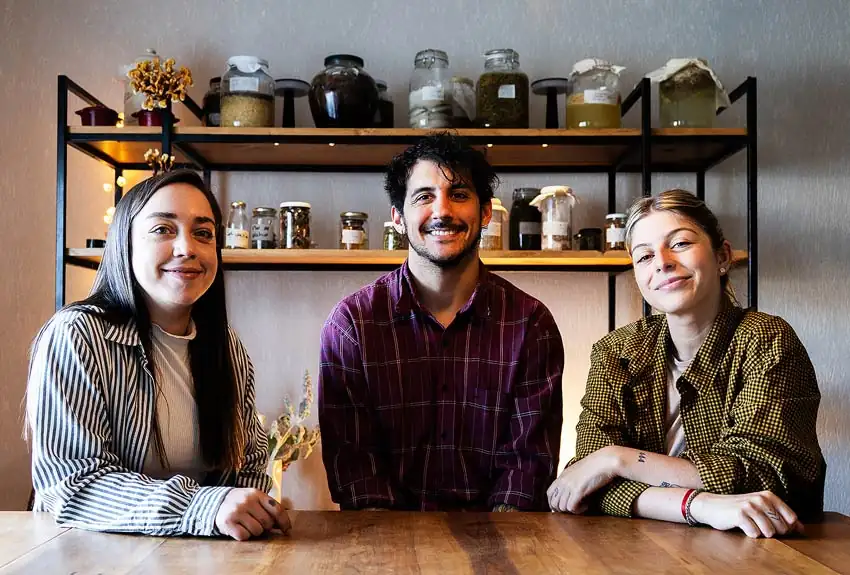
In places like these, where the 21st century arrives late and winter's cold feels like an unwelcome slap in the face, the opening of a door to find delicious dishes waiting for you on a shared tablecloth feels a lot like paradise. Leandro Giménez, chef and creator of Crujiente, studied psychology before cooking captivated him forever. And it shows, because the private space he opened almost a year ago with his partner and sommelier, Camila Fernández, feels very much like an embrace, a refuge in the midst of the storm.
“When I arrived here with my family in the nineties, I was three years old, and my parents didn't know a soul. I had no grandparents, cousins, or anything. But right away, someone lent my dad their car when he needed it, others introduced him to their friends, and everyone opened their homes to us,” he says. And that same spirit—very southern—is what permeates his first personal project, where he cooks and ferments everything fermentable in mysterious jars with a Harry Potter vibe, whether it's bones, mushrooms, or samphire, while Camila takes care of the hospitality and the wines. And the formula works, of course it works.
“I recently read that almost 85% of what is eaten in Tierra del Fuego is imported. Well, at Crujiente it’s exactly the opposite: 85% of what we serve is from here, produced here and perfectly traceable.”
In places like these, long ago, there were hundreds of shipwrecks, and those who rescued the shipwrecked were called "raqueadores" (from "wreck"). Leandro and Camila may unknowingly be the last vestiges of that noble lineage tasked with helping the lost and bringing them home. In their case, it's through flavors and temperatures, in a part of the world where even the most basic things feel like a heroic act.
“The other day I saw a surreal scene: a neighbor, with a giant bucket full of fire, trying to heat the pipes in her house because it was so cold that the water had frozen,” says Camila while taking the first of a bunch of mates.
If we're being honest, the issue of food has always been complex in Tierra del Fuego, and time hasn't always brought an improvement. "If you look at old photos, you realize it right away," Leandro remarks. "You see that all the houses had a vegetable garden in the back. The first migrations of white men to Tierra del Fuego were mainly from Britain and Croatia, and they brought back species from colder parts of Europe—like rhubarb or blackcurrants—that we now consider typical here, but they actually come from there."
The thing is, over time, the idea of producing local food was lost, and we started importing absolutely everything from the mainland. A whole range of knowledge was lost, but for some years now, we've been trying to recover it, and the Crujiente project is part of that. For example, I recently read that almost 85% of what's eaten in Tierra del Fuego is imported. We work with local producers, which is why the fish arrives live and everything is equally fresh,” he says proudly.
The proposal with which they will compete in the Prix also says it loud and clear: they are committed to a type of cuisine that is rooted, hyperlocal and woven by many hands.
“We’re going to present mussels from the channel, which are hand-harvested, with small Chilote potatoes, pickled samphire, a fermented potato foam, and a sea bass garum. The unique thing about the Tierra del Fuego mussel is that, because the water is crystal clear, there’s no sediment, no dirt, no impurities. So, the so-called ‘pearl’ doesn’t form, and everything is different,” the chef explains.
After all
Finis terra, End of the World, or simply “the Cape”—in the sense of finality, of closure, as Cape Horn was known for centuries—are some of the words that have always been used to describe this region so prone to shipwrecks and famines, to petrifying cold, to madness, and—for that very reason—home to unconventional people. Adventurers, gold prospectors, fervent missionaries, anarchists, and various fugitives landed, wave after wave, on a land molded from a little bit of everything, where mixture is the natural law.
People from all over, arriving at the very edge of things to redefine time and space, but also ready for a relentless sense of wonder. Because, truth be told, nothing here is predetermined, and surprise lurks around every corner.
Camila says that as soon as they received the news that they were finalists for the award, greetings and visits began pouring in. Among them was one from El Juan. Yes, with the article, which is how almost everyone is referred to here.
Traveling to the source and meeting the producers is also part of our culinary approach. Behind every product there is an origin, a journey, and people who make it possible, like Miguel and Silvia from Estancia Cabo San Pablo.
“Juan is the fisherman we work with. He dives, and his work is truly incredible because even with the weather we have, he really gives it his all. He recently showed up with a little bucket. He told us, 'I'm going to bring you something I caught today that I've never caught before. I'm going to bring it so you can see.' They were nine-year-old mussels. The size!” he shouts.
But his enthusiasm is justified when he sees one of those specimens, a kind of mega mussel the size of a hand or a large stone, on whose shell a whole story can be read.
“Unfortunately, there aren’t enough of these to take to many people, and we can’t take them to the Prix. But counting the markings on their shells, yesterday we registered some that were eleven years old, which coincides with a mussel farming project that was later canceled. Many sank to the bottom, and it seems that a bed of those mussels survived, and Juan managed to capture some of those specimens yesterday.”
And so it is with everything: the pine mushrooms that abound here came with the first pine trees brought to the island by the ranchers —in which dormant mycelium also traveled— and the Chilote potatoes arrived with the Chilean migrants who came to work with their customs, their cuisine and even their plants.
“In fact, today in Tierra del Fuego there are more than 500 varieties of potatoes, and these little potatoes that I'm going to present for the competition are very small, with very delicate skin and a mild flavor. They are very tasty and have nothing to envy from any potato in the rest of the world. What's special is that they can even grow in a flowerpot, understanding that growing food here is extremely difficult,” he says.
“Of course, there’s a huge amount of work by the producers behind this. In the case of fruit and vegetable producers, the work they do is impressive. There are many seeds already adapted so they can grow in this climate, but also so they can produce abundant harvests,” she counters.
And although neither of them says it, they're thinking the same thing: how to make Tierra del Fuego's gastronomy a sustainable alternative for employment and growth. Because, beyond international tourism and the cheerful fauna of expensive cruise ships, people live here. Entire families, young couples with children who want something resembling a future.
That's why, they explain, "most of what we offer at Crujiente are local products, and that's very important to us."
"Not only because it's our way of living in Tierra del Fuego, but also because we believe it's our chance to create jobs, so that a fifteen-year-old boy can plant potatoes in a pot and, I don't know, sell me even just two kilos. So he can start doing something," Leandro says, his eyes shining with hope.
The creaking earth
The snow when you walk on it, but also the entire forest, when the lenga trees truly dry out and each step is a loud crunch, or the crackling fire. Everything around, says Leandro, sounds special in Tierra del Fuego and always has echoes of splinters and bread, “because the crust of the sourdough loaves I like to knead also crunches like that. Hence the name of the project,” he explains.
And it is perhaps this awareness of the fragility that surrounds them, of how easily people and things can be lost forever in the steppe or out at sea, that makes them so meticulous about everything: the products, the producers, the space, the visits.
The priority, they say, is definitely the local clientele. The neighbors, the "people from around here." "My favorite customer is the resident," the chef clarifies. From this core, everything else springs and is defined: the number of people they host in their home, the menu designed so that nothing goes to waste, and the attention to detail that makes everything—from the menus to the prices—feel friendly.
Some restaurants have operated for years as tourist traps, and as a result, some people don't want to eat out anymore because they think it's always expensive, the food isn't good, or they'll get ripped off. We try to prevent that from happening here, and our customers are embracing our approach and supporting us.
In fact, the Crujiente experience begins even before you arrive at the house, which is our house. As Ushuaia has grown in a rather unusual way, and even though our house is five minutes from the center, it's very important for us to be on Instagram so people can see what we do and where we go. But a year ago, when we started the dinners, there was nothing, and it was—literally—"What am I getting myself into?" There was nothing behind closed doors, but there was also no audiovisual material to back us up, nothing like what exists today around Crujiente, no Google reviews, nothing.
“We even had some tourists who, half an hour after arriving at our house, confessed that they had written to their children, who were in Buenos Aires, to tell them that if they didn't hear from them in a while, they should call the police,” Cami says, laughing.
Today the landscape is so different that they're already thinking about expanding. Gradually, over at least five years, but their plans already include a restaurant open to the public and capable of accommodating almost twice as many diners.
Everything, they insist, remains to be seen. For now, what obsesses them is continuing to explore products and flavors, and finding the right approach to an entirely personal project, where cravings, experiments, and even their own mothers' sweets are combined as part of the desserts that conclude each gathering.
“We have three menus: Biodiversity, where you try everything, from north to south. It's ten different dishes. Then there's the seafood menu, with fish and shellfish, and another option is a daily special. In that case, you can choose between land, sea, or vegetarian. We set it up this way because it allows us to organize ourselves well as just the two of us. And customer feedback was also key. Thanks to all of that, we don't waste any food, and we think that's wonderful,” says Camila.
For Leandro, the horizon they have been walking towards for years came a little closer with their consecration as finalists of the Prix Baron B Édition Cuisine.
Especially because for us it's a really nice excuse to talk about the project, and when we talk about the project, we talk about Tierra del Fuego, which is the place where we grew up and which we love and to which we always seek to give added value because we want to continue living here.
So, regardless of what we serve to eat, the central element is hospitality, the welcome. It's about telling people, 'This is how we live here.' And among the things we offer are the finest foods. We know this place has immense potential, both for its products and its communities.
We want something we may not see in our lifetime: to establish Tierra del Fuego's international gastronomy and make it a benchmark, like Mendoza and Buenos Aires are today. We're paving the way for someone other than ourselves. It's future generations who will reap the rewards.
I'm very grateful to this place. We're not fine dining. We've shattered the myth that locals aren't ready for this kind of experience, and also the one that says we're expensive. There's technique and complexity involved, but the service is very friendly and direct. It's very, very relaxed, for a very diverse clientele. And everyone has a fantastic time.
The day I see someone at a table of eight people who didn't know each other order a bottle of wine to share, that day I think: 'That's it, that's done'.
Trademark Title INPI No: 2,880,726 – Law 25,506.
Total or partial reproduction of the published material is prohibited without the express consent of its owners.