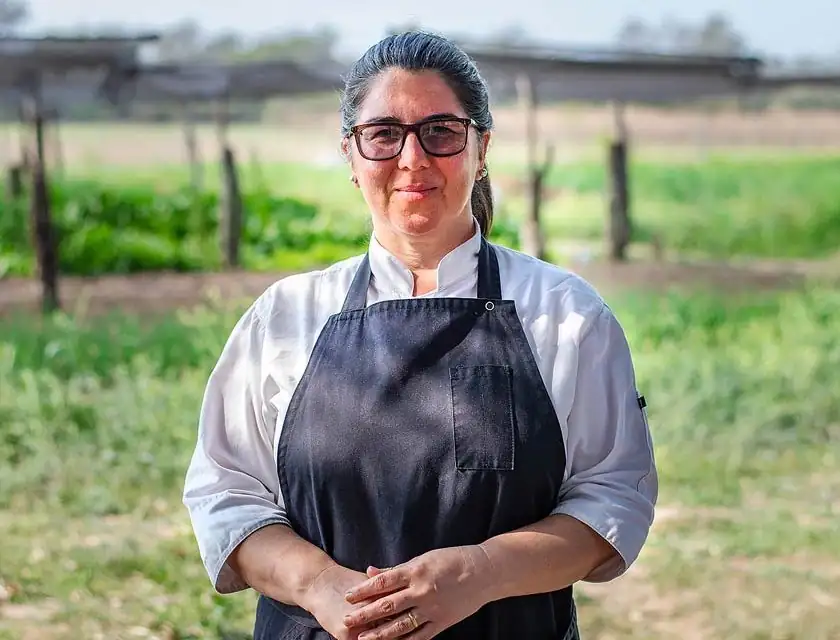
Anna Restaurant
“I work with real conscience, without caring about what is fashionable or trendy.”
Anna Restaurant – Chaco
A goat farmer who is also a chef and has been running her own restaurant deep in the mountains for almost twenty years. With a menu that highlights the cuisine of the Chaco region, she has reached the final of the prestigious award and is using the spotlight to talk about all those topics that few in the culinary world dare to mention: inflated egos, zero waste, and the importance of cooking from what you truly know.
Or maybe it's the Zonda wind, but it feels just as hot, and here in Castelli, in the heart of the Chaco region, all it takes is a breeze to disrupt everything. Bugs, animals, and even hair are ruffled, electrified, and agitated in a peculiar way, and you have to wait for order to return by doing something quiet. Alina Ruiz, born and raised in El Impenetrable, takes advantage of days like these to carve out a space in her busy schedule of cooking and training to chat with Solo Por Gusto. She wears glasses and has an accent that gives her away from the first sentence. And she says that, of course, here it's the wind that decides whether or not the restaurant she opened in 2009 will have outdoor seating today. Whether the couples and families who come to Anna – Restaurante de Campo (the place she dreamed of since she was a girl) will be able to enjoy their meal under the palm-thatched shelter or if, on the contrary, they'll have to take shelter inside so that even their shade doesn't blow away.
“Yesterday was a beautiful day, with lots of people in the restaurant, and we were able to serve outside. Today is impossible because it's such a busy day. The dining room only fits twenty or twenty-five people with our tasting menu. It's a six- or seven-course menu. But outside, when we're open for lunch, we serve an appetizer, main course, and dessert, and there's room for about forty people,” she explains with a somewhat melancholic tone. And it's no coincidence, because this chef, born in El Impenetrable, who spent a few years in Buenos Aires studying at the Argentine Institute of Gastronomy (IAG) and returned to Chaco to make her dream restaurant a reality, doesn't do things halfway. It's all or nothing. And today it was nothing. So, we have to face the music.
Alina Ruiz will serve her finalist dish this Thursday, inspired by the flavors of the Impenetrable: goat ingot, chanfaina and paper from its milking, paired with Baron B Brut Nature, to the jury made up of Mauro Colagreco, Dolli Irigoyen, Gonzalo Aramburu and Gabriel Oggero.
His strength lies in persistence. Scanning the field, checking the signs, sniffing the wind. Reviewing the deck and, if necessary, dealing again and starting anew. That's how it happened with the Prix Baron B – Édition Cuisine, for which he is now a finalist after much effort; he entered three times before, but only in 2026 did he manage to reach the grand final. “The last time I participated was in 2023. They sent me a bottle of champagne and a note congratulating me because that time I had made it into the top ten. That encouraged me because I thought, ‘Well, at least they looked at my project.’ But in 2024 and 2025 I didn’t apply because… I was angry, yes! (laughs). But then my husband, who is an economist, told me not to take it personally and to try to see that, despite everything, the Impenetrable region still hadn’t achieved the kind of international recognition it enjoys today. That’s how I managed to put my anger aside and think more clearly,” she summarizes.
Thinking things through, as she says, meant understanding that cooking alone wasn't enough because the region she wanted to portray through her dishes was still awakening, barely revealing itself. Compared to other, much more dazzling tourist and gastronomic destinations, Alina knew her proposal still had to wait. It wasn't the right time because maturity wasn't so much an individual matter as a reflection of the environment, and Chaco still had a long way to go before taking off. “I saw a project like Gunther Moros's winning the prize—a project located within a reserve on the Misiones ridge and with all the investors behind it—and I thought I didn't even have enough to get started. But I also understood that I couldn't stop there. I understood that not having all the money invested in the project didn't mean I couldn't compete.”
I have a project that ranges from a clay oven to a smoker, which is very homemade. Look, my roof here at the restaurant is made of corrugated iron, and outside it's all palm thatch. We clearly don't have the mountains that Jujuy has, nor the water of the Iberá Wetlands. This is a thorny scrubland that you have to know well to understand its natural richness. I could hardly "sell" you this in a video or surpass Jujuy, Calafate, or Misiones. This isn't "Instagrammable." It was from that perspective that I understood it and thought: "Well, at some point, El Impenetrable will rise in popularity and become more attractive, or people will decide to look to this part of the country." That moment has arrived, and although her simplicity allows her to admit it aloud, she also contributed her grain of sand to make it happen. She also helped to bring the hidden flavors of the Chaco to light.
Deep into the mountains
Born and raised in a family of goat farmers, Alina has a unique quality that makes her words resonate differently: she knows exactly where everything she offers on her table comes from, how it was produced, and its characteristics. What is now called "traceability" is, for Alina, a given, the prerequisite for eating with confidence. Or is there, perhaps, any other way to sit down to a meal? That's why, in her case, talking about "local produce" is painfully obvious. Everything she cooks comes from here or from a neighboring farm.
1 | This is called Doca or Tasi, it is a climbing plant, it is usually almost hidden, covered by leaves on the fences or usurping some shrub.
I discovered in this fruit a unique, subtle, transformative beauty.
A fruit that's not to be wasted and has a rich history; it helped me learn more about my region and its people. 2 | A freshly opened Doca, its center in harmony. 3 | Black seeds indicating ripeness and brown ones, which are the edible ones, although the most delicious aren't in the photo. They're ivory-colored, sweet, juicy… impossible to stop eating while opening the Docas—"maybe that's why there are no photos." 4 | Beautiful! A unique sight! These are the seeds that have been exposed to the air and have detached from their centers, carried away by the typical wind of this time of year. 5 | The magic time of day with the Doca fibers that will be transformed into clothing.
From meat to honey, including milk, cheeses, and garden produce, everything has a clear and precise origin. Every morning, she watches the entire menu pass by her kitchen window, and perhaps that's why she's so careful when speaking about certain issues that sound trendy today but are essential to her: sustainability, zero waste, and product care.
“In my restaurant, we don't have a menu and we don't serve soda. So, to get kids to stop drinking soda, we try to work with the parents. If the parent is a good communicator, they'll be able to explain. Sometimes when we make a reservation, they tell us, 'My child doesn't eat such and such.' And then the child comes in and eats everything!”
“In my case, all of this is very much mixed up with the day-to-day life in the countryside, as a producer. Without belittling the new generation of chefs who talk about not wasting food in Las Cañitas or Palermo (where you see that there is waste but they have to say that they don't do it), you who are on the ground see that and you understand that everything is wrong.”
What do you understand by “no waste”? Why is “everything wrong”?
- From my perspective as a producer, I see young chefs whom I admire immensely. But honestly, I prefer to watch them rather than listen to them. I see the plating and the ingredients they use, and I applaud them, because I can't reach that level of technique, and I admit it. I'm lacking a lot in terms of technique and attention to detail.
But then, when I hear them talk and see how they trivialize it… I don't know. I understand that they feel they have to keep repeating this about not wasting, about territory, and about food. But then you look at their little hands and you realize that the person speaking has never left the kitchen.
So, for you, what would be the true meaning of terms like utilization or sustainability?
- For me, the first thing is to work conscientiously and understand what each territory is. I work with genuine conscientiousness, without caring about what's fashionable or "trendy." The rhetoric doesn't matter to me, because when you truly delve into the subject and understand the process behind each food item, things change. When you understand what happens to the cow, the pig, or the sheep, only then can you speak from a different perspective. In the meantime, as long as you're pressured by a photo, the urgency of filming, or the immediacy of social media or likes, we'll continue in the same way. We'll talk about food, about territory, and we'll repeat the words "collective," "federal," or "no waste," but without any substance. It will remain rhetoric and not reality, because—for example—if I understand that when an animal is slaughtered (however crude it may sound) there's blood, and I can save it to make offal stew or blood sausage, that's true zero waste. If, on the other hand, I don't use brains because old-fashioned brain cannelloni are out of fashion, that's another matter.
How did you manage to survive in Buenos Aires with those kinds of ideas?
- I arrived in 2001, penniless and with little support. I absolutely had to work to support myself, and it wasn't like it is today, with social media and all that. There was nothing, and I had nothing. But academically, I didn't let myself be overwhelmed because deep down I knew it was just about getting the piece of paper. I'd been cooking for a long time, because in my family, we've always grown and cooked what we eat. That's also why the whole "local food" thing, but there wasn't a famous chef mom or anything like that. What there was, though, was a cradle of producers and a cradle of cooks, but of everyday cooking. From there, I understood that this was what I wanted to do, but to do things right, I needed that piece of paper that would validate my experience and allow me to come to the town (which is now a city) and open the kind of restaurant I wanted. I couldn't just open it as Paco and Susana's daughter.
“When you’re dazzled, you can’t fight back, and that’s fine, but there has to be a moment when you sit down and think that you can’t speak so vaguely about food, gastronomy, or the producer. Because your moment on the pedestal is just a moment, but food has to be considered for the future.”
I return in glory
In fact, in 2009, when she was finally able to open her own place, which she named after her grandmother, she did so on her family's land, starting from scratch. For her, it meant creating everything from the ground up because—even though the locals knew her last name and that she was the daughter of some neighbors—communicating her project and getting people from other places to come and visit her restaurant was a real feat. Why? “First, because we are, as I always say, in the middle of nowhere. Far from absolutely everything. But that's sometimes also an advantage because from so far out I can see, for example, that the chef has taken on an excessively prominent role these days.”
What would that be like?
- I feel like he's put himself on a pedestal that's distanced him from the land, the food, and the producer. But, ironically, to be on that pedestal, he talks a lot about the producer. For me, that's wrong and very irresponsible, but you can't fight ego.
You can't fight against your moment of glory, you can't fight against the bright lights of the city. Because your moment on the pedestal is just a moment, but food has to be thought about for the future, for the future of new generations. You can't always think about the little gelled sphere, the caviar, the foam (laughs).
Did the change and intervention in your territory change your cooking? Because the Chaco region has a brutal advance of extensive agriculture.
- Luckily, the area here is still very well preserved and remains the impenetrable wilderness everyone talks about. Thank God, it's still protected even though tourist traffic is inevitable. So, on the one hand, it's wonderful that this part is being discovered, and on the other, it's a little frightening.
And how do you handle that tension? How do you get people to approach you without completely changing yourself? How do you get them to put the Coca-Cola aside for a while?
- Business. For example, in my restaurant there's no menu and we don't serve soda. So, to get kids to give up soda, we try to work with the parents. If the parent is a good communicator, they'll be able to explain. Sometimes when we take reservations, they tell us, "My child doesn't eat such and such," and then the child comes in and eats everything. I've always believed that: it all depends on how you explain things, because a child will always be a child and will push until you give in. But you're the adult and the one responsible for feeding them well. It comes back to the same thing: whether you raise them consciously or not, whether you feed them consciously or not. I take reservations and try not to lose customers. I might even give in to a breaded cutlet, with local beef. But I'm not going to make you ham and cheese empanadas or some kind of waffle with strawberries from who-knows-where. And I'm not going to give you soda. And that was a whole process, a learning experience over time. Some people had soda in their cars and, at intervals, they would go to the parking lot, give soda to their children, and come back. But I didn't let them take it out of the car (laughs).
And they accepted it…
- Yes, nowadays those who come understand the concept and accept it as it is, even though there have been times when we've lost reservations for this very reason. But those were the exceptions, because you also want to maintain a project and you see that you're losing reservations because of your approach, you take a closer look. That's when, without straying from the project, you have to be flexible. So far, we've managed not to sell soda and not to have a menu. Here, people don't tell us what they want to eat; we bring the food to them. And they like it, of course.