From paddock to rickhouse: the story of bourbon and horses
Before I knew anything of whiskey, beyond perhaps the faint smell as my dad came home from a bar, I loved horses. It was very much an inherited passion. One of my nan’s earliest memories was of lying across the back of a powerful Shire horse on her family farm as it ploughed fields.
“The evolution of the horse and jockey stopper advanced the brand’s celebration of Kentucky’s horse racing heritage. Today, the stoppers have become one of the most recognizable and collectible symbols in bourbon.”
Today, Kentucky combines my more adult passion of bourbon with that childhood delight in horses. They are perhaps the two things most associated with the state, both lying at the very heart of life in the Blue Grass state. Historically as today, bluegrass pastures, limestone-filtered water, and strength in agriculture all support both distilling and thoroughbred breeding. Whether raising a young thoroughbred or aging a barrel of bourbon, a certain investment and trust in judgement is required. Socially, horses and whiskey are also deeply intertwined — love either, but particularly both, and you’re welcomed with open arms by many in Kentucky. Conversations flow easily, and everyone has a recommendation for somewhere to visit or something to try, revealing hidden gems.
Last summer I booked a few days at Big Red Stables near Harrodsburg. It was part of a larger bourbon-focused trip where I visited many brilliant distilleries, but during my stay I treasured the fact that there weren’t really any distilleries close by to our charming bunkhouse on the farm. It was a fabulous chance to disconnect. For more than 30 years, the third-generation, family-owned farm has offered horseback riding at the heart of the Bluegrass region. Current custodians Emily and Drew Dennis follow in the footsteps of Emily’s mom Judy, who started offering horseback riding as a way to keep the family’s herd on the farm. Early on our first morning, we headed out on Tennessee Walking Horses. Beautiful, calm animals with a fun running-walk, they had all the sure-footedness needed to explore the rolling hills. As the day warmed up, we splashed through a creek to keep the horses cool. I still can’t think of a better way for visitors to get a feel and appreciation.
for Kentucky.
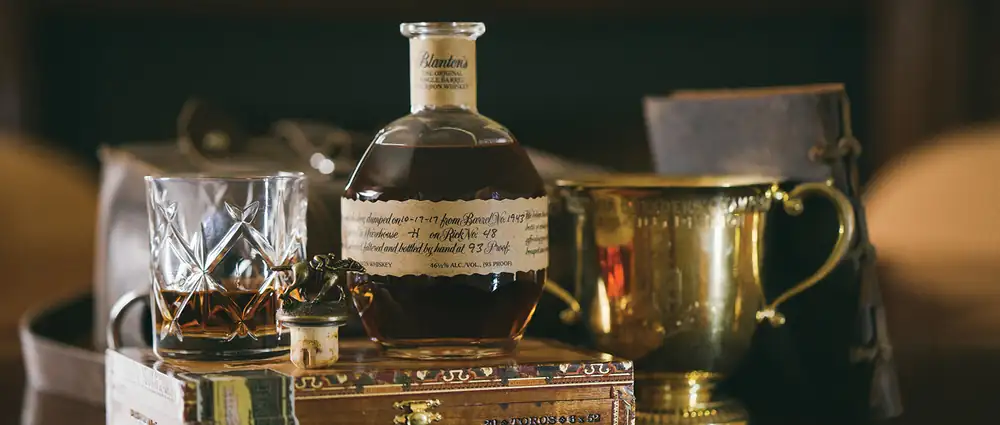
Start to look out for horses on your bourbon, and they’ll be revealed everywhere. Blanton’s is probably the most famous — with thoroughbreds galloping across the toppers — and that is intentional. “From the very beginning, Elmer T Lee envisioned Blanton’s as a bourbon that felt unmistakably Kentucky,” says Charley Costa Jr, brand manager for whiskey at Buffalo Trace. “The evolution of the horse and jockey stopper advanced the brand’s celebration of Kentucky’s horse racing heritage. Today, the stoppers have become one of the most recognizable and collectible symbols in bourbon.” Collectors flock to the single barrel releases, not just for the snapshot in time that they represent in taste, but also to complete their set of stoppers that will eventually spell out BLANTONS.
A younger brand that showcases horses perhaps even more predominantly is Pinhook. Co-founder Sean Josephs brings his background from wine and hospitality to the whiskey world, and was particularly interested in presenting vintage-driven whiskies. On trips to explore this in Kentucky, he developed a natural love for the lifestyle of the state and the horses that also live there. “I was hanging out with [fellow co-founder] Jay Peterson in Lexington, Kentucky, and naturally started spending time around thoroughbred horse racing. There’s a majesty of the rolling hills and horse farms there.”
As the small team began to think about brand development, the ways the two worlds meet became central to the business idea.
“Part of what Jay does is called pinhooking — you’re buying a baby thoroughbred based on pedigree, with a view to selling them on.” That struck the friends as something that was highly relatable to their approach of buying barrels of whiskey in order to later bottle them — and so Pinhook Bourbon was born. Developing the idea further, each vintage is linked to a specific racehorse, illustrated on the labels, and draws on the bright palette of jockey’s silks for striking patterns and color schemes. Ultimately, while the brand and thoroughbreds on its bottles are young, it’s anchored in two of the state’s most heritage-rich industries in a way that feels deeply authentic. Josephs is enthusiastic yet matter of fact about the journey. “We came across the story organically — it was just spending time in Kentucky and looking at the two things Kentucky is most famous for.”
All of this cumulates in the Kentucky Derby at the iconic Churchill Downs racetrack. Famously bringing Louisville and much of the state to a standstill as private jets bring in the glamorously clad, big-hatted guests, it is world famous, and presenting sponsor of the event is Woodford Reserve. To celebrate ‘The Greatest Two Minutes in Sports’, it releases annual, highly collectible, limited-edition bottles of its whiskey featuring original, thoroughbred-focused artwork. More than that, though, the Derby is also the perfect time for drinks professionals in Kentucky to show just what the state can deliver. Their skilled mixology presents visitors with an array of bourbon-based creations — above all, though, guests want Mint Juleps. The first references to the drinks date back to 18th century Virginia, making them one of the oldest cocktails in the US. They are considered to have been perfected by Jasper Crouch in the 1820s. A free man of color, he was widely respected for his mixology skills. Post Prohibition, they began to be promoted as the official drink of the Derby and today more than 125,000 of them are enjoyed by race fans each year. That’s a massive win for bourbon distilleries and for Kentucky.
Dr Danni Capp, assistant professor and hospitality and tourism program director at Walker College of Business, has recently been researching how the combination of bourbon and horses translates into such a powerful force. “Our study found that the Kentucky Derby and Kentucky bourbon work especially well together because they share symbolic themes such as celebration, tradition, prestige, and hospitality,” she explains. That is economically significant for the state, too, as visitors attracted by one industry also spend money on the other. “Consumers do not necessarily separate the bourbon from the broader cultural experience. Instead, they view it as part of an immersive Southern lifestyle experience. That creates a stronger tourism pull than promoting either product independently.”
Aside from race days, another place to experience the power of the combination is Hermitage Farm in Oldham County. Operating as both a 90-year-old thoroughbred farm and a hospitality business complete with restaurant and bourbon bar, Hermitage Farm was founded in its current form by Laura Lee Brown and Steve Wilson to protect the site from being developed into housing. The hospitality side of the business is now owned by Cara and Steven Brooks, the couple behind Blaize & Brooks bourbon — and they have big plans. For now, the tours of the farm include visiting the thoroughbreds and tasting bourbon flights.
I couldn’t help but fall utterly in love with the place when I visited. Greeting the thoroughbreds with a view over paddocks, while sipping on an Old Fashioned, the evening felt like a magical kind of embodiment of my favorite things about Kentucky. According to program director Ryan Mahony, that’s deliberate. “Both bourbon and horses are expressions of place — of Kentucky,” he explains. “Both are rooted here, not just historically but also really to the land itself, via the blue grass and mineral rich limestone water. This is what supports the bone health in horses and similarly makes Kentucky bourbon so special.”
Capp sums up the combination: “The strongest bourbon brands today are not just selling whiskey, they are selling access to a cultural experience tied to place, ritual, and Southern identity.” Perhaps the key is the way that both industries invite visitors to step inside and get a taste for local life — such a challenging thing to do in many places around the world with strong visitor economies. Despite a complete lack of roots in Kentucky, horses and whiskey make the place feel like a warm embrace whenever I return. I imagine taking my own children to visit the grand horse farms and experiencing a renewed sense of wonder, seeing the state through their eyes for the first time, and buying vintage-based, horse-adorned bottles of Pinhook to be shared with them years down the line.