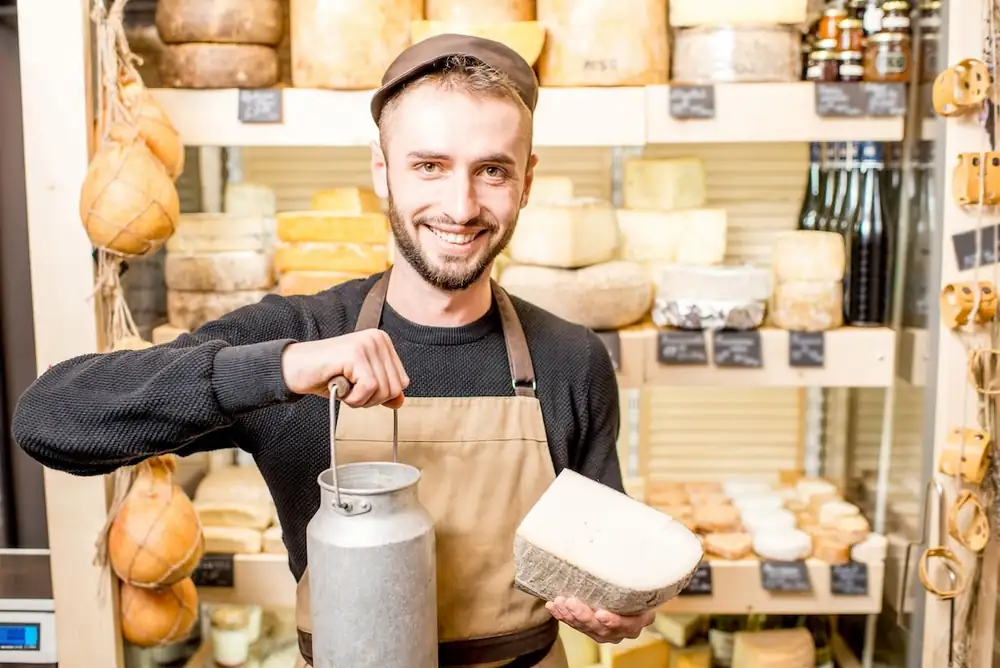
What are raw milk cheeses and why are they so popular?
What raw milk means, how to recognize unpasteurized cheeses, what are the main Italian cheeses, and what to know about food safety.
by Oriana Davini
Raw milk cheeses are made using milk that has not been heated above 40°C or subjected to any other treatments with an equivalent effect. Unlike pasteurization, the milk therefore retains its microflora, which contributes to the cheese's aromatic characteristics and its connection to the terroir. This technique is still used today for some of Italy's most important PDOs, from Parmigiano Reggiano to Fontina.
Recently, however, raw milk cheeses have returned to the spotlight, especially due to food safety concerns. Unpasteurized milk can carry pathogenic microorganisms, and the consumption of certain products requires special care, especially for the most vulnerable groups.
Index
The first place to look for information is the label. European legislation requires products made from raw milk, when the production process does not include certain heat, physical, or chemical treatments, to be labeled "made with raw milk."
In the case of PDOs, you can also consult the production specifications, which establish the characteristics of the raw materials and the methods by which the cheese must be produced.
The use of raw milk has an importance that goes beyond the simple absence of pasteurization. The microbial flora naturally present in milk participates in the transformation processes and can contribute to the development of the product's aromas and characteristics. This is one of the reasons why this process continues to play an important role in traditional cheesemaking.
The main difference concerns heat treatment. By definition, raw milk has not been heated above 40°C or subjected to an equivalent treatment. Pasteurization, on the other hand, uses temperature and time combinations sufficient to inactivate vegetative pathogenic microorganisms: the Ministry of Health guidelines cite, for example, 72°C for 15 seconds or 63°C for 30 minutes, or equivalent treatments.
Be careful with the terms: "raw milk" and "unpasteurized milk" are not technically perfect synonyms. Milk can be subjected to thermization, that is, heating less than that necessary to achieve the pasteurization effect. Precisely for this reason, the new ministerial guidelines use the broader term "unpasteurized milk" when addressing microbiological risks.
A raw curd cheese isn't necessarily made with raw milk. The term "raw curd" refers to the processing of the curd, not the treatment the milk undergoes before cheesemaking.
A very clear example is Gorgonzola PDO: it is a raw cheese, but it is produced exclusively with pasteurized whole cow's milk.
In Italy, there are numerous cheeses made with raw milk, including some of the best-known PDOs. Among the main ones are:
- Parmigiano Reggiano DOP
- Grana Padano PDO
- Castelmagno DOP
- Bettelmatt
- Fiore sardo DOP
- Fontina DOP
- Roccaverano PDO
- Bitto Dop
- Piedmontese Toma Dop
- Strachitunt Dop
- Don't complain.
- Pecorino from the High Barony
The list is not exhaustive, and, more importantly, the name of a cheese type alone isn't enough to establish that it's always made with raw milk. In some cases, the regulations allow for different treatments. This is the case, for example, with Caciocavallo Silano DOP, which can be made with raw or thermized milk.
Puzzone di Moena DOP is also a special case: the specifications normally require the use of raw milk, but a temporary modification has been authorized that allows for thermization of the milk. To determine whether a specific cheese is made with raw milk, therefore, it's essential to check the label.
Gorgonzola DOP, on the other hand, is made with pasteurized milk. This is also a useful example to avoid a common confusion: it's called a raw-curd cheese, but this term refers to the processing of the curd and doesn't mean that raw milk was used.
The topic of safety has once again become particularly topical. In August 2026, the Ministry of Health released new Guidelines for the control of Shiga-toxin-producing Escherichia coli (STEC) in unpasteurized milk and milk products, along with FAQs for citizens and operators.
Products made from unpasteurized milk may be exposed to microbiological risks because the milk has not undergone a heat treatment capable of eliminating certain pathogenic microorganisms. Among those receiving the most attention today are STEC, strains of Escherichia coli capable of producing Shiga toxins.
This does not mean that all raw milk cheeses are equally risky. Product characteristics and the production process—acidification, processing temperature, water and salt content, and ripening—can affect the survival of microorganisms. Therefore, it is incorrect to establish a universal threshold beyond which a raw milk cheese is automatically considered risk-free.
The Ministry of Health draws particular attention to the categories most susceptible to the consequences of foodborne infections:
- Pregnant women
- Children
- Elderly people
- Immunocompromised people
For these people, choosing foods and following correct storage and consumption methods require greater attention.