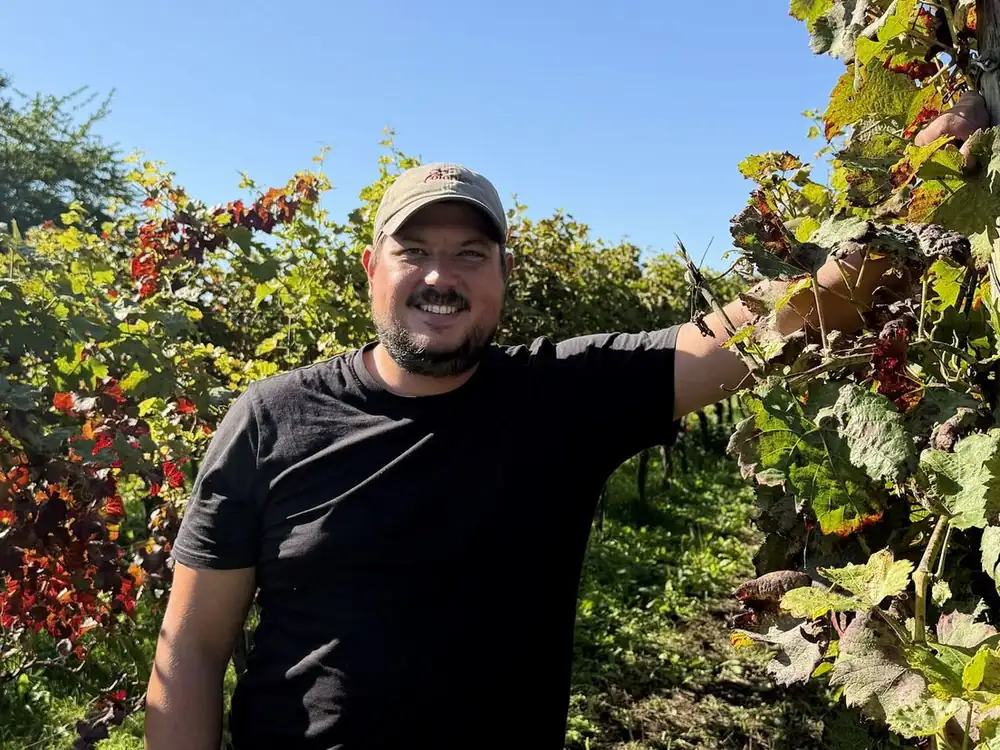
A winemaker who has no time for wine: Adam needs to go all out now
GROESBEEK - Winegrower and oenologist Adam Dijkstra (42) worked towards this period all year: the grape harvest.
They are long days during harvest time. On Friday, the team started around 5:00 AM and continued until 8:00 PM. On Saturday, the harvest will last until about 11:30 PM. But it is the best period, according to Dijkstra.
“Being a winemaker is a fine and fun profession, but nowadays I spend a lot of time organizing things. I am actually built to run production at full throttle,” he says, sitting on the terrace of De Colonjes in Groesbeek, on the edge of one of the vineyards. “Structuring that chaos well, keeping an eye on all those processes, doing a lot of tasting.”
Becoming a winemaker. It came to him like a vision when, as a young man in his twenties, he was walking through a vineyard in the Moselle with his father. He had just dropped out of his studies in electronics and technical computer science. “I wanted something different; I preferred working outdoors.” During his part-time job in the hospitality industry, he was introduced to wine while having drinks with colleagues after closing time. Dijkstra: “They had such a beautiful wine list.” It was the beginning of his fascination with the product.
But he also wanted to study. And there is such a thing as a university degree in the study of wine: oenology. Such studies do not exist in the Netherlands, but they do in wine-producing countries like Italy, Spain, France, Germany, and South Africa.
Everything had already been arranged for his studies in South Africa when he ran into the owner of Colonjes in Groesbeek. He received an offer to come and work there as well. And so, instead of studying in South Africa, he ended up studying in Germany. He combined working at Colonjes with his studies.
Despite drought, green orchard
Now, years later, he is one of the few wine scientists in our country and stands at the helm of the company that produces 50,000 liters of wine per year and has thirteen hectares of vines. Colonjes claims to be the largest organic vineyard in the Netherlands. The vineyards in Groesbeek are doing well because the soil there contains fine, fertile sand, Dijkstra explains. “Despite the drought, the vineyard is still green,” he says, pointing to the vineyard.
Dijkstra produces white, red, sparkling wine, and rosé with his team. What is he most proud of? The Amira, Brandon, and Amanda. Wines that bear the names of his children and his wife.
Into nature. The role of winemaker suits him, Dijkstra believes. “Because you are close to the product. And that product comes from Mother Nature. She is your teacher and your guide. Look, there are also oenologists who walk around in a three-piece suit and only give advice. That is also a beautiful profession. But then you are far removed from the product, which is simply provided by a plant.”
Not his style. He prefers being outdoors. “You can see how I’m dressed,” he says, pointing to his shorts and sturdy work boots. “Eighty percent of the year I walk around in shorts and a ripped shirt.”
Wine with a story
He is an emotional wine drinker himself. “Sometimes I feel like red wine and sometimes I feel like white wine,” he jokes. In the rare moments that arise, he enjoys drinking a glass of white wine on the couch with his wife Amanda, who also works in the company.
Because you have to enjoy wine, he believes. Every bottle has a story, and you can link an emotion or event to every bottle, he states. The birth of a child or a wedding. But it can also be smaller. If there has been a week of hard work, a special bottle of wine may be opened on Saturday evening. Which one is it this week? “This week is harvest time. No time for that.”
But this week, at the Groesbeek Wine Festival, there will certainly be some toasting. For about twenty years now, this event has been organized by five winegrowers from the village. The public can then visit the local wineries and, of course, drink wine.
Dijkstra cannot yet tell whether this year will be a good wine year. “Something about the bear and the skin,” he says. “You can only sell the skin once the bear has been shot.” So, when the grapes have been harvested.