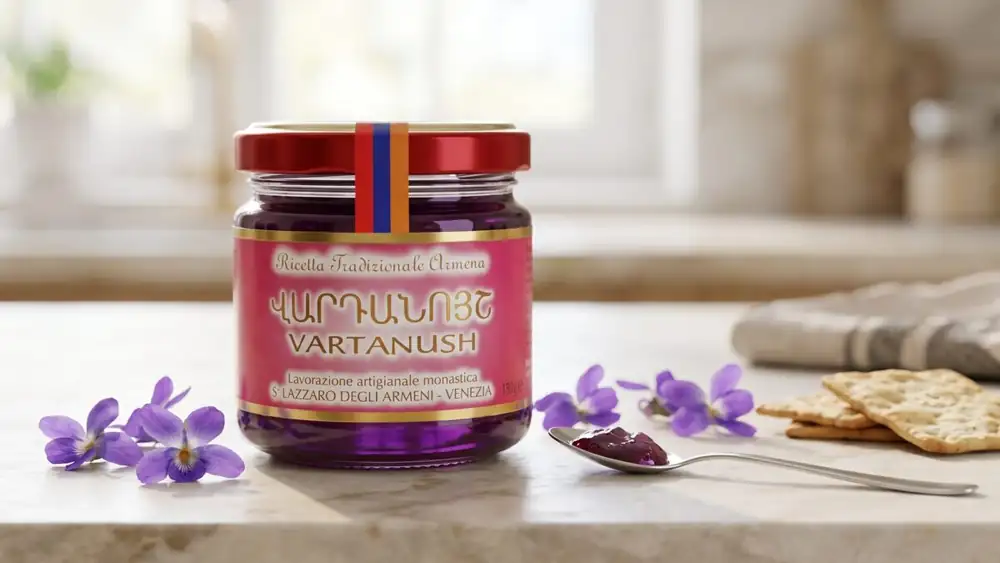
A jam not made of fruit, but of flowers: the Venetian vartanush produced by monks since 1850
The Venetian lagoon is a fascinating place, rich in mystery.
One of these traditions is vartanush (or vardanush), a unique and rare product: a jam made not from fruit, but from rose petals. It is produced only for a few weeks each year, when the shrubs in the monastery's rose garden are in full bloom, and in very small quantities. For centuries, vartanush was made only for consumption in the monastery, but in recent years it has also been sold, with the aim of promoting not only this ancient recipe but also the history and Armenian cultural heritage preserved in the monastery. This is the story of the rose jam from the island of San Lazzaro degli Armeni.
History and origins of vartanush: how it arrived from Armenia to Venice
Vartanush is a rose jam prepared by the monks of the Mekhitarist monastery located on the island of San Lazzaro degli Armeni. But what does the Armenian tradition have to do with the Venetian lagoon? It all began in 1715: due to persecution at the hands of the Ottoman Empire, a handful of Armenian monks led by the monk Manug Petrosyan, known as Mekhitar ("the consoler"), fled and took refuge in the lagoon. Initially, they had nowhere to live, but then, in 1717, the Republic of Venice finally granted the refugees a place of their own: the island of San Lazzaro, a tiny square of just three hectares, originally the seat of the Benedictine order of Saint Hilary. From the twelfth century onward, it had been chosen as a quarantine site and used as a lazaret, taking the name of the patron saint of lepers, Saint Lazarus, before falling into disuse.
Mekhitar, along with his followers, founded the Congregation of the Armenian Mekhitarist Fathers, restored the ancient medieval monastery, restored the ruined church, built the cloister and the premises for the art gallery, the eighteenth-century printing press, and the enormous library. When Napoleon abolished nearly all the monasteries in Venice, he allowed the Mekhitarist monks to continue running it as an academy. The congregation transformed the island into a center of culture and science, dedicated to preserving the language, literature, and traditions of the Armenian people. Even today, the thousands of ancient volumes and over four thousand manuscripts and illuminated manuscripts housed in the monastery constitute the most important collection of Armenian culture in the West, attracting scholars from all over the world.
It is in this context of culture and nature, in this green corner of land caressed by the sun and sea breeze, that large plantations of scented roses flourished, particularly the famous and fragrant Damask variety. And it is using the petals of this particular variety of intensely colored rose that the monks prepared, and still prepare, vartanush, rose jam: a gastronomic product so delicate, special, and unique that even Lord Byron fell in love with it during his stay at the monastery. A meticulous and artisanal preparation that carries with it centuries of history and exudes the scent of exotic, distant lands, of cultures that, though distant, coexist in a convivial atmosphere of respect and sharing.
How is vardanush prepared?
Vardanush—derived from the Armenian words "vard" (rose) and "anush" (sweet)—is an Armenian recipe that monks have relied on to produce this jam since 1850. The main ingredient is Damask rose petals, used for centuries in the East for preserves, syrups, and rose water. The preparation, even today, strictly follows the ancient practices passed down by the monastic community: the rose harvest begins in May and coincides with the approximately two weeks of full bloom in the rose garden. The flowers are picked only at dawn, when they are fresh and best retain their aromatic richness. Then the petals are individually stripped and the whitish base attached to the corolla, known as the "nail," manually removed, which would impart a bitter note to the preparation.
Only then are they blended with sugar and lemon juice, hand-massaged to release their aromas, color, and natural substances, and left to rest for a short maceration. Cooking is slow and continues until the desired consistency is reached. The result is a jam with a deep crimson red color, with the petals still recognizable and a delicate scent of fresh roses with citrus notes. All vartanush processing takes place strictly close to the rose harvest, otherwise the jam's distinctive freshness and aroma are lost.
For centuries, vartanush was produced exclusively for the consumption of monks and their guests, a closely guarded secret on the island of San Lazzaro degli Armeni. For a few years, the monks have decided to offer the jam to tourists visiting the island and to sell it, while maintaining its almost "intimate" nature: production remains limited, amounting to just 5,000 jars per season. If you're among the lucky ones who manage to purchase it, the easiest way to enjoy vartanush is for breakfast, spread on buttered bread, but its aromatic profile also lends itself to yogurt and ricotta, as a filling for a tart or small shortcrust biscuits, or paired with fresh cheeses, especially goat's cheese. Remember that a small amount is enough to add a floral note without overpowering the other flavors. And if you haven't managed to get a jar of vartanush, you can always follow our recipe and make your own homemade rose jam.