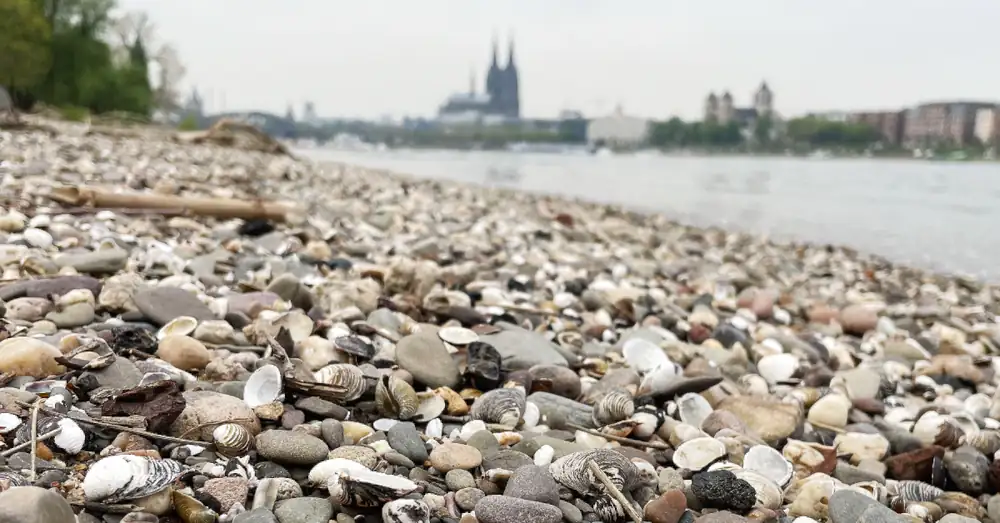
Where do all the mussels on the banks of the Rhine actually come from?
When the Rhine's water level drops, you can sometimes see them in large numbers along the riverbank.
Where do the mussels in the Rhine come from?
As is so often the case, humans played a crucial role here as well. The most common mussel species in the Rhine is the so-called Asian clam (genus Corbicula), which originally comes from Asia. But how did a mussel from Asia end up in the Rhine near Cologne?
- According to the Rhine Station of the University of Cologne, the mussel was introduced to the Rhine in the 1980s via North America, presumably through so-called ballast water from large ships. Ships take on ballast water when they are not carrying cargo to ensure sufficient stability. This ballast water then enters rivers like the Rhine – and with it, the mussels.
There are two types of the so-called Asian clam found in the Rhine: the fine-ribbed and the coarse-ribbed Asian clam.
- The Asian clam (African spp.) is now the most common mussel species in the Rhine. This can also be seen in the picture, which predominantly shows Asian clams.
- Because the large-ribbed mussels produce up to three generations per year, they can reproduce in massive numbers. Over the past 15 years, they have spread to more and more rivers in North Rhine-Westphalia and will continue to do so in the future. The result can also be seen on the banks of the Rhine in Cologne.
- From the Rhine, it has also spread to other rivers in Germany.
Theoretically, these mussels are edible. However, opinions differ regarding which pollutants from the Rhine might be present in them. Although many traditional Cologne restaurants offer mussels, Rhine mussels are rarely found on the menu. And for good reason.