Attilio and Mochi: from importing wine to becoming winemakers
In the Casablanca Valley, just an hour from Santiago, Chile, nestled among the low hills that let in the breeze straight from the coast, Brazilians Marcos Attilio and Ángela Mochi feel right at home.
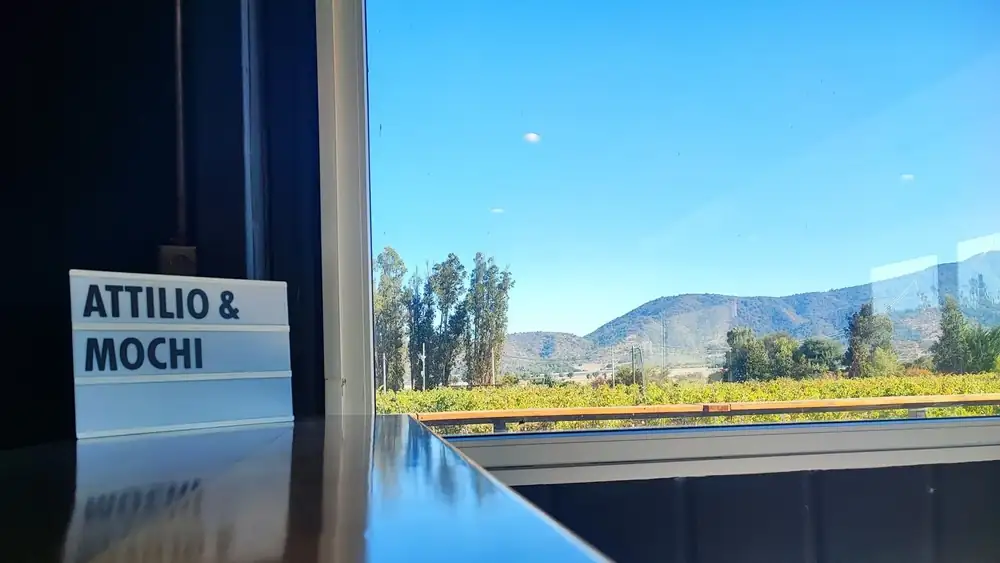
On a crisp autumn morning, with vineyards tinged yellow outside the window, Ángela explains that both she and her husband are food engineers. They met at university, where Marcos was researching Brazilian spirits. This shared interest led to their first business venture: a bar, or cachaça bar, with over 300 different labels. Then came the wine shop, and finally, the import business. “We were tasting wines we loved abroad that weren't available in Brazil. That's where we saw an opportunity.” The business grew quickly, she says.
“We had three companies and three different teams. The restaurant operated from Tuesday to Sunday, the store from Monday to Saturday, and the import business from Monday to Friday. We also traveled a lot because we distributed throughout Brazil… A typical office day involved dealing with numbers, reviewing things, and thinking about how to improve. What I enjoyed most was showcasing wines in training sessions for new clients, but that didn't happen often.”
Until Chile appeared. Or rather, Tunquén.
“We came here because of a tremendous midlife crisis… We spent ten days in Tunquén, a beach that for me is paradise on earth, because it's total disconnection in a very pristine environment. They were the best ten days of our lives. When we returned to Brazil we realized that we couldn't take it anymore.”
After that trip, they didn't consider moving just anywhere in Chile: their decision was to come to Casablanca. The reason might seem too simple: this is where the wines they most enjoyed drinking were produced. That intuition continues to guide the project that now bears both their surnames.
And Tunquén remains central to the vineyard. It's the name of the line of wines they make entirely in stainless steel, seeking freshness and tension. “Tunquén is the beginning of everything; it's the ten days that literally change our lives. That's why they're the freshest wines, meant to be enjoyed on their own, in the summer.”
Another key name within Attilio & Mochi is Sucre, their first wine: a vibrant and complex red blend. It was born after an unforgettable night at the Sucre restaurant in Buenos Aires. Ángela smiles before summarizing it very precisely: “That’s why our wine labels are like tattoos.”
Looking back, Ángela and Marcos arrived from Campinas, a small city near São Paulo, in 2011; with a plan, yes, but little else. They started by buying grapes from the valley and producing wine at another winery while they looked for their own land. They found it that same year: 5.5 hectares in one of the coolest areas of Casablanca. In 2012, they planted almost half of the vineyard.
The selection of grape varieties also didn't follow the most obvious path for Casablanca or for Chile. There's no Chardonnay, the valley's flagship grape. Nor are there Cabernet Sauvignon or Carmenere, the most popular red grape varieties in the country.
“We planted the varieties we like: sauvignon blanc, viognier and roussanne for whites; pinot noir, syrah, malbec, cabernet franc and grenache for reds… I have the feeling that the more wine people drink, the fresher they want it. That's what happened to us.”
Thus, in a valley historically associated with coastal whites, they also opted for cool-climate reds, without too many certainties, but convinced that the place had something different to offer.
“We are in the wind corridor between the Casablanca Valley and Algarrobo Beach. All the wind that comes in from the sea passes through us. That wind quickly dries the moisture from the morning fog, reducing health problems. It also changes the amount of sunlight. That's why we are as cold as Las Dichas, known as the coldest part of the valley, even though it has more sun.”
That combination of coolness and sunlight has allowed them to work with red grape varieties while maintaining tension and acidity. “When people taste the Malbec from here, which is fresher, they are amazed and see that there is another way.”
Grenache is probably the best example. Today it appears without surprise in the portfolio, but fifteen years ago it was a daring move for Casablanca. “After tasting an Australian wine that blew me away, I knew I wanted to plant it here.” The result is a red wine lighter than the rest, spicy and vibrant. The same is true of their Cabernet Franc, marked by a very fresh herbal note and a sharp acidity, which, with its structure and strength, has become one of the favorite wines of those who visit the vineyard.
That ideal climate during summer and autumn can also turn too cold when the buds are just emerging. The 2026 harvest, for example, was marked by a late spring frost that caused them to lose nearly 40% of the production.
Because they lack active frost control systems, their vulnerability is high. Traditional solutions haven't fully convinced them either.
“Fans don’t work in a polar frost. The water system doesn’t work either, because water isn’t plentiful in Casablanca. And the chunchones, coal stoves, generate smoke and pollution, precisely what we don’t want.”
Following the same low-impact approach, they manage the vineyard organically. Pruning debris and grass clippings are left on the soil to form a ground cover that helps retain moisture and reduce evaporation.
Perhaps the most radical decision in ecological terms was the construction of their new winery, recently inaugurated with the 2026 vintage, which has Ángela beaming from ear to ear. The entire project was built by reusing polyurethane-lined shipping containers that were destined to become scrap metal. Even the remnants were used as a collage for walls and interior partitions.
“The insulation is excellent. It can get hot outside in the summer, but the temperature stays steady in here,” they say. As we tour the cellar, Marcos is working next to a small, newly arrived still. Everything indicates that the former researcher of Brazilian spirits will soon be back to experiment.
Thinking about everything the two of them have built on their own in this time, I can't help but think of that old Quino comic strip where a weary man leaves the city to cultivate a small vegetable garden, until his success growing lettuce brings his desk back full of papers and worries. I ask Ángela if she's afraid the same thing will happen to them. "No, we don't want to go back, that's precisely what we're protecting, you know?" That's why, she explains with her distinct Portuñol-Chilean accent, the scale of the project hasn't changed much since they arrived in Casablanca. In a good year, they produce about 15,000 bottles.
“There are two of us. We have people who help in the vineyard, but they only come once a week. That's why visits are by reservation only and in small groups,” they explain. Ángela personally leads the tastings. She explains how their wines range from fresh profiles to more complex ones. The Sauvignon Blanc, for example, can range from the Tunquén version, direct and sharp, to Attimo, fermented and aged in barrels alongside other white grape varieties, with notes of peach, apricot, and honey.
They also take advantage of each harvest to experiment with new things. This is how two of Attilio & Mochi's most unique wines were born. Ámbar, a blend of white grape varieties fermented with their skins, combines tension, texture, and aromas of white flowers and dried apricots—a combination rarely found together. And Dulce Fuerte, a fortified wine made from Syrah and Malbec, confirms how both red varieties are increasingly important in these times of climate change in Casablanca.
I can't help but ask Angela what the advantages are of having started producing wine after so many years working on the other side of the business.
“It’s been many years being on their feet, isn’t it? So it’s much easier to understand the other side when you know what their pains are, their needs… You understand that each channel behaves differently because it has different needs… Just yesterday I did a training session for the Diablo restaurant team at the MUT.
They have one of our wines on their wine list, the Tunquén Cabernet Franc, and I also brought them the Grenache, because I want the people serving the wines to have a broader understanding of our vineyard. They told me it was the first time this had happened to them. Since we also have a restaurant, we know how important team training is.”
That close relationship is also reflected in how they sell. They prefer direct relationships, small restaurants, and clients who understand the project.
Before saying goodbye, I ask Angela if they ever regretted leaving Brazil.
“No. Never. Now I wake up to the birds singing… The days are defined by nature, and not just by the needs of the business. In autumn we harvest and ferment. In winter we prune. In spring we start again. Before, every day was the same. Today every day is different.”