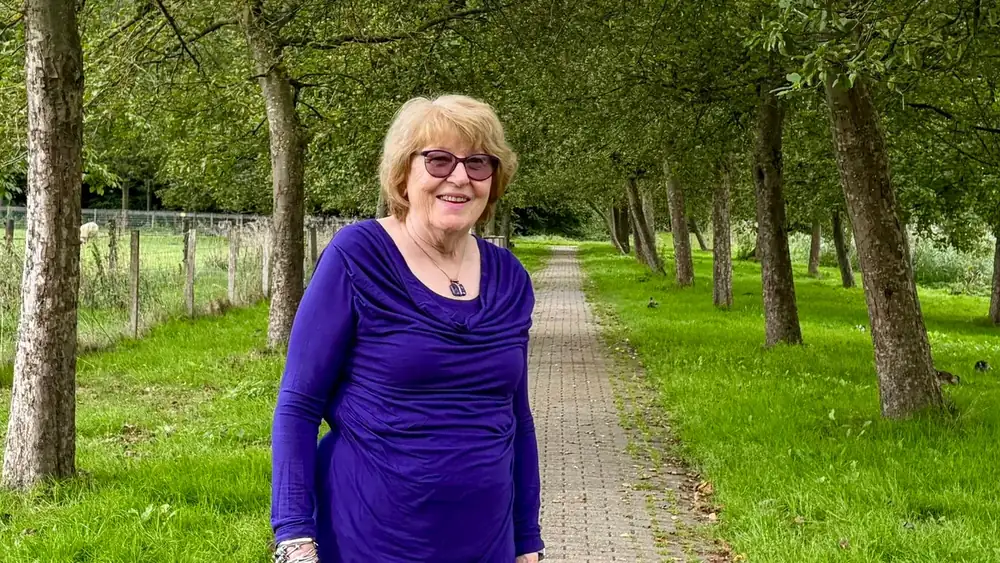
'They find it exciting when an apple suddenly turns into juice' | Guda (76) teaches children from Almere to discover nature
Children need to learn what nature entails from an early age and develop respect for their surroundings, believes 76-year-old Guda van Rijn.
About ten children, aged around five, stand in a line wearing yellow vests, with a bowl of apples in their hands. In the Stad & Natuur classroom, they are learning about this type of fruit on Wednesday morning. One by one, the children are allowed to put the apple pieces from their bowls into the fruit press so they can see how apple juice is made. Guda stands at the front, guiding the children and explaining what is happening.
Decades of classroom experience
Guda has been active as a volunteer for eleven years now, and prior to that, she taught in primary education for 42 years. She started teaching in Amsterdam, where she lived in an apartment with her family. In 1986, like many other Amsterdam families at the time, they moved to a single-family home in Almere. There was a huge shortage of teachers here back then due to the rapid growth in the number of schools. She decided to move her job with her and start teaching in Almere as well.
She has always considered it important to focus on basic development and the children's world of experience during lessons. “Besides arithmetic and writing, there is so much else they can discover. Preschoolers are at the beginning of their school careers and can still learn a great deal.”
In primary education, she did not do this by focusing directly on numbers and letters, but by working creatively 'with paper, with clay, with paint', which in practice amounted to 'a huge mess in the classroom'. She has also always taken pupils outside to discover what nature is, and even took older children to the supermarket to raise awareness about where their food comes from.
Learning by doing
According to her, learning to socialize is the most important thing. Guda notices that children's lives nowadays are increasingly shifting towards screens and hurried visits to the supermarket. “How often do you see children and their parents in the city with a tablet in their hands? I think: look around you, tell me what you see.” She feels it is a loss that children are less aware of everyday processes and their immediate surroundings. Where possible, she tries to impart this during her lessons as a volunteer.
The topics of the lessons change with the seasons. In addition to processing fruit, Guda also teaches about insects, for example. “We teach children what creepy crawlies are, exactly what they do, and that you shouldn't just stomp on them,” she explains. “In this way, we try to instill respect for nature in them.”
From tree to glass
She continues to give lessons like the one about the apples with great pleasure. “The children’s enthusiasm and how exciting they find it when an apple suddenly turns into juice remains incredibly fun.” Earlier that morning, the children had already gone out to pick the apples themselves. Then, indoors, at low square tables and with the help of an apple slicer and supervisors, they cut the apples into pieces.
Guda notices that sometimes a whole new world opens up for the children. “They learn the entire process: from growing on a tree to the product you can make from it,” Guda explains. “It is really important that children discover that apple juice doesn't just end up in a carton, but that a whole process precedes it.”
Later in the morning, the lesson turns out to be a success for at least a few children. “It looks different from normal apple juice,” one of them observes. Another child normally doesn't like fruit, but still drinks a glass of freshly squeezed juice with pride.