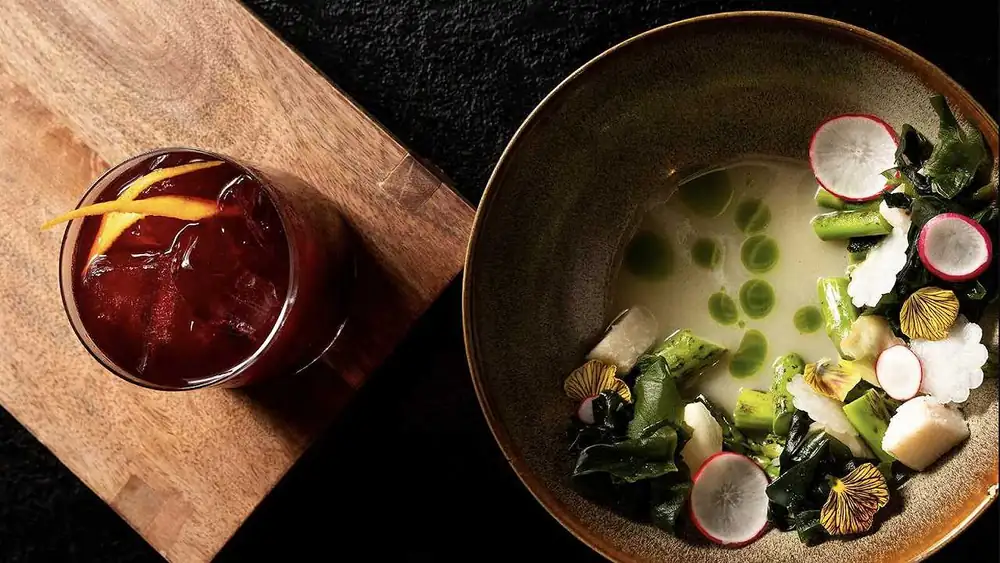
Las verduras se están convirtiendo en tendencia en coctelería: dónde probarlas
El mundo de la coctelería, que ha experimentado una profunda transformación en los últimos años, ha visto cómo los cócteles trascienden sus límites y se limitan a un contexto específico —como aperitivo o digestivo— para afianzarse gradualmente, incluso en el ámbito culinario.
The world of mixology, undergoing a profound transformation in recent years, has seen cocktails move beyond their confines to a specific context—aperitif or after-dinner drink—to gradually gain a foothold, even in the culinary world. Kitchen and bar are increasingly engaging in dialogue, exchanging techniques, ingredients, and inspiration: while chefs borrow the language of mixology, bartenders respond with cocktails that showcase a region, showcase a particular ingredient, or reinterpret dishes in liquid form.
The result is a scenario where the menu and cocktail list become the protagonists of the same narrative. Just as the menu has long since ceased to be a mere list of dishes, the mixology offering has become a tool capable of expressing the restaurant's personality and shaping its journey. In this context, the use of herbs, flowers, vegetables—in short, everything sourced from gardens and farms, often adjacent to the restaurant—is increasingly a defining feature.
And while plant-based dining has become mainstream (with a corresponding short-circuit, of which the surrender of the Michelin green star is just the latest example), the cocktail world still seems to have much to offer, with fermentations, extractions, distillations, infusions, and shrubs featuring aromatic herbs, plants, edible flowers, leaves, roots, stems, and peels. From restaurants nestled in prominent agricultural settings to restaurants with cocktail menus that draw heavily on the plant world in dialogue with the cuisine, here are a series of addresses worth trying.
Ca' Apollonio Heritage
Ca' Apollonio Heritage, a 5-star luxury boutique hotel with 18 hectares of greenery in the Pedemontana Veneta, between Bassano del Grappa (Vicenza) and the Venetian Prealps, has transformed the cuisine-mixology duo into a dedicated event: it's called Aperitage and takes place in the summer. Here, the starting point is not the mixology technique, but the garden. The drinks list is born from a direct dialogue between maître d' Lorenzo Palma and Executive Chef Alessio Longhini: from the same ingredients (aromatic herbs, vegetables, and flowers grown on the estate) that form the culinary offerings, a menu is created that sees the cocktail as a natural extension of the cuisine, where ingredients, textures, and flavor profiles are treated with the same care as the dishes.
Not simply reproducing recipes in liquid form, but building a coherent exchange between cuisine and mixology, allowing each ingredient to express a different personality in the glass. Thus, L'Orto d'Estate (mezcal, tomato water, lemon juice, celery extract) places tomato at the center of its aromatic construction; Red Baron (basil leaf-infused vodka, strawberry extract syrup, lemon juice), conceived with the idea of creating a fresh and aromatic liquid salad; and Garden Spritz (with ruby vermouth, Pallini bitters, and raspberry water), which reinterprets one of the symbols of the aperitivo through the use of raspberry water and Ecelo II sparkling wine from the Ca' da Roman winery, introducing new aromatic nuances.
Pietrasanta Paradise
In Pietrasanta, Versilia, the Hotel Paradis is a boutique hotel born from the renovation of an ancient noble palace with a fine-dining restaurant and a farm that combines art, agriculture, and cuisine according to a project by Alain Cirelli, a chef (formerly of Enoteca Pinchiorri) and entrepreneur of French origins.
The restaurant is run by Alessio Bachini, who designs a gastronomic offering that emphasizes local and seasonal ingredients, most of which come from Paradis Agricole, the 9-hectare organic farm located a few kilometers from the hotel.
The cocktail menu and signatures change according to the seasonal availability of vegetables: among the most interesting proposals of the “Agricole in Bicchiere”, as they have been called, stand out the Margarita Salsa Verde (parsley tequila, lime, triple sec, chilli cordial, lemon leaf salt) and Tom & Berry (vodka, fino sherry, tomato and raspberry cordial).
Rosewood Castiglion del Bosco
With its 904 square meters of cultivated land, including the greenhouse, the organic garden at Rosewood Castiglion del Bosco represents the productive heart of the resort, nestled in the 2,000-hectare Val d'Orcia Park. It provides the vegetables, herbs, and fruit that fuel not only the cuisine of chef Matteo Temperini, the star of the Michelin-starred Campo del Drago restaurant, but also the new mixology offering at the Lobby Bar. The menu showcases the Val d'Orcia through the glass, strengthening the connection between the garden, the kitchen, and mixology. The project, designed by bar manager Raffaele Orlando, was born with the aim of translating the same philosophy that guides the cuisine into the glass: showcasing the region through fresh, self-produced ingredients, complemented by local artisanal products.
The drinks list includes a dozen cocktails and mocktails inspired by seasonal garden produce, transformed into infusions, cordials, and homemade concoctions. Standouts include Peperone (pepper-infused Fortaleza Blanco, Empirical Ayuuk, pepper cordial, passion fruit soda), Zucchina (zucchini-infused Pisco Waqar and Parmesan, zucchini extract, lime, Stillabunt), and Sedano (mezcal, celery and tomato cordial).
Borgo Antichi Orti
Borgo Antichi Orti, just outside Assisi, is a hospitality and research project born from the restoration of a former 15th-century Benedictine monastery. Today, the village is home to an inn, twelve scattered residences, and most importantly, a large food garden with over 1,000 plants of 130 medicinal plant species (created under the supervision of Alessandro Menghini, professor at the Faculty of Agriculture of Perugia and founder of the medieval botanical garden of San Pietro all'Orto at the University of Perugia), conceived as an open-air laboratory for botanical study.
Through a spagyric laboratory dedicated to distillations, aromatic waters, essential oils, and extractions, Borgo promotes a new culture of mixology, grounded in direct knowledge of the raw ingredients. It's no coincidence that it has become a hub for bartenders and professionals who choose to explore the connection between terroir, botany, and cocktails, helping to bridge the gap between the bar and the production chain.
The cupboard
The restaurant, led by Michele Valotti, has developed a Manifesto of Living Cuisine that reads like a true declaration of intent. Among its various points, two—"Attention to wild produce, including herbs, berries, and everything the land has to offer" and "Knowledge and use of the natural and spontaneous fermentation of vegetables and alternative beverages"—provide a deeper understanding of Valotti's work in crafting a drinks menu that isn't simply a pairing, but a counterpart to what's prepared in the kitchen.
So, just as the menu seeks a balance that "includes all five flavors," in a clever experiment we told you about a few years ago, the contemporary trattoria in Brione, a small town in Val Trompia in the province of Brescia, seasonally releases a dozen or so dishes with flavor profiles ranging from dry and refreshing notes to sweet, smoky, or bitter nuances. T.
Among the others, it is worth mentioning the Surlo Sour (Surlo, Bourbon, raspberry shrub, lemon, Red kombucha), the Juniper Cola (cornelian cherry syrup, Boroni juniper distillate, lemon juice, Coca Cola kombucha, angostura), and the Fiori rosa (Tassoni Gin, Di Baldo Gin, rose syrup, rose kombucha, hyssop hydrolate).
Rooftop
Azotea, in the center of Turin, is one of Italy's leading restaurants for Nikkei cuisine, a blend of Japanese and Peruvian culinary traditions. The project, launched in 2021 by Noemi Dell'Agnello and Matteo Fornaro, after an initial experience in Laigueglia, has built its identity on the integration of cuisine and mixology, proposing a constant dialogue between dishes and cocktails.
Today, Peruvian chef Alexander Robles is in charge of the kitchen. He interprets Japanese-Peruvian fusion through ingredients selected from small Peruvian producers and recipes inspired by the country's diverse eco-regions. Fornaro develops a contemporary mixology of fermentations, shrubs, homemade preparations, and cocktails designed to accompany each course. The tasting menu features six dishes, each paired with a sip—alcoholic, low-alcohol, or non-alcoholic—in a journey that brings the kitchen and bar together.
Rounding out the offerings is a dedicated cocktail menu, where ingredients like sake, shiso, umeboshi, wasabi, and fermentations sit alongside Western spirits. Standouts include the umami-infused Asian Mary (vodka, sake, tomato, wasabi, soy, ginger, honey, and lemon), the light and citrusy Ibo-Shin (gin, elderflower, apple extract, and shiso soda), and the more savory Brine and Stone (dried plum-infused gin, vermouth, aged Edo Genshu sake, and sweet and sour fermented caper extract).