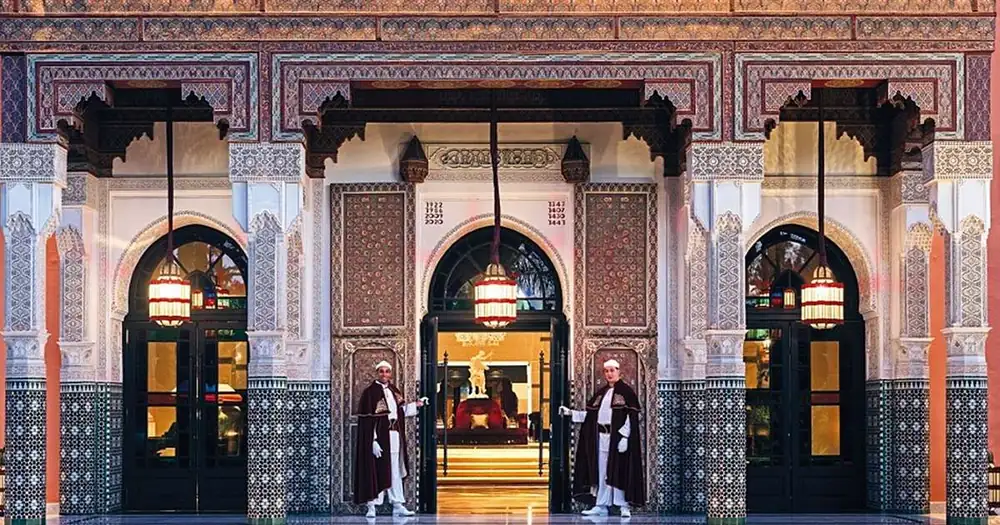
La Mamounia transforms its gardens into a stage for three dinners with Michelin-starred chefs
Hotel de Marrakech brings together Emmanuel Renaut, Olivier Nasti and Pierre Hermé in three nights dedicated to high French gastronomy, from 6 to 8 October.
For three nights in October, La Mamounia in Marrakech transforms its gardens into a setting for a meeting between luxury hospitality and haute French gastronomy. From October 6th to 8th, the legendary Moroccan palace-hotel will host chefs Emmanuel Renaut and Olivier Nasti for a program of special dinners, with desserts created by pastry chef Pierre Hermé.
The concept goes beyond a series of gastronomic experiences. By bringing together professionals from different backgrounds in one place, La Mamounia uses gastronomy as an element in building the experience and identity of the accommodation itself.
Each of the three evenings will have a different setting. The program begins on October 6th, with Emmanuel Renaut, a three-Michelin-starred chef and Meilleur Ouvrier de France, presenting his interpretation of contemporary French cuisine.
The following day, October 7th, Renaut joins Olivier Nasti for a four-hands dinner. The experience brings together two cuisines marked by distinct territories and references, in a creation developed especially for the occasion.
The event concludes on October 8th, with Olivier Nasti taking over the culinary program. A two-Michelin-starred chef and Meilleur Ouvrier de France (Mere Craftsman of France), Nasti will bring to Marrakech a cuisine strongly rooted in the identity of Alsace and a contemporary interpretation of its products and traditions.
Desserts as part of the experience
The program also gains a third signature. The desserts for the three dinners will be created by Pierre Hermé, one of the most renowned names in French pastry.
Founder of Maison Pierre Hermé Paris, established in 1998, Hermé built his career on an approach that combines technique, creativity, and different flavor combinations. In 2016, he was elected the World's Best Pastry Chef.
The presence of the pastry chef adds another layer to the experience: instead of treating dessert as a secondary ending to the menu, the project places the pastry in the same prominent position as the main courses.
Three chefs, three identities.
The program allows you to explore different facets of contemporary French cuisine.
At the helm of Flocons de Sel in Megève, Emmanuel Renaut develops a cuisine connected to the mountains and the products of his region. His career includes three Michelin stars and the title of Meilleur Ouvrier de France (Best Craftsman of France).
Olivier Nasti runs Le Chambard in Kaysersberg. His Table d'Olivier Nasti has two Michelin stars and uses Alsatian ingredients and references from a contemporary perspective.
Although they come from different backgrounds, the two chefs share an important characteristic for the event's concept: they use the territory as an element of gastronomic identity, without abandoning technique and contemporary style.
It is this diversity that the meeting in Marrakech highlights.
Gastronomy as an extension of the hotel industry.
The organization of these dinners also reveals a recurring strategy in the international luxury hotel industry: transforming the restaurant and its gastronomic program into part of the reason for visiting the hotel.
At La Mamounia, this relationship takes on an additional dimension through the setting. The gardens cease to be merely an architectural element of the property and become a space for a short-term experience, carefully constructed around gastronomy, ambiance, and exclusivity.
With limited seating, the three dinners were designed for a select audience. The scarcity of places helps to position the program as a special experience, and not simply as another gastronomic option available during the stay.
Market Analysis | Tourism & Events
La Mamounia's initiative demonstrates how luxury hotels can use gastronomy to create specific reasons to travel. When internationally renowned chefs are invited for special experiences, the restaurant ceases to cater solely to guests and can become an attraction in its own right.
Another aspect lies in the curation. Bringing together chefs with distinct territorial identities and adding Pierre Hermé's signature creates a narrative that goes beyond the menu. The product then becomes synonymous with origin, technique, personality, and exclusivity.
For high-end hotels, this model also allows them to use programming as a positioning tool: temporary experiences, with a limited number of participants and recognized names, can generate new reasons to visit or return to a property.