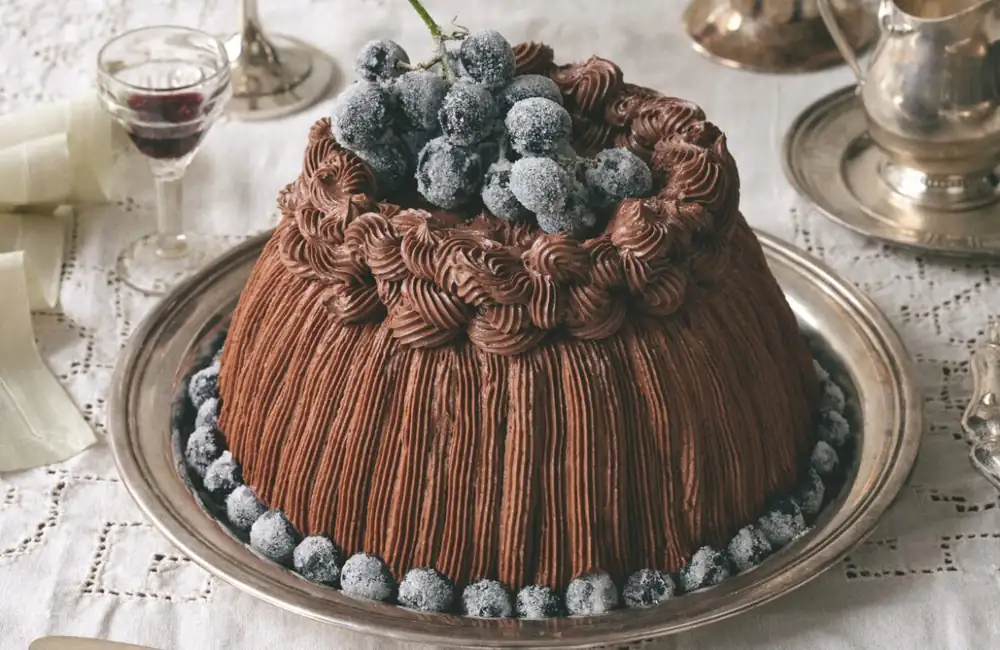
Red wine chocolate pear ginger dome cake
This cake holds a special place in my heart.
This cake holds a special place in my heart. Growing up on a vineyard in France, I spent my school holidays working in the vines to make pocket money, surrounded by my father’s winemaking passion. At age 11, I started learning about wine and the complexities of different flavour notes. As a result, I have a deep love for pairing food with wine, so naturally, I had to create a cake using my family’s wine. Infused with a rich, full-bodied red wine, the cake is paired with a velvety chocolate ginger mousseline buttercream and pear ginger jam – my love for red wine–poached pears definitely inspired this cake. The buttercream can seem intimidating at first, but once you’ve nailed making a custard, you’ll be able to make it blindfolded. For the pear ginger jam, I like to leave bits of pear in the mix to preserve the texture.
For the red wine dome cake
canola oil spray or canola oil, for the pan 350g (12½ oz/2 1/3 cups) plain (all-purpose) flour 2½ teaspoons baking soda 135g (5 oz/½ cup) sour cream, at room temperature 2 large eggs, at room temperature 1 tablespoon vanilla extract 255g (9 oz/1 cup) unsalted butter, cut into small pieces 240ml (8 fl oz/1 cup) red wine, such as Cabernet Sauvignon or Merlot 400g (14 oz/1¾ cups) white (granulated) sugar 2 tablespoons unsweetened Dutch-process cocoa powder
For the chocolate ginger mousseline buttercream
5 large egg yolks, at room temperature 30g (1 oz/¼ cup) cornstarch 100g (3½ oz/½ cup) white (granulated) sugar 480ml (16 fl oz/2 cups) full-cream (whole) milk 1 teaspoon vanilla extract 140g (5 oz/1 cup) dark chocolate 340g (12 oz/1 1/3 cups) unsalted butter, at room temperature and cut into small pieces 60g (2 oz/½ cup) icing (powdered) sugar, sifted 25g (1 oz/¼ cup) unsweetened Dutch-process cocoa powder 2 teaspoons ground ginger
For the pear ginger jam
MAKES 1.5 KG (3 LB 5 OZ/4 CUPS) 3.2kg (7 lb) ripe fresh pears (about 16 medium pears), peeled, cored, and cut into small cubes 900g (2 lb/4 cups) sugar 2 tablespoons vanilla bean paste 2 teaspoons ground ginger 2 teaspoons freshly squeezed lemon juice (from 1 medium lemon) ¼ teaspoon fine sea salt.
For the red wine dome cake:
Set a rack in the middle of the oven and preheat to 180°C/350°F. Spray or brush the sides of a 1.4 L (47 fl oz/1½-quart) stainless steel bowl with a 20 cm/8-inch diameter opening with canola oil, then line the base with a round of baking paper. Sift the flour and baking soda into a medium bowl. In a small bowl, whisk together the sour cream, eggs and vanilla. In a large saucepan, combine the butter and red wine and warm over medium heat until the butter is melted. Remove from the heat, then add the white (granulated) sugar and cocoa powder and whisk until smooth. Add the sour cream mixture and whisk until fully combined. Gradually add the flour mixture, whisking until smooth. Pour the batter into the prepared bowl and bake until a skewer inserted in the centre of the cake comes out clean, about 1 hour 15 minutes. Set the bowl on a wire rack and let cool for 30 minutes. Flip the bowl over to release the cake, then remove the baking paper and let the cake cool completely.
For the chocolate ginger mouselline buttercream:
In a large bowl, combine the egg yolks, cornstarch and 2 tablespoons of the white (granulated) sugar and whisk until fully combined and smooth. In a small saucepan, combine the milk, vanilla, and the remaining white (granulated) sugar and heat over medium–low heat until warm. While whisking continuously, gradually add the warm milk mixture to the egg yolk mixture. Pour this mixture back into the saucepan and cook, whisking continuously, until it has a thick custard-like consistency, about 3 minutes. Pour through a fine-mesh sieve set over a medium bowl. Cover with plastic wrap, pressing the plastic wrap directly onto the surface of the custard to prevent a skin from forming, and refrigerate until cold, about 2 hours. When the custard is cold, fill a medium saucepan with about 2.5cm/1 inch of water and bring to a simmer over medium–low heat. Add the dark chocolate to a large heatproof bowl, then set the bowl over the pan of simmering water, making sure the water does not touch the bottom of the bowl. Warm the chocolate, stirring occasionally, until melted. Remove the bowl from the pan (careful – it will be warm!) and use a clean kitchen towel to carefully wipe any condensation from the bottom of the bowl. Let the chocolate cool slightly. In a stand mixer fitted with the paddle, beat the butter and icing (powdered) sugar on medium speed for 1 minute, then increase the speed to high and beat until light and fluffy, about 3 minutes. Scrape down the bottom and sides of the bowl, then add the cocoa powder and ground ginger and mix on low speed until fully incorporated, about 30 seconds. On medium–low speed, gradually mix in the cooled custard, 1 tablespoon at a time, until fully incorporated. Add the cooled chocolate and beat on medium speed until the chocolate is incorporated and the buttercream is smooth and silky.
To assemble
Using a serrated knife, cut the cake horizontally into three even layers. Place the wide bottom layer, flat-side down, on a cake plate. Put about 400g (14 oz/1¾ cups) of the buttercream into a piping bag fitted with a plain round tip with a ½-inch/13 mm or similar diameter. Holding the pastry tip about 2.5cm/1 inch above the cake and starting about 6mm/¼ inch from the edge, pipe 2 concentric rounded rings of buttercream around the perimeter. Spoon about 195g (7 oz/¾ cup) of the pear ginger jam into the middle and use a small offset spatula to spread it evenly. Pipe zigzags of buttercream on top of the jam so it’s completely covered. Using a small offset spatula, gently spread the buttercream zigzags to fill in any gaps and connect them to the outer rings. Carefully place the second cake layer, wider-side down on top, then gently wiggle it into the buttercream. Add more buttercream to the piping bag as needed. Repeat the above process to pipe and spread the buttercream and add the jam to the second cake layer. Place the final layer (or dome), flat-side down, on top, then gently wiggle it into the buttercream. Using a small offset spatula, spread the buttercream in a thin, even layer to completely cover the outside of the cake. This is your crumb coat. You should still be able to see some of the cake underneath. Put the cake in the refrigerator for 15 minutes to firm up. Add the remaining buttercream to a piping bag fitted with a small open star tip, then pipe vertical stripes of buttercream from the bottom to the top of the cake. Decorate the top with swirls of buttercream, then place a cluster of sugared grapes in the centre. Arrange individual sugared grapes around the base of the cake for a finished look. The cake is best the day it’s made, but it keeps covered in the refrigerator for up to 2 days. Remove the cake about 2 hours before serving, so the buttercream has time to soften.
To make the pear ginger jam
In a medium bowl, toss the pear cubes and sugar together to coat the fruit. Cover and let macerate for 2 hours at room temperature or preferably overnight in the refrigerator. When ready to make the jam, put two small plates in the freezer. Add the macerated pears to a large stockpot or heavy-bottomed saucepan. Set over medium heat and cook, stirring frequently and mashing the pears against the side of the pan if you want the jam to be smooth, until the pears are quite mushy, 20 to 25 minutes. Continue cooking and stirring until the pears are fully broken down and the jam is thick, 5 to 8 minutes more. Scoop a spoonful onto one of the frozen plates and wait 1 to 2 minutes for it to come to room temperature. Tip the plate from side to side. If the jam is ready, it will hold its shape on the plate rather than run down it. If you’re not sure, try running a spoon through the jam on the plate – if it holds the line, it’s ready. Technically, jam should register about 104°C/220°F, and if you’re new to jam making, using a thermometer can be really helpful, but part of the fun is relying on your senses. The jam will be syrupy with chunks of pear, unless you mashed the fruit while cooking to make it thicker and smoother. If needed, continue cooking the jam until it sets on the second frozen plate. Once the jam passes the frozen plate test, stir in the vanilla bean paste, ginger, lemon juice and salt, then remove it from the heat. If you want to seal the jam in jars for longer term storage, do so while it’s still hot. Otherwise, let the jam stand in the pot, without stirring, to cool and thicken for about 30 minutes, then transfer it to jars or airtight containers but do not cover. Let the jam cool to room temperature, then cover and refrigerate for up to 2 weeks. You can cool the jam in the refrigerator, but it’s important to allow the jam to fully cool before covering, as condensation could drip back into your beautiful work and loosen the texture.