En Montreal y Nueva Orleans, perdura una celebración navideña francesa
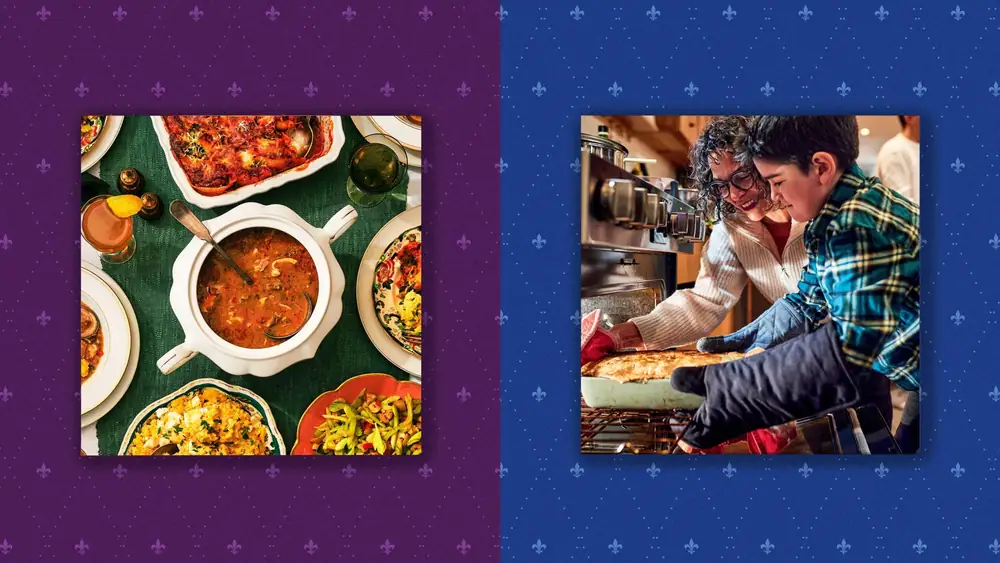
Ilustración fotográfica: Russ Smith • Fotos, de izquierda a derecha: Doaa Elkady, Michael Abril Desde una reunión acogedora en Montreal hasta una cena con influencias criollas en Nueva Orleans, las dos historias que siguen revelan cómo las celebraciones de las fiestas católicas se han transformado a lo largo de los años en estas dos ciudades de influencia francesa. Lo que antes era un banquete elaborado en las primeras horas de la madrugada después de la Misa de Medianoche, los réveillons de hoy continúan evolucionando.
Photo Illustration: Russ Smith • Photos, from left: Doaa Elkady, Michael Abril From a cozy gathering in Montreal to a Creole-inflected dinner in New Orleans, the two stories that follow reveal how Catholic holiday celebrations have transformed over the years in these two French-influenced cities. Once an elaborate feast in the wee hours after Midnight Mass, the réveillons of today continue to evolve, but one thing stays the same: Family is always front and center.
Le Plateau-Mont-Royal, Montreal Michael Abril It’s 7 p.m. on Christmas Eve, and the table is set. When I was a kid in the suburbs of Montreal, every holiday season was celebrated with a dozen aunts and uncles, cousins, and our beloved Grandmaman.
The annual réveillon meal was served at midnight back then, but I can’t imagine keeping my 6-year-old up that late now. By the time the food was brought out, my cousins and I were ravenous, and our eyes were itchy with sleep. Michael Abril The star of the table was always Grandmaman’s ragoût de boulettes et pattes, a hearty Quebecois stew of pork trotter gravy and meatballs served with plain boiled potatoes.
At little more than 100 pounds, Grandmaman was the pillar of our large family. At Christmas, it’s used not only in ragoût but in the meat pie known as tourtière.
New Englanders brought it with them when they settled the Saguenay region in the 1850s. And yet, as Reyt notes, despite the absence of traditional dishes on restaurant menus—or maybe because of it—the cultural importance of home cooking in Quebec is huge.
The entire province was in a deep freeze when we drove up from New York, him brushing up on his French in the car. At midnight, we all exchanged kisses on both cheeks, and Richard was granted some of the most heartfelt blessings he had ever received: wishes for love, health, joy, and children, each delivered with eyes locked in devastating earnestness—just like when I was little.
We might not hunt our own meat or stay up until midnight, but we try to keep it sincere, with family at its heart. —Chantal Martineau The Montreal Menu: Michael Abril Ragoût de Boulettes et Pattes (Stewed Meatballs and Pork Trotter Gravy) Tourtière du Lac-Saint-Jean (Quebecois Meat Pie) Ketchup aux Fruits Uptown, New Orleans L. In the 1800s, réveillon dinners in the Crescent City were formal affairs.
New Orleanian author Poppy Tooker tells me of some of the city’s earliest celebrations: After fasting through Midnight Mass, “in the wee hours of the morning,” she explains, observant Catholics “would have an enormous feast with beautiful luxury foods, imported and local.” Intricate cakes and pastries dotted the table. Each year on Christmas Eve, she and her family attended mass at the Sacred Heart of Jesus Church on Canal Street before coming home to feast on seafood, Italian pastries, and—most memorable to Dangelo—laughter: “the key ingredient for everything,” she says. While Lee’s family has long preserved a version of the tradition, my dinner with them was two days before Christmas, not on Christmas Eve, and many of us certainly wouldn’t last until the early hours of the morning.
Lee’s family is not alone; per to Tooker, by the 1940s, home-cooked, post-midnight réveillon dinners had become nearly obsolete; the idea didn’t quite translate to 20th‑century social norms. By the 1990s, as part of a city-wide tourism initiative, other historic restaurants in the Quarter, including Arnaud’s, Commander’s Palace, and Galatoire’s, had all begun offering réveillon menus.
The week before I rang in the holiday with Lee and his family, I visited Copper Vine Wine Pub & Inn on Poydras Street, and was delighted by the hotel’s cozy holiday décor. Beneath the glow of street lamps affixed to walls and strings of miniature lights, I tucked into a réveillon menu of chargrilled oysters, seared scallops, and a pumpkin trifle that convinced me that, here in New Orleans, this truly is the most wonderful time of the year.