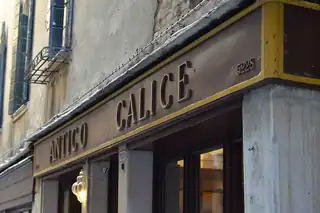
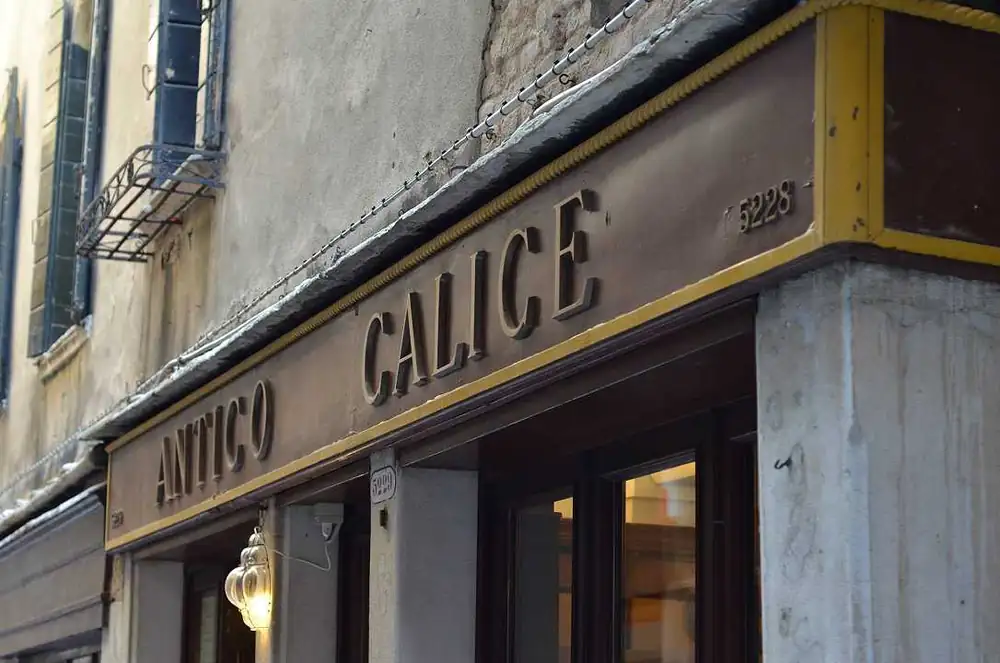
Antico Calice en Venecia, reseña: cocina tradicional y variedad lagunar sin concesiones
Una de las expresiones más ingeniosas que se usan en Venecia para indicar el atractivo de un lugar es "a pocos pasos de...", que cualquiera puede completar añadiendo Rialto o San Marco al final de la frase.
One of the most cunning expressions used in Venice to indicate the attractiveness of a place is "a few steps from ...", which anyone can complete by adding Rialto or San Marco to the end of the sentence. In the city, much is measured, in tourism terms, based on the location relative to the two main hubs where the flow of visitors is concentrated. With unfortunate outcomes or deceptions, which transform into miles of walks to reach the desired destination. In this case, however, the few steps are surprisingly real, and lunch at Antico Calice ends up being a stop in the heart of the city (if Venice even has a city center), less than two minutes from the Rialto Bridge.
The surprise then turns into pure amazement or even disbelief when you discover that in such a central location, at risk of pre-cooked food and blood-sucking receipts, the quality-price ratio (and happiness) is excellent: it is no coincidence that Elio Zorzi in “Osterie Veneziane”, a compendium of the gastronomic history of Venice, writes that the sign “represents one of the most celebrated taverns in Venice and the Veneto Region”.
The history of the place and the spritz
It's impossible to review the Antico Calice without considering its history. Zorzi traces its origins back to 1537. For the centuries that followed, leaving aside changes in ownership and vicissitudes, one date must be taken as a reference and a defining one: 1902, the year in which the Bolla brothers opened the establishment: "They came from Soave, the beautiful castle in the Veronese Marches, which supplies the very famous dry white wine and the less famous but sweeter Torbolino." In addition to Soave and Torbolino, the offerings expanded to include "red wines from the Verona hills, red wines from Valpolicella, and Reciotti," while the kitchen was abolished, replaced by a "cold service" that included prosciutto, Verona salami, cold roast veal, and anchovies. "This sort of buffet (...) quickly attracted customers, among whom Professor Marsich, the ingenious inventor of the ombra, immediately stood out.
The shadow consists of half a glass of wine drunk standing at the bar. Etymologically, the shadow derives from that exception of the word ombra which means a little bit, an idea, a breath (…) and standardized in the measure of exactly half of a quarter of a liter”. So far the framework and the clarification regarding an expression that is part of the minimal Venetian vocabulary and the very essence of the frequenter of osterias (and bacari, obviously): the shadow of wine. However, the following lines are fundamental, and it is worth noting them because they codify once and for all the birth of the spritz, identifying the Antico Calice as the place where the famous aperitif was born, which has become a symbol of Venice itself: “At the Calice you can enjoy as an aperitif a scorzeta, that is, a Bismarck or spritz, a delicate and innocent invention of the Calice, which offers under this name a half shadow of white wine in soda water with a slice of lemon peel”. This is the starting point for all the interpretations and variations on the theme that will follow. The Antico Calice chalice, in short, as the navel of the world.
The history of the Calice is linked not only to the birth of the spritz, but also to that of the Gazzettino, a local newspaper founded by Giampietro Talamini in 1887. Alvise Zorzi recalls how the proximity of the newspaper's headquarters to the tavern effectively transformed the Calice into a second editorial office: many journalists "made it their address and office," and beyond the city limits, the place attracted a diverse mix of people from all over the Veneto region.
The atmosphere is welcoming, with details reminiscent of Venetian tradition (gondolier hats hanging from the ceiling beams) but without being overly grotesque or gaudy. The service is equally attentive: courteous, attentive, and efficient, yet discreet.
The menu, the dishes
Having consigned the cold drinks service to the past, the current management, entrusted to Cristiano and Marco, who gained experience at the nearby Osteria Alla Botte, has transformed the establishment into a classic trattoria, where tradition is presented with respect for style and quality. The menu offers a journey through the great staples of lagoon cuisine (folpetti pasta, creamed cod, bigoli and black risotto, sardines in saor, fried fish, cuttlefish and polenta) with a few essential concessions to tourist tastes (prosciutto crudo, fillet steak, and tagliata). Prices are average, but considering the location, quality, and quantity, they are absolutely competitive: appetizers range from €15 to €22, first courses from €15, and second courses between €15 and €22. The wine list is extensive, with regional references that showcase their expertise.
Among the appetizers, the mixed platter is a good test: often limited to three or four options, here it reveals a desire to include lesser-known fish, crustaceans, and mollusks, which require the use of dialect. While creamed cod, mantis shrimp, baked scallops, polenta and shrimp, octopus salad, cuttlefish eggs, and marinated anchovies are more well-known and common, less so are garusoi and bovoeti, murex and snails, respectively, which are difficult to understand, not only linguistically but also in terms of taste. A rare mix.
Among the first courses, from the options not on the menu but listed verbally, the choice is undeniably spaghetti with clams, simple and tricky. Here, the sweetness of the clams (a good quantity) is given a measured boost by a light spicy note and chunks of tomato. The sinewy spaghetti absorbs the sauce well and reveals an expert hand in the kitchen: no sand, of course, but plump clams and aromatic notes that enhance the mollusk rather than overpower its flavor. Try them.
The desserts continue in the same vein as the rest of the menu: tarts, local biscuits, tiramisu, and crème brûlée. Homemade, they're also exceptionally well executed, with neither the tiramisu being overly flattering nor the crème brûlée being blandly sweet.
Opinion
In the heart of the city, Antico Calice remains faithful to its origins and a history that has made it one of Venice's leading restaurants. With a menu in keeping with tradition and expertly executed, flawlessly executed and without the dullness of traditional classics, it's a safe bet, both gastronomically and economically.
AGAINST
- Plating that does not fully enhance the menu offerings.