The Zero Day inspired the tasting menu at Balcón del Zócalo
What is Day Zero?
What is Day Zero?
With the aim of raising awareness among diners, the chef presents nine dishes that spark conversation on the topic. The experience begins with a glass of water served from a pitcher shaped like Tláloc, the rain god.
Later, inside the restaurant's wine cellar, you are served a glass of champagne, which begins this reflective experience.
Day Zero refers to a period in the future when we will not be able to supply or provide the amount of water we currently require for basic subsistence and development needs, according to the National Autonomous University of Mexico (UNAM).
More than a quarter of humanity lives under the threat of reaching the dreaded Day Zero, according to The Social Water Foundation, dedicated to water conservation. In numbers, this is illustrated by the one billion people who currently lack access to clean water and the other 2.7 billion who experience water shortages at least once a month.
Balcón del Zócalo Tasting Menu
For those who choose to experience this menu, it's important to do so with an open mind, ready to listen, acknowledge, and act on Day Zero. This topic inevitably brings to the forefront what we are individually doing to destroy our planet.
Meteorite creates water on Earth
Chef Pepe Salinas begins this experience with a popsicle served on a rock. Inside, the popsicle contains sangrita, tequila, and lime. The texture and color of the meteorite are achieved with cacao cream and corn husk powder.
This little tidbit is the result of a news story that broke in 2021: “Water found in meteorite that fell in England.” The meteorite fell in the front yard of a family in Winchcombe, Gloucestershire, England, and researchers discovered that it contained water similar to that found on Earth.
Crisis at Lake Pátzcuaro
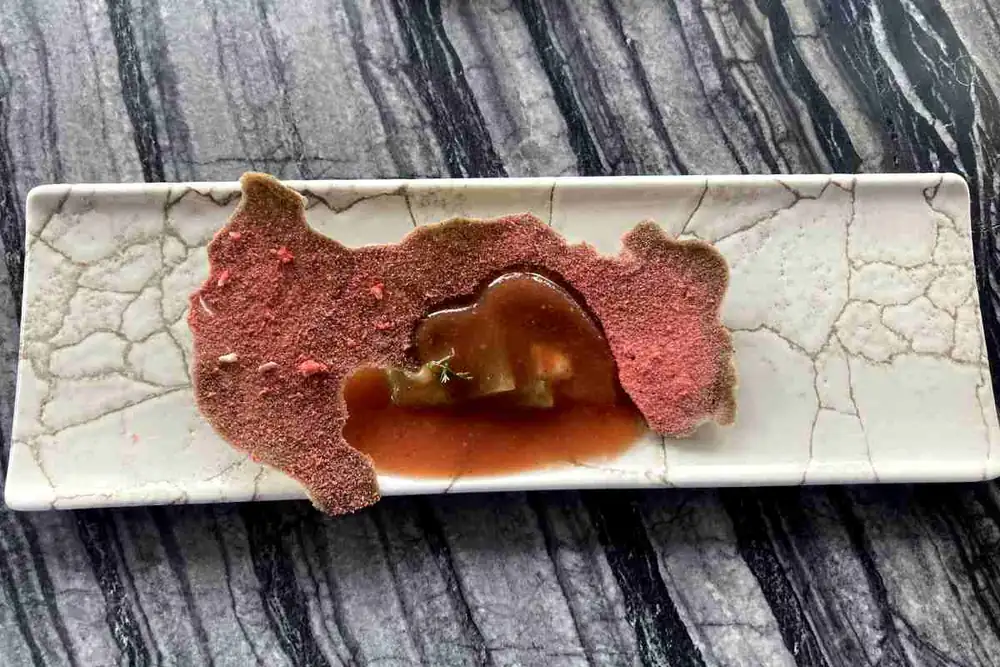
You will also be able to taste a dish inspired by Lake Pátzcuaro, which has lost 42% of its surface area due to water theft, drought, and irregular planting.
People can walk on land that used to be covered in water, on which the inhabitants who made their living from fishing and tourism economically depended.
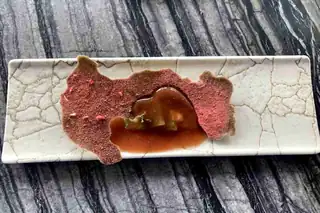
This dish is a melon aguachile, with a corn tostada with freeze-dried strawberry, served on a porcelain plate that alludes to the drought in the lake.
Water footprint of the textile industry
To continue the experience, Pepe Salinas presents a dish that critiques the water footprint of the textile industry. It is estimated that 10,000 liters of water are used to manufacture a pair of jeans.
In this context, Balcón del Zócalo presents a salad prepared with hydroponically grown lettuce. Hydroponics makes it possible to grow your own food even at home, since hydroponic crops adapt to any type of space and conditions.
Soft drink consumption in the state of Chiapas
This tasting menu also addresses the problem of soda consumption in the state of Chiapas. Each resident of Chiapas consumes nearly 822 liters of soda per year, reducing their water intake, according to data from the National Council of Humanities, Sciences and Technologies (Conahcyt).
At this time, a clarified Cuba Libre (a cocktail made with cola, rum, lemon juice and ice) is served, using a milk punch technique.
The process involves curdling the milk, lowering the pH (traditionally using lemon juice), and removing the milk solids through filtration (traditionally using cheesecloth, nowadays using a coffee filter). The result is a clear beverage.
It's time to act for our planet
This is how this experience seeks to reflect on what we are doing to our planet and the bleak future; however, there are optimistic academics who claim that Day Zero in Mexico is far off if we become aware.
Manuel Perló, an expert at the Institute of Social Research at UNAM (National Autonomous University of Mexico), urges people not to panic and to take action now. One of his recommendations is to use water as is done in areas of Mexico City where people lack access to it.
,
The Balcón del Zócalo tasting menu will be available from July 21st to September 21st.
Location: Av. 5 de Mayo 61, Historic Center of Mexico City, Centro, Cuauhtémoc, 06000 Mexico City, CDMX.