Restaurantes que traen el jardín
La filosofía de la naturalidad se ha extendido por todos los restaurantes, y no solo por los de alta cocina. Esta forma de entender la gastronomía dejó de ser una moda pasajera hace años y se ha arraigado firmemente en la mentalidad de un número creciente de chefs.
A philosophy of naturalness has spread throughout restaurants, and not just fine dining establishments. This way of understanding gastronomy ceased to be a budding fad, just another trend, years ago, and has become firmly established in the mindset of a growing number of chefs.
Their commitment to themselves and to their customers is best expressed by those who work directly with farmers and producers who grow products specifically for them, allowing them to select what and how they want the vegetables, herbs, fruits and even olives to make extra virgin olive oil.
There are well-known examples of chefs who not only work this way, but have made it the hallmark of their culinary style. Perhaps two of the most paradigmatic examples are Ricard Camarena, from Valencia, and Rodrigo de la Calle, a staunch promoter of the Madrid region's vegetable gardens in Aranjuez at El Invernadero.
They are not the only ones; there are many more, to the point that Michelin and Repsol-awarded chefs have turned producers like Rafa Monge, from Cultivo Desterrado (Cádiz), or Santi Pérez, from the Galician Finca de los Cuervos, into stars of horticulture.
The luxury of having a vegetable garden
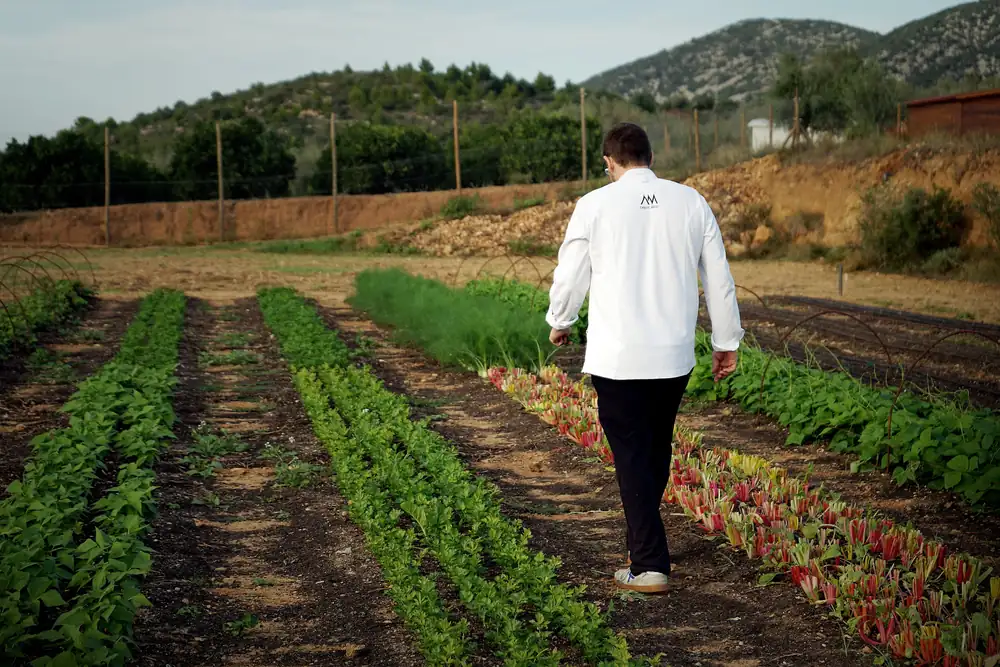
The pinnacle of this philosophy is having your own garden, which allows chefs to offer a unique culinary experience, with fresh, seasonal ingredients recently harvested, minimizing waste and controlling the entire food process.
It also allows them to experiment with exclusive flavors and products, promote sustainability, and reduce their carbon footprint.
For obvious reasons, restaurants with gardens are usually located outside of large cities, with some exceptions such as Seed in Madrid, with a small urban garden right on Serrano Street.
But there are establishments located in cities that have orchards on the outskirts, far from the urban center. This is the case with the Sandoval brothers and their farm, El Jaral de la Mira, in El Escorial (Madrid), whose 1,300 square meters supply the Coque restaurant and their other projects. Or take Qüenco de Pepa, where Pepa Muñoz puts her motto "the countryside united with the kitchen" into practice, thanks to her Ávila orchard, abundant in her famous tomatoes, and many other products, that reach her dining room and the adjoining grocery store where she sells them.
The Madrid-based Huerta de Carabaña supplies its vegetables to the restaurant of the same name at the Gourmet Experience of El Corte Inglés in Castellana, and the Mexican Roberto Ruiz does so from his Segovian farm, 7 hectares of organic cultivation where, among other things, several types of chilies are planted for his two locations in the capital, Barracuda MX and Can Chan Chan, and for the production of sauces.
Rural orchards
In Galicia, one of the staunchest advocates of this form of self-sufficiency is Javier Olleros, of El Culler de Pau (Pontevedra), who boasts a magnificent vegetable garden and greenhouses covering more than 2,500 m2, cultivated organically. He has also managed to turn the restaurant's organic waste into compost to nourish the plants, closing the loop.
The Echapresto brothers have done the same at Venta Moncalvillo (Daroca de Rioja, La Rioja), where they've managed to bring their vegetable garden right into the dining room, almost literally. Located next to the restaurant, they proudly showcase it and the immediacy and quality of the biodynamically grown seasonal produce it provides.
A similar case is that of María Gómez, of the Magoga restaurant (Cartagena, Murcia). She owns a 30-hectare family farm, certified organic and strictly dryland (they plan to install two more irrigated hectares), where they grow Marcona and Largueta almonds, fig trees, carob trees, fennel, and wild greens. In September, they will begin planting vegetables: elephant garlic (native to Murcia), citrus fruits, and other produce. All of these ingredients end up on the plates of a kitchen committed to using Murcian produce and its culinary roots.
Toño Navarro, head chef of Essentia (Tarancón, Cuenca), has the privilege of offering his own extra virgin olive oil, made from the Picual, Cornicabra, Manzanilla, and Gordal varieties. The restaurant boasts a plot of land planted with olive trees, as well as a small 600-square-meter vegetable garden located behind the premises.
Legumes, cruciferous vegetables, winter and summer vegetables, aromatic herbs… They are even recovering heirloom seeds of products that have always existed in the area, varieties that are now almost extinct. True to their cuisine, which features the best raw ingredients, their idea is to keep incorporating new fresh vegetables into their dishes.
L'Antic Molí (Ulldecona, Tarragona) has been awarded the 2023 Spanish Food Award for the restaurant industry by the Spanish Ministry of Agriculture, Fisheries and Food (MAPA) for its Mans project, which focuses on regenerative agriculture and the circular economy. Its chef and owner, Vicent Guimerà, owns a 7-hectare estate divided into six areas (vegetable garden, citrus groves, dryland orchards, stone fruit trees, and a recreational area featuring species, flowers, and seeds being recovered), as well as a mobile chicken coop with 70 free-range hens.
The spectacular vegetable garden yields up to 100 varieties of fruits and vegetables, cultivated naturally and sustainably. Guimerà's philosophy is to cook with the landscape, the land itself; hence, he uses only local produce in his kitchen and creates his innovative menus based on what the land provides. It's a concept that goes beyond mere gastronomy, embracing nature and local craftsmanship.