Patricio Letelier, innovating by returning to the beginning
Patricio Letelier made a career in Europe with an unconventional profession: training German Shepherds. It was 12 years of hard work, “albeit a very hippie lifestyle,” he admits. His life changed when his father fell ill at the end of 2009.
The long-haired, silver-haired hippie stayed to live in the dilapidated 1790 manor house. He had a plan. In Europe, he had seen the structure of small farms. “In Chile, that wasn't even a concept at the time. They were all huge. I understood that it was possible. I had to uproot the 125 hectares of vineyard that the whole family owned and kept the 5 hectares of Carmenere. From my room, with a cracked wall, I looked out and saw incredible chaos. I was so naive that I thought I could do it. I had savings, but not enough to create a wine project just for ego, and since I don't like getting into fights I can't win, I decided to keep selling the grapes and making chicha cocido (a fermented corn beverage).”
To learn what he didn't know, he called on the elders of this prime agricultural region of central Chile, where everything grows well. “Each old man came with his own technique and made his own chicha. The oldest one arrived; the wisest of the tribe. I gave him 400 liters of Chardonnay juice. He took egg whites, beat them, and added ash from the rinds of Carmenere grapes. Beforehand, he passed them through a fine sieve. Suddenly, he poured it all into the vat. After a few minutes, a black foam began to appear, and he skimmed it off with a strainer. The liquid was pristine, wonderful. We made 2,200 bottles of premium cooked chicha, which was a huge success. It sold out. The elders were very happy with me. They told me, sadly, 'If you don't continue with this, it will be the end of us.'”
A year earlier, a winemaker friend had told him he had to make Carmenère. “He insisted it was special; that I shouldn’t give up on it.” He didn’t give up on it, and in 2012 he made a little. When he gave it to him to taste, the friend told him again, “See? You have to make Carmenère.” It was the weight of evidence. When he came across the costs of creating a winery from scratch, he was somewhat depressed. But a week later, he told himself: “Wait, the most expensive thing is the equipment: three-phase power, pumps, tanks, destemmer, hydraulic press. That’s been around here since the mid-60s, but wine has been made for 4,000 years. There’s another way to make wine.”
He went back to the old folks.
“The first tap was sold to me by the wise man. He told me: I'm not capable of filling it myself. He gave me the contact information for someone who repaired them. I went to see him; he wasn't making them anymore. I convinced him, and he made ten for me. It took three years, and when he finished, he passed away. He had already explained the mechanics to me: how to make them, the tricks, everything. Meanwhile, my friend, a genius with Carmenere, was giving me the technical guidelines. I intertwined the two worlds of knowledge, without having any idea what I was doing.”
From his first serious harvest (2013), he made 4,100 bottles. The following year, with the winery restored using adobe (bricks of mud and straw, a craft he learned from the elders), production grew to 5,200. Just when he thought he needed a better destemmer and press, someone shouted from the street: “They send word from Villa Alegre that the machines are ready!” Long story short, his grandfather had sold his in the 1970s, with the understanding that they would be returned when they were no longer needed. A week later, he went with a crane to pick them up. He spent the winter restoring them without fully understanding how they worked. It was an 1890 Marmonier crusher and destemmer. “When I got it running, we discovered that you can’t process a million kilos, but for the volume I produce, it’s the best there is. The first few years we turned the wheel by hand; later we adapted an electric motor.”
Patricio points out that the decision not to use pumps like those used today is related to restoring the traditional winemaking process. “Modern methods arrived in Chile in the early 1980s, so there are still people in every town who make wine the old-fashioned way. I was lucky enough to be with these people and for them to be willing to teach me. I learned how to make adobe bricks and wooden beams, how to distill the spirit I use to make brandy, how to make the chicha cocido (a fermented corn beverage) that's making a comeback this year, how to make wine… Between the land, the process, and the final product, the greatest human intervention is in the process. It's the most cultural aspect of the entire chain.”
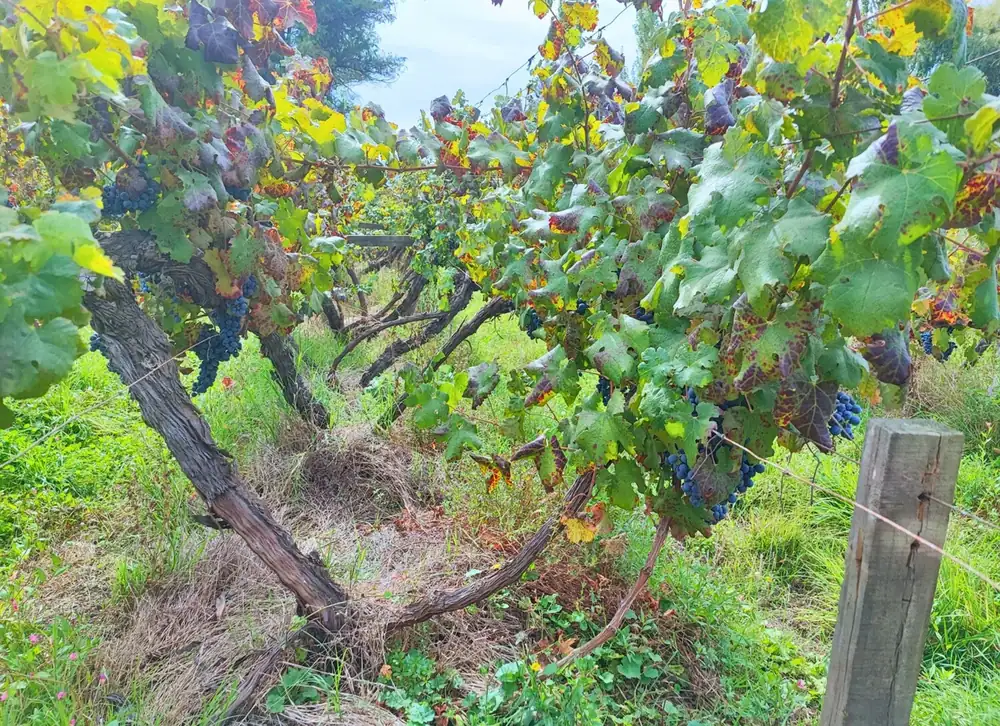
With the winery ready, he turned his attention to the vineyard. Everything was meticulously planned; he had done everything the company that bought his grapes asked of him. Until he noticed the vines were aging and producing less. “That’s when I said, well, if I keep doing the same thing, these plants will die. My daughter studies at a school called Rudolf Steiner, and that influences my thinking. I started to move towards regenerative agriculture and stop using agrochemicals. That’s where Steiner comes in, for whom everything is about the balance of factors.” The idea is to provide the plants with the nutrients they lack, so they begin to exude them downwards. When their pH rises, they are no longer attractive to pests. The attractiveness lies below, in the mulch. “We started experimentally, with a friend who owns the company Ecosuelo. Now he’s working with large vineyards.”
To achieve Carmenère with good natural acidity, he began harvesting in sections. “We discovered that the weaker vines ripen earlier, losing their green color but not reaching the desired concentration. So, we harvest the thinnest rows with the highest acidity first; a week later, the medium-flavored ones; and so on, until we reach the last rows in May, with the most complex flavors, the creamy, graphite notes, just when the acidity has run out. We do it in small plots. Essentially, it's the same as they used to do, when there weren't so many people to harvest everything at once.”
Thus were born two different ArteSano wines: the red-skinned one, fresher, and the black one, deeper. Now comes a third: El Diario del ArteSano, a wine designed for everyday enjoyment. Shorter, but with all the layers of flavor and natural acidity.
Patricio explains that they've been improving what he calls the method every year. For example, in 2019 they started washing the grapes. When he put it into practice, he saw how the water actually came out dirty. “Today you taste the 2019 vintages versus the 2018, which is a super year, and there's a significant difference. Keep in mind that the soil is in the air, and I don't filter, nor do I use sulfites.” As he mentions, since 2019 the fruit in his wines is much purer. A great success.
Walking through the galleries of the old, 1,000-square-meter mansion, he tells me: “I started restoring the winery because it was the most fragile part and could have brought the rest down. When I started making wine, I realized that one of the most expensive phases of aging in barrels is temperature control. Thanks to the winery being in the southern part of the house, in the shade, with high ceilings and giant adobe walls, it stays at 16°C without spending a penny on energy. It's a whole two-way process.”
The 2021 ArteSano wines are currently on sale. Two years ago, he says, he achieved his goal of vinifying his five hectares. On September 4th, Chile's Wine Day, he will open the winery to visitors for the first time and invite local artisans; those who work with wicker, make jams… “My dream,” he says, “beyond finishing the house so it can be my daughter's refuge, as it was mine, is for it to be a School of Trades. That people who own half a hectare can learn that they can make quality wine without a huge infrastructure; that they can learn about self-construction, chicha (a fermented beverage), preserves, and charcuterie. My debt is to cheese. I always say I'm lazy because I should do so much more. It's just that I'm a bon vivant. I like to think, observe, listen to nature, watch the grass grow, connect with animals. Things that, for me, are productive because the goal of life is happiness.”