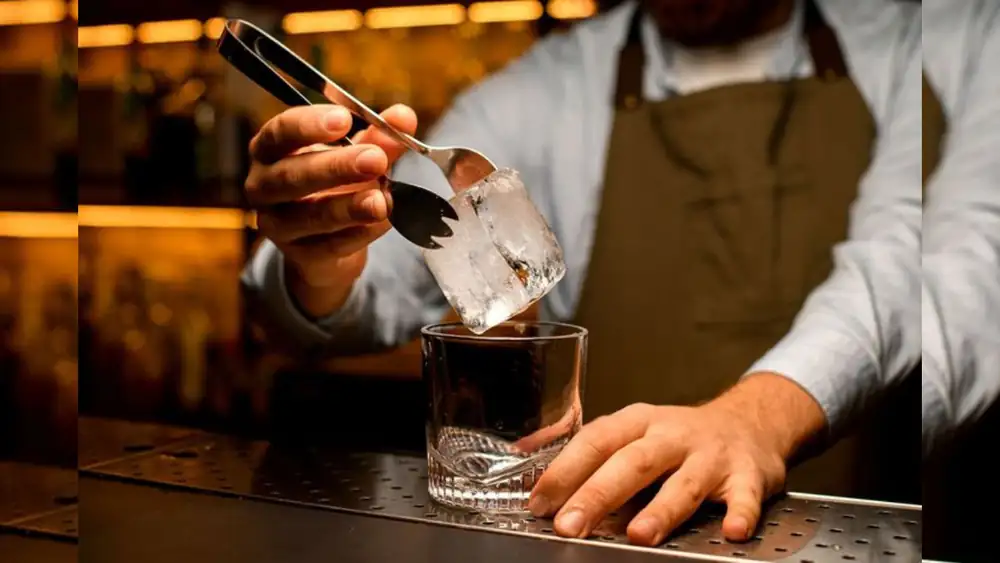
Why the shape and size of the ice in your drink matters
An extra-large, crystal-clear ice cube is perfect for an Old Fashioned, but it wouldn't do a glass of soda any favors. Similarly, the crushed ice that makes a Big Gulp so refreshing on a hot day would result in a watery, sluggish Negroni. One size or shape of ice isn't inherently better than another.
We all know that ice cools and dilutes our drinks, but let's scientifically analyze how it can affect the flavor and texture. There are two important concepts we need to keep in mind.
Melting matters
When you add ice to a drink, it heats up and then melts. It takes some energy to heat the ice, but it takes much more to turn the solid ice into melted water. This energy is drawn from the surrounding liquid, which cools it. So, the drink cools down a little as the ice heats up, but it cools down much more as it melts.
That melted ice will dilute the drink with water, of course. Dave Arnold, author of the scientific cocktail book Liquid Intelligence: The Art and Science of the Perfect Cocktail, states that, from a practical standpoint, “there is no cooling without dilution.”
The more ice melts, the colder the drink gets. That's why a giant ice cube isn't the best choice for a room-temperature soft drink. It simply doesn't melt fast enough.
Surface area and volume
Ice melts on its surface, so the more surface area of ice your drink touches, the more it can cool at once. Imagine a large ice cube in a glass of liquid. If you break it in half, more surface area will be in contact with the liquid. The two pieces of ice can cool the drink faster than the whole cube.
Now, let's consider the total volume of ice in the glass, as this represents its cooling power. A small piece of ice can only cool a drink to a certain extent. More ice means greater cooling power, regardless of whether it's in the form of one large cube or many small cubes.
The total volume of ice determines its cooling power, while the surface area influences the rate of cooling. The large cube we cut in half has the same total cooling power as when it was whole, but it will cool faster when cut in two. It will cool even faster if divided into smaller pieces.
This ice is too big, this ice is too small
The shape with the smallest surface area to volume ratio is spherical. A large sphere of ice will cool a drink more slowly than an equivalent amount of ice in another shape.
Many people claim that an ice sphere in a glass of whiskey or other drink "chills it to the maximum with minimal dilution," but this isn't true. It chills and dilutes slowly; the two are related. If you want a drink that chills to the minimum, put the glass in the freezer for 10 minutes before pouring. Without ice, it won't dilute.
Even so, large ice cubes can be ideal for a drink like whiskey, which you don't want to get as cold as a cocktail. The ice will dilute and chill the drink slowly, allowing you to enjoy it in sips.
Often, dilution is just as important as chilling to enjoy a drink. If the whiskey has a very high alcohol content, such as a Scotch or barrel-aged bourbon, water can reduce its alcohol content to a more manageable level. A couple of small ice cubes in a barrel-aged bourbon glass can quickly dilute and chill it, and a larger cube on top can maintain the temperature.
Sometimes you crave a very cold, diluted drink, like a Mint Julep. Crushed or shaved ice is the perfect tool for this. When served in its traditional metal cup, all that ice cools your hands and provides minty-flavored ice water to enjoy for a few more minutes after finishing the bourbon.
Which ice is suitable?
And what about regular ice cubes, like the ones in your freezer tray or ice maker? They're the most useful for most drinks (though they're not the prettiest ice, but that's another story). They're the ideal size for shaking or stirring cocktails, as well as for serving most beverages.
Large, five-centimeter cubes are not ideal for shaking or stirring. They often don't fit in the cocktail shaker, and even when they do, there isn't enough room to mix and dilute effectively.
Ice that's too small is also ineffective. In a cocktail shaker, soft, small ice (like crushed ice) doesn't do much to mix ingredients or muddle things like mint leaves, milk, and egg whites.
In the glass, fine ice covers the surface of the drink and can dampen the impact of the carbonation. Perhaps that's why gas station sodas with crushed ice taste better with a straw. Carbonated drinks, like a gin and tonic or vodka and soda, are ideal served with medium-sized ice, as this allows some of the bursting bubbles to tickle your nose as you drink them.
When cocktails are shaken, the ice breaks up inside the shaker. Most drink recipes specify straining the drink over fresh ice cubes, usually of a normal size.
The most common ice cube size may be the most versatile option, but there are many good reasons to use other shapes to better control the temperature and dilution of the drink.