Waman, high-flying Basque-Peruvian cuisine
It all started with a pepper, “the fiery rocoto of the temples” as the Peruvian poet César Vallejo described it. The modest Rocoto restaurant had been warming up the Bilbao neighborhood of Deusto long before Waman opened its doors just a few meters away.
It all started with a pepper, “the fiery rocoto of the temples” as the Peruvian poet César Vallejo described it. The modest Rocoto restaurant had been warming up the Bilbao neighborhood of Deusto long before Waman opened its doors just a few meters away. In the former, the mother's cooking, the heart of the cuisine, served in generous portions of fried fish, stews, and causas, with their vibrant anticuchos; in the latter, the son's cooking, the brain, the evolution. Together they form a body that breathes Basque Country but always looks to the other side of the Atlantic, to his native Peru.
To say that Waman is Gabriel Huaman would be reductive, because for him to lead the team at this restaurant, there first had to be a father, Edson Huaman, a chef who instilled his passion for cooking, and a mother, Rosa Elvira Lucas, who left the continent and forged a path in this city, juggling up to three jobs simultaneously. Gabriel arrived in Bilbao as a teenager. He trained in the culinary arts at the Artxanda Hospitality School, where Lucía Freitas (A Tafona) and Álvaro Garrido (Mina) also studied, and honed his skills at Eneko Atxa's Azurmendi, although he had already established himself as a chef in the family restaurant, the first Peruvian restaurant in Bilbao. Seven years of savings culminated in the opening in 2021 of a restaurant that infused the Andes with the flavors of the Basque Country and which, in its first year, earned a recommendation from the Michelin Guide.
Gabriel's shyness is hidden behind tattoos of crosses and roses. He smiles softly. The three years he's been at the helm of this establishment have instilled in him a serious demeanor, not only in front of the table but also in the kitchen. Noticeable changes are evident from those early dishes that seemed to tiptoe around the Bilbao native, as if not wanting to offend him, to his latest tasting menu, Pachamama, which is more substantial and personal. Just a few weeks ago, he completed an immersion program at Central, Virgilio Martínez and Pia León's restaurant, as part of the Slow Food movement. His younger brother, Renzo, is about to do the same at Maido, Mitsuharu Tsumura's restaurant in Lima, which was chosen as Latin America's best restaurant in 2023 by The World's 50 Best Restaurants.
The peaks of Pachamama
Lunch starts off strong. It begins with three complementary bites that revolve around ají de gallina, one of Peru's great stews: a buñuelo (a classic at Azurmendi, with different fillings) not greasy, filled with the stew, which is pleasant and flavorful; a small sandwich of a pâté made with the livers of the hen (and it is hen, not chicken as is the case in many Peruvian restaurants) in which two slices of fried plantain, typical of Chifa cuisine, serve as bread; and, finally, in the style of a consommé, a reduced broth of the bird that seems to have nested on the roof of a Basque farmhouse.
“It was my childhood breakfast, a baguette stuffed with this meat” Gabriel recalls as he serves another classic: lomo saltado. He's brought it into Nikkei cuisine in the form of a beef tenderloin tartare, aged in quinoa koji for 48 hours. The real highlight is the pickled chili peppers he adds. He bathes it in the juices from the original recipe and adds a touch of soy sauce and oyster sauce. Umami on brioche bread.
It's a well-executed surprise, and one of the most interesting and appetizing bites on the menu: the rabbit escabeche with oyster tartare. Subtle notes of the sea, rounded textures, and sweet accents with a sweet potato purée that perfectly complement the escabeche. The chef confesses that he finds surf and turf a testing ground, where he takes the most risks. He had already done so before with a duck and sea urchin tartare, and on this occasion, he succeeds again with the result of this exploration, which is always a triumph in itself.
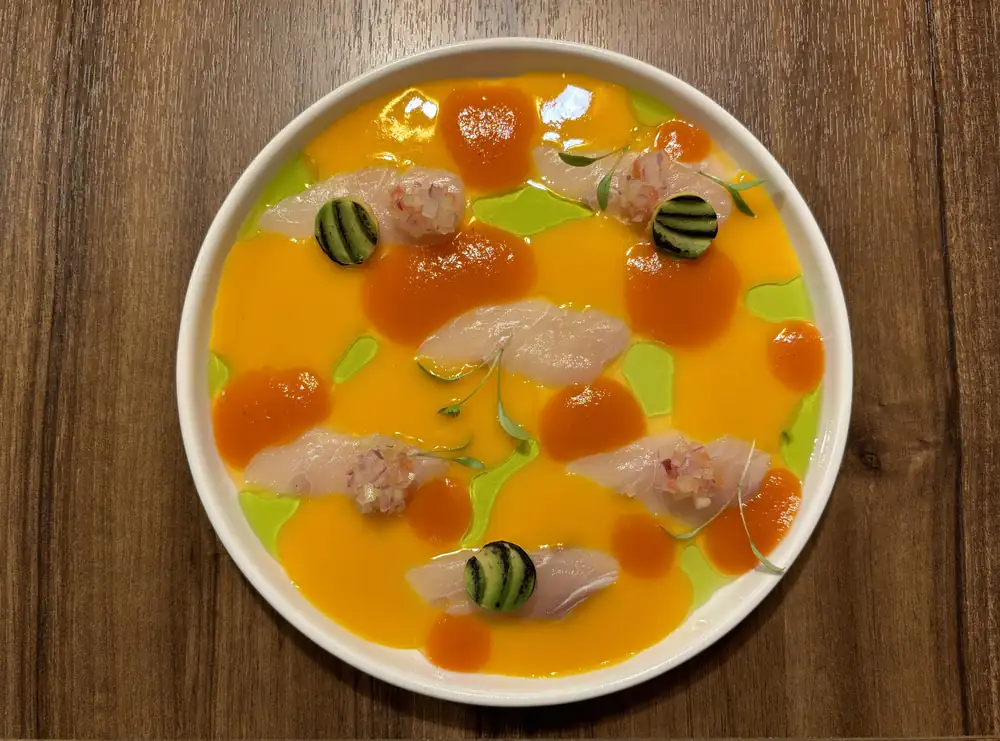
He also excels with another classic, the tiradito, this time made with yellowtail (it's also served with cured salmon on the menu), which is flawless. The tiger's milk made with yellow chili pepper, a perennial favorite at this establishment, is complemented by rocoto pepper, from which it takes all the flavor and aroma but not the spiciness. The traditional cilantro appears this time in the form of an infused oil. A welcome change, given the mistreatment this dish, along with its sibling, ceviche (which is by no means negligible here), suffers in so many restaurants with rigged menus.
This is followed by a faux risotto of carabineros prawns, a foolproof dish as long as the cooking times are respected, and at Waman they do. Puntalette prawns bathed in a flavorful American sauce with dots of fresh cheese cream (reminiscent of a shrimp chowder) are topped with a carabineros prawn shamelessly displaying its barely warmed, naked body. An outlaw exhibitionist. Jyulieth Garay, the head of the dining room, lets the diner take the task of carrying its head to the guillotine and mixing the corals in an act of succulent sadism.
“I want to express Peru through Basque products.” That’s the chef’s objective and the idea that hovers over Waman’s menu, like the falcon in its Quechua meaning, the indigenous language of the Andes. This Basque-Peruvian fusion shines in a cod kokotxa that, although it comes from the sea, has a taste for the heights, because with it, the menu reaches its peak. He demonstrates a skillful touch with pilpil, here made with mirasol and yellow chili peppers (like Mario Sandoval’s at Coque), which gives it a rich, rich flavor, and presents it under a miniature ear of corn (or a teardrop pea when in season).
The meal begins with a surprisingly tender, anticucho-style octopus, advertised as a flavorful dish (the sauce is infused with garum made from the octopus's own tentacle and an emulsion of beef marrow), but the result is milder than expected. However, the overall presentation is less elegant than the previous courses. The same is true of the Euskaltxerri rib, infused with seaweed to bring it into the Nikkei culinary world, but the marine notes are barely perceptible. That said, they again pay close attention to the cooking times.
From his time at Azurmendi, the young chef inherited the exquisite attention to detail in his plating (always featuring leaves and flowers, Cookplay tableware, and pieces by artisans Miriam Cernuda -Working In The Red Woods, Barcelona- or Sara Fernández -Bilbao-) which is maintained right up to the last dessert: a tribute to the terraces of Moray in Cusco, where he interprets the terraces of the archaeological site with concentric circles of 50% Peruvian chocolate mousse, a lucuma sorbet, and an intriguing olive oil infused with Valrhona cacao for two years. It's appreciated that it's not overly sweet. A perfect ending, just like the postcard it replicates.
A hawk with a thirst
In the kitchen, a team of young people from diverse backgrounds act as the wings of this falcon, which is the meaning of Waman in Quechua, the indigenous language of Peru. The same is true in the dining room, with a team dedicated to explaining ingredients, even bringing them to the table, and the origins of traditional recipes. There's a clear commitment to promoting Peruvian culinary culture in a place where Latin American cuisine is barely represented. Some will be curious and attentive, while others will be impatient and only interested in digging in their forks. They'll need to read the tables carefully in this plaza.
Their latest addition is Guillermo Miranda, former sommelier at Mina (Bilbao) and Ceibe (Ourense), another Peruvian expat who has lived in the city since adolescence. His arrival is part of the Huaman-Lucas family's commitment to small producers like Carlos Sánchez, Verónica Ortega, and César Márquez, a good selection of sparkling wines from both near and far, and around twenty Bizkaiko Txakolina wines, because they want "the fusion between Andean flavors and the surrounding environment to be complete."
The family's significant investment in the restaurant and its decor has now aligned with the culinary offering, and while some may have considered the Michelin Guide's recommendation premature, Gabriel Huaman has proven that he deserves it and is capable of meeting expectations.
From those initial enthusiasms comes this more focused and elegant proposal, one that stands on solid ground but doesn't forget to take flight like the falcon it is, to explore new ideas. It still has miles to travel. However, it's worth walking those miles that separate Deusto from the city center and crossing that estuary that divides the city of lions in two to discover that the rocoto pepper is as fierce as its offspring.