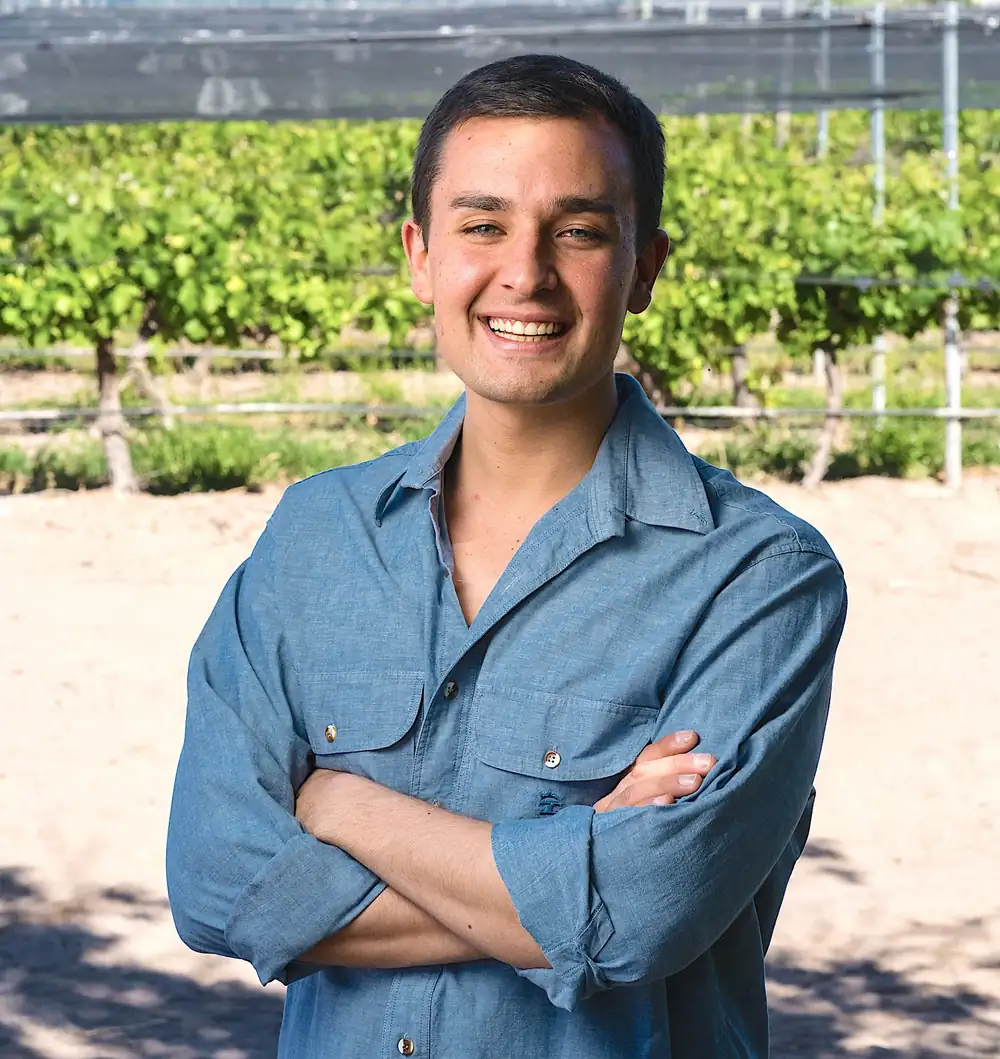
Matías Morcos, the revolution of the east
It wasn't always the other one, it was the first. Eastern Mendoza used to foot the bill for everything. But little by little, it was strangled by monopolies that set ridiculously low prices until it suffocated everything.
Matías is 28 years old. He inherited his father's penchant for winemaking, and although he decided to study oenology, he was already an oddity for a generation that generally sells their land for next to nothing to pursue more lucrative university degrees. Very few people still make a living in eastern Mendoza. The winemaking families who had small family vineyards in the 1970s are now impoverished and selling their grapes for next to nothing. But Matías senses there's still gold to be found, and as he travels and produces, he shares his epiphany: the revolution of the east.
“In 2016, a friend and I went to Chile to try Carmenere and Cabernet Sauvignon, which were the closest things to our wine, and we stumbled upon the País grape revolution, a variety with over 400 years of history. That's when it hit us: they were the same Criolla grapes we had planted in the east. It was a revelation to realize we had value. What they're doing is fantastic; they're reviving vineyards in the oldest areas. I asked myself, why would I become an employee at a winery in the Uco Valley when I have historical potential and a wealth of grapes at home, with my father's Muscat, Criolla, and Pedro Ximénez vineyards? Everything that I considered garbage up until then, I now see as fabulous.”
The revolution is about adding value.
Four years ago, this crusade against time began. The revolution consists of adding value. It's not about getting better pay from the big wineries for their production, but about moving towards a model where each vineyard can market its story with a bottled wine. Criolla grapes from the east, labeled, rich and drinkable wines, low in alcohol and at a good price. "Reclaiming the table," says Matías. "The idea of the revolution isn't to buy a vineyard to renovate it, but rather, 'Let's partner up, I'll make the wine for you, you bring me the grapes, we'll bottle it, we'll make money, and you stay where you are working the land.' Because I can buy one or two vineyards, but I can't buy the whole east, nor is the idea to monopolize."
Matías is living proof that it's possible. He has several wines under his own name, including Ríe la Vid and Érase una vez, which tell the story of different vineyards in Palmira, Chapanay, and Monte Casero—classic, forgotten places in the east—from his Aleph winery. He also collaborates with other producers, helping them understand that added value is everything they have. “We can make delicious wines, but then we have to label and sell them. Developing all this extra value isn't easy; there's a lot to do.”
“It’s about telling the new generations that what they see as horrible has great winemaking potential. Convincing them of this perspective and urging them not to migrate, not to leave. If they dare to bottle it and promote it, things can happen. Wine isn’t about romance here; it’s pure profitability and survival. The sad thing is that there’s no one left from my generation. There are very few young people, because the Uco Valley isn’t where owning a vineyard is cool. Here, you get tired of losing money, and the landscape is abandoned and desolate, with so much to do. Young people aren’t interested, which is why we’re having an internal revolution, because otherwise, it will be lost, it will end up disappearing with some strong wind that stirs up the fire.”
A major turning point in this revolution came when Patricio Tapia named him Revelation Winemaker in the Descorchados Guide. From then on, his wines began to gain more recognition, so much so that last year they were named Decanter Wine of the Year by the British magazine Decanter. “Without a doubt, it’s the first time in the world, and in history, that a Criolla grape from South America and eastern Mendoza has been recognized in such a prestigious place. For us, it’s revolutionary, betting on the region and showing that it can be done. Furthermore, the wines remain simple, rich, and suddenly being at the same table as the most important châteaux in the world is a huge achievement.”
Organic by force
They're organic by necessity. Money is tight; they're organic vineyards out of both love and fear. "We have to go back to the simple, everyday peasant wine. We have natural vineyards because of profitability; there's no money for supplies," Matías explains. In a way, relying on knowledge from the past to keep the grapes healthy is almost the point of connection with the fourth wave of winemaking, which maintains native vegetation and draws on the wisdom of its origins.
The winemaker swallows his own prejudices and vinifies disruptive styles to shake things up. White wines made from Bonarda, orange wines from Criolla and Muscat.
“The revolution isn’t just about what’s outward, but about shedding your own prejudices,” he explains. “I started growing oranges for fun and to break with an industry that was more conservative in 2016. I have a small internal struggle against the snobbery of the wine world, the ultra-premiumization, the importance of specific soil types, $200 wines… We need marketing, but let’s not stop making a delicious wine, a drink to brighten people’s lives.”
“This idea that a bottle is so important seems excessive to me. I think we've focused too much on that and lost touch with the everyday consumer. If you're not in a restaurant or a hotel, you can't drink wine. My feeling is that we've gone overboard; a five-star hotel has a wine that costs more than a family can live on for six months. I feel that these rockstar wineries are very detached from reality, and being where I am, I see the other side of things. I know what it means to survive.”
Matías belongs to a restless generation that struggles to think long-term, and in the wine industry, everything is a very long-term endeavor. So, he develops interesting strategies to avoid boredom and to understand the world that's coming. His winery was the first in the country to accept cryptocurrencies as a form of payment, they created the first label using artificial intelligence, and they dream of launching a collection of NFT wines.
“We have to be very forward-thinking because the modern world we live in can sweep you aside in an instant. I think it's important to play a different game; I feel there are tons of opportunities. For me, it's not enough to just save ourselves if my neighbors are those poor people who can't afford to eat. Besides, I feel we have a historic opportunity. Abroad, we're very successful with Asian food, in small bars, all very different from the Malbec in steakhouses. With the Criolla, we can win back a consumer we've lost, with young, simple wine, the kind you have in a pool with ice. I can offer good products to consumers who have drifted away from the world of wine, high-quality winemaking without losing freshness. We have to understand where we are and communicate that. My ideal would be to have very affordable Criollas on the shelves and for young people to drink wine like they drink beer. That's my goal.”
Adding value doesn't always mean being premium. There's talk of revaluation, but did such a thing ever exist? Or did "revaluation" always mean something else? Perhaps this is the first time someone has looked at it this way.
“This revolution is a dead end. I'm interested in helping our neighbors, but we have a more pressing problem in the future. I'm waiting for technology to be as disruptive as it needs to be; I don't know if we're ready for a Netflix for wine. I have a technology company with friends because I feel we're an industry of the past, with behaviors more akin to a Rolex that confers prestige, and little of the freshness and nourishment of everyday life. My long-term vision is obviously focused on the local people, but I feel we need a technological push or we'll be left behind. I feel we've made a lot of progress as a product; we're launching a one-liter bottle of clear wine with Creole spirits for drinking in the US, something that was unthinkable before.”
“A lot of projects are popping up that I'm not familiar with, and at the end of the day, that's what's most important: producers making Criolla and Bonarda wines, communicating that they're in the east. This narrative of 'we're in the east, in a place with hundreds of years of history, and we make great wines' is what matters to me. It's too early to know exactly where we stand, but I'm thinking about having a Geographical Indication or the moment when a big company calls us saying they want to buy 500,000 liters of premium Criolla. That's definitely going to happen, that's when it's going to be happening.”