In-Pulso: reivindicación del tradicionalismo
Si bien se reconocen las diferencias y se evitan las comparaciones, que siempre son odiosas, podría decirse que el trabajo que el madrileño Álex de la Fuente ha estado realizando durante los últimos tres años en su restaurante In-Pulso tiene muchos puntos en común con el del cordobés Paco Morales en el restaurante Noor, galardonado con tres estrellas Michelin.
While acknowledging the differences and avoiding comparisons, which are always odious, one could say that the work that Madrid native Álex de la Fuente has been carrying out for the last three years at his restaurant In-Pulso has many points in common with that of Cordoba native Paco Morales at the three-Michelin-starred Noor.
While Morales has spent years researching the culture, gastronomy, and traditions of Al-Andalus to recover, reclaim, and update them, De la Fuente does the same with Madrid's culinary heritage, determined to demonstrate that Madrid has a historical and traditional recipe book that is much broader and more varied than the people of Madrid themselves think, and that it goes far beyond stew or tripe.
A millennial and a proud and dedicated Madrileño (that is, at least a third-generation Madrileño on both his mother's and father's side), De la Fuente worked with some of the biggest names in Spanish gastronomy before embarking on his solo venture: Santi Santamaría, Fernando Pérez Arellano, Ricardo Sanz, Roberto Ruiz, and especially Ramón Freixa, for whom he was head chef for five years. This experience translates into a vast knowledge of ingredients and a remarkable mastery of technique, which earned him the award for Best Chef of the Community of Madrid in 2024.
His restaurant is located, quite literally, in the middle of nowhere, in an up-and-coming area next to the Planetarium in Tierno Galván Park and the South Bus Station. It's not the best-connected in the world, but in return, parking is incredibly easy. A cheerful, bright, and informal bistro, dominated by a painting of the capital's skyline, a clear statement of intent, because with it begins the celebration of traditional Madrid culture that we are about to experience.
The celebration continues with the drinks. As an aperitif, an assortment of cocktails made with vermouth, sarsaparilla, strawberry tree liqueur, or violet liqueur, evocatively named Pichi, Chotis, El Chulapo, or La Violetera, recalling the old street bars. Or a beer… Mahou, of course, since their brewery is just steps from the restaurant. And, in the wine cellar, selections from the various sub-regions of the Vinos de Madrid DO.
Beyond these subtle nods, it's in the main courses where the chef's original and highly personal approach truly shines. Here, ancestral recipes unearthed from history books, manuals, cookbooks, and gastronomic treatises are transformed into contemporary dishes of considerable substance. Each dish is accompanied by a presentation that (thankfully) avoids becoming a pseudo-philosophical discourse, instead offering a brief narrative to contextualize each one and, more or less, situate its origins.
There's no better way to start than with this version of beef chuck, a dish that, perhaps because it's made with puff pastry, is now relegated to bakeries, even though it's a savory dish that was already being enjoyed in the 18th century. In his version, the chef places braised and shredded beef with tomato sauce and roasted chilies (remember, he was featured on Punto MX) on the puff pastry base, lightening it and enhancing the flavor of the stew. Definitely worth repeating.
The very rustic potato omelet pintxo appears in an interpretation somewhat reminiscent of Adrià's celebrated version: it's creamy, served in a glass, and features a base of green pepper and a crispy potato topping. While its texture is impeccable, it's excessively sweet. A bit cloying.
A very noteworthy proposal is the cauliflower mousseline with garlic toffee and pickled mussels, which elegantly and refinedly combines two of the techniques that have always been most popular with Madrid residents, garlic and pickling, while also highlighting the value of the cruciferous vegetable.
Historically, for obvious conservation reasons given its inland location, freshwater fish were highly prized in Madrid. One of the stars was the trout, now almost vanished from the capital's tables, whose most emblematic recipe was the Cibeles style: smoked and stuffed. De la Fuente takes this dish and significantly improves it with a subtle homemade smoking process and the accompaniment of its roe, an intoxicating sherry sauce, crispy pork powder, and frisée salad.
Time for some hearty stew. And speaking of hearty stews, what could be more traditional than Tío Lucas's beans (although some place their origin in Toledo, but that's another story)? Buttery beans, bacon, paprika, cumin, and wild boar cheek. Perfect for dipping lots of bread… Which, by the way, comes from Madreamiga and is absolutely delicious.
A final savory course, with game as the star. Farm-raised quail presented in four courses served together: juicy roasted breast, drumsticks with a unique pepitoria sauce (it doesn't include bread or hard-boiled egg), toast made with its offal, and a soft-boiled egg.
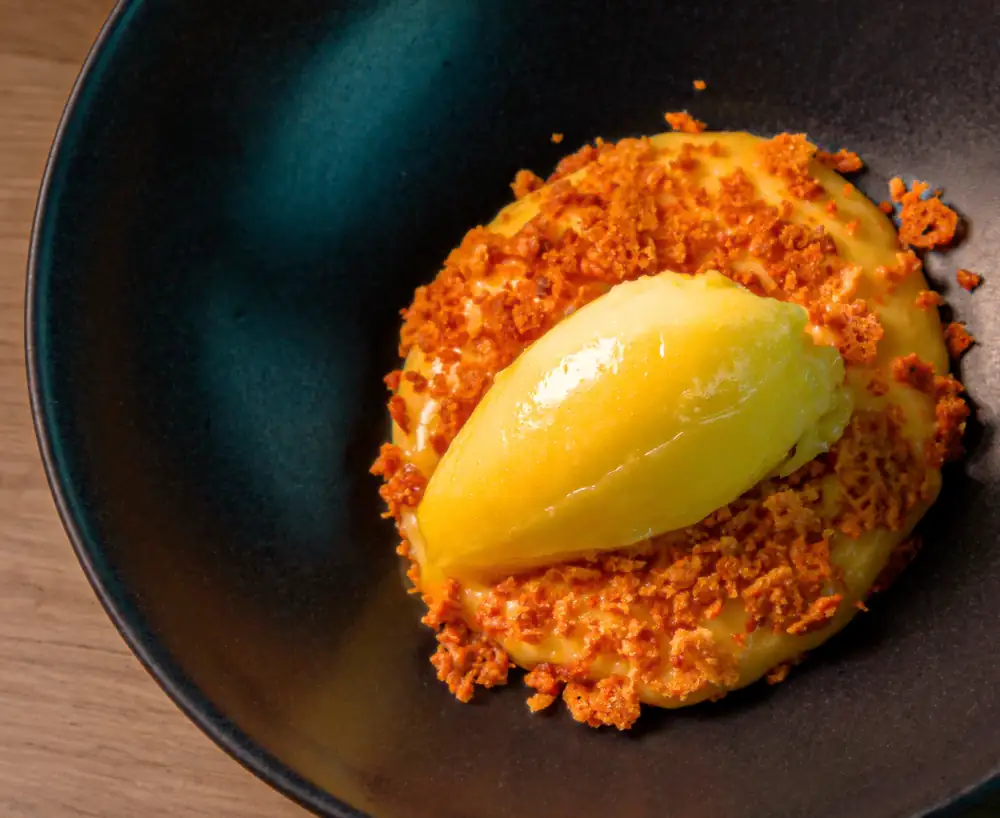
The crowning touch, and the name couldn't be more fitting given its origins in the 19th century, is the revival of the eletuario with brandy, which, according to period chronicles consulted by the chef, was a favorite breakfast of Lope de Vega and Quevedo. The original version, orange segments candied in syrup with honey and brandy, is transformed into a crumble with orange sorbet and the citrus peels candied in brandy. A fresh and invigorating dessert, which is surely what these literary giants, as quintessentially Madrileño and as unique as In-Pulso's offering, sought each morning.