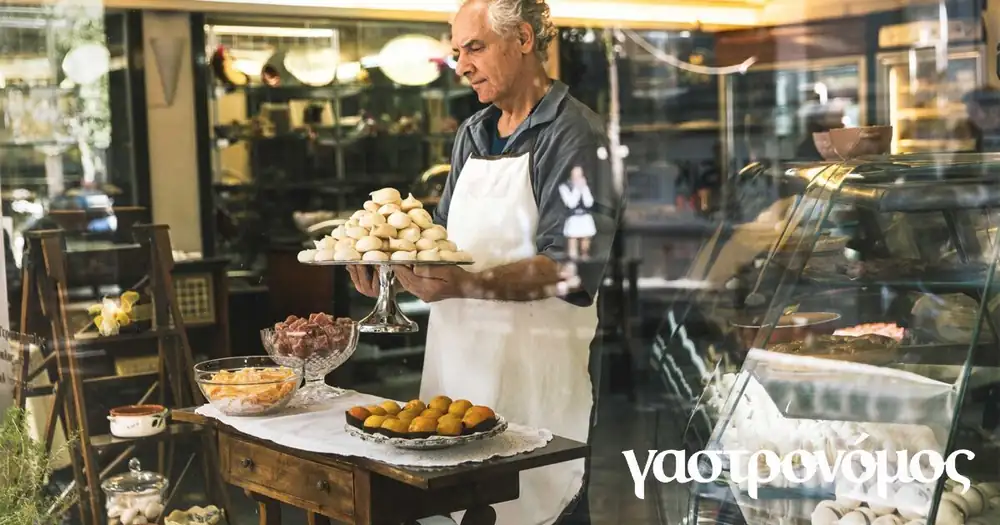
Metropolitan: at the historic pastry shop for “mandarinakia” and baklava
The bronze sign with calligraphic letters, the display case with white curtains, the covered platters with treats: fluffy meringues, quince paste sprinkled with sugar and those, trademark, shiny and fragrant "tangerines" made of whole candied Clementines, with crispy skin and an explosion of syrup at the first bite.
“My grandfather left Sifnos when he was young. In poor years back then, he came to Athens, worked in some pastry shops and, after learning the art, he then managed to open his own shop in 1930, here where we are today,” says George Gerontopoulos while digging out an old newspaper clipping from the family album, which talks about the “new aristocratic center”, “impeccably clean”, that was being inaugurated in the city at the time. Mr. Gerontopoulos, although he studied economics, could not help but follow his duty as the successor of the historic, family pastry shop. From a young age, he remembers important personalities stopping by the Metropolitan: “Tsatsos and Konstantinos Karamanlis loved their fathers. We make them not with rum and raisins, but with cognac, almonds and apricot jam. I often remember the girls who worked at their homes and bringing the silver platters so that we could put the sweets directly on them. And today we have many old Athenians as customers, but also young people, who come and look for the treats they ate as children at their parents' and grandparents' houses. Taste is memory," he continues.
Meringues, plain or filled with chocolate or cream, Skopelos plums with dark chocolate ganache, covered in chocolate and cocoa, snowmen, gateaux, Napoleons, butter candies still hand-wrapped in white paper – these are just some of the sweets that fill the display cases. For their famous “mandarinaki” at the Metropolitan, they follow a time-consuming process, during which whole Clementines with their peel are left for a day in water that is changed every six hours, so that they become bitter. Then, the fruits go through four different syrups, to end up becoming these balls that resemble shiny Christmas ornaments. The "Germans", despite being one of their most complicated sweets, as they have many stages of production, they do not stop making them because they have fanatics who visit the store especially for them. The recipe, from Germany as its name suggests, includes a very thin layer of waffle, milk chocolate ganache, a thin sheet of almond paste, apricot jam and almond. In the end, the sweet with its many textures and nostalgic taste is dipped again in milk chocolate. As for the unusual "tomatoes", it is a combination of almond pie, soft meringue and apple jam, which gives them their characteristic red color.
When Christmas approaches, they also prepare their own pudding, different from the English one with its many spices and heavy feel. To prepare it, cubes of tsoureki that have been rubbed with butter and cinnamon are placed together with “drunken” raisins, orange zest, milk and cream in a bain-marie. After the pudding is cooked, it is slowly and gently poured with orange crème anglaise. “I remember Christmas, when I was a child, going to houses to deliver the puddings, the melomakaronas and the daddies. In those years, a lot of people came up from the island, relatives who came to help us with the production and the orders that never stopped,” recalls Mr. Gerontopoulos.
Beyond the retro treats, many local, mainly island, Greek sweets make the Mitropoliton stand out. Here we get Sifnian "mantilakia" (something like a walnut pie covered half with phyllo), sekeria (a variation of Asia Minor seker pare, a Sifnian recipe with olive oil and honey), amygdalota Hydraiika or mandarinata (the almond paste here is worked together with a sweet made from tangerine peel). Grandpa Gerontopoulos' insistence on Greek local sweets was even a point of friction with Tselemente, uncle of the confectioner's daughter-in-law and a customer of the shop, who, as is well known, had a preference for French ways...
Baklavo, the bridal baklava of Mytilene with white almonds and thick honey syrup, is one of the most beautiful sweets at Mitropoliton. “Tradition says that when a woman is about to get married, she prepares a pan of this baklava and gives it to her future mother-in-law. And her mother-in-law returns the “heart” of the baklava – the central piece – in a small piece, to accompany her wishes,” explains Giorgos Gerontopoulos. In the shop’s workshop, they prepare the special local dessert using Volos almonds, good butter from Mytilene and honey from the family’s cousins in Sifnos. Cut into bite-sized pieces, wrapped in silver paper, baklava fits conveniently in your pocket and leaves a rich, milky and elegant sensation in your mouth that you remember for a long time.