Orange wines: the Venus of furs
To explain the strong resurgence of orange wine, we should go back to 2008, when the conflict between Russia and Georgia sparked the South Ossetia War. Russia, which bought almost all Georgian wine, decided to block trade between the two countries, not allowing a single liter more to reach the pro-Russian republics.
Many Georgian producers went bankrupt, some reinvented themselves, and the most visionary set off to travel the world with their bottles of orange wine under their arms, all the while claiming their origin. In the following years, Georgia showcased its wines at every international fair it could. Riding the wave, Croatia, Slovenia, and the Friuli region of Italy, which also had a tradition in the style, joined in. The exposure was so great that orange wines made headlines. The trend reached Latin American supermarket shelves almost a decade later.
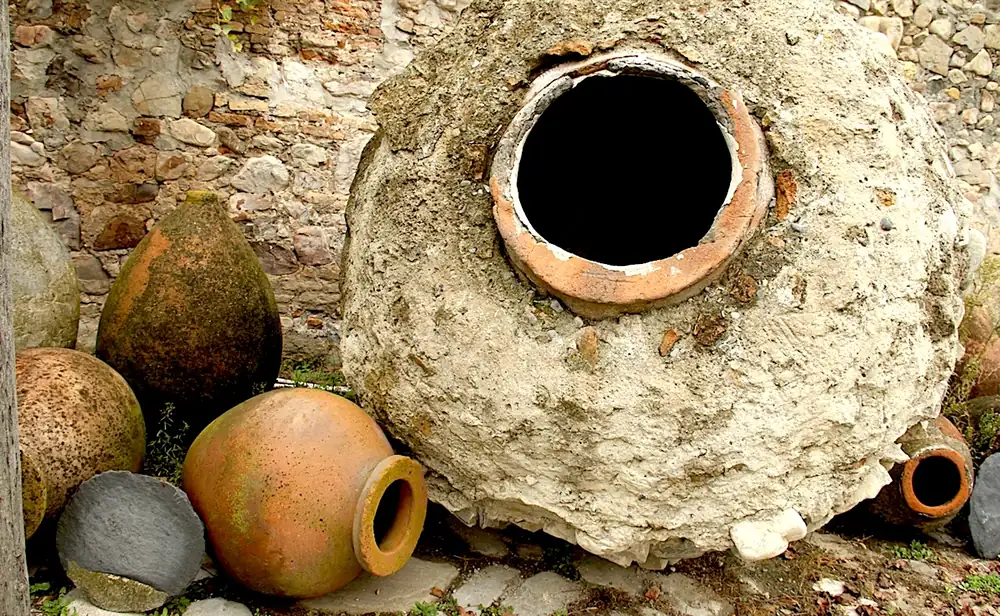
With their distinctive amber color and a rich history stretching back 8,000 years, orange wines are a fascinating expression that blends ancestral techniques with modern trends. Their global resurgence continues the tradition of winemaking with white grapes in prolonged contact with their skins. Back then, the grapes were fermented and buried underground in large clay vessels called qvevri; today, they are made in amphorae, barrels, foudres, and even plastic bins, resulting in different styles and profiles depending on the producer and the grape variety.
Wines with a history telling new stories
Mariam Tabagari, a Georgian winemaker, came to Argentina to promote her country's wine culture through the embassy. "I wanted to come and share knowledge and techniques, and raise awareness about Georgian wines," she explains. "I'm working on a digital magazine about Georgian wines because the problem in our industry is a significant lack of information. I think it's time for orange wine producers to assert their brand. And an interesting fact is that we don't call it orange wine, but amber."
Orange wine remains an enigma in the country, rising from the ashes of a trade war and under global scrutiny. Our beautiful bubble of domestic wines doesn't make it easy to fully understand this phenomenon. The INV (National Institute of Viticulture) decides to market them as white wines; it's understandable that we can't yet focus on the subtleties if even the category is merely a marketing ploy.
Styles vary, with some wines being more tannic, others with higher or lower acidity, different grape varieties, and some more aromatic or more rustic. We also find skin contact, a very similar technique that reduces the contact time with the skins. In Argentina, orange wines have found fertile ground for development and experimentation, evolving from a curiosity to technically well-crafted wines. Producers have explored a wide range of varieties and styles.
If we had to choose the top spot, perhaps we should declare Matías Michelini's Torrontés Brutal as the prime example, even though Matías himself didn't call it that. Other outstanding orange wines included German Masera's Livvera Malvasía, Domaine Alma Negra Orange and Finca Beth's Chardonnay 2km, and the classic Luigi Bosca's Apuntes Naranjo, each contributing its own interpretation and character to the category.
When discussing the expansion of orange wine, one cannot overlook innovative projects such as Bodega Pielihueso, La Imaginación al Poder, and Finca Las Payas, all of which boast several wines in their portfolios and are deeply committed to technical expertise. In the north, El Porvenir produced its first Salta orange wine, which has been a resounding success with consumers.
They're no longer a fad; their aging potential and gastronomic profile continue to gain popularity, establishing them as an exotic and exciting option. There's something captivating about their novel palate and complex aroma. With a texture capable of pairing with meats and challenging conventional wisdom, their blend of Torrontés and Moscatel grapes gives them a distinctly Argentinian character. Often compared to a sour beer due to their complex flavor and acidity, the mouthfeel, bitterness, and oxidative character are perhaps the guiding thread we seek, as technique tends to take center stage, making it difficult to consider terroir as the protagonist.
These are three labels that I find interesting and very different from each other. Here are my suggestions from Argentina that I think you should try if this style appeals to you.
Wines: Imagination to Power
It's a wine with its own unique identity. Its image evokes Kubrick's A Clockwork Orange. It speaks with subtlety and complexity on the palate, possessing the knowledge of orange trees, the savoir-faire. "To describe Naranjo Mecánico sensorially is to seek the rusticity in its texture and the finesse and freshness in its natural acidity, which makes it juicy, but with the tactile sensation of suspended particles. That alone, in my opinion, invites a unique tasting experience," says Mauro Villarejo, co-creator of the wine along with Marcelo Richard.
“On the nose, beyond the fruity, tropical, or floral notes that each variety (Chardonnay and Torrontés) can contribute, what I most like to highlight is that slight hint of rancidity, of nuttiness, that spiciness that completes its complexity. And as its backbone and key differentiator, I think the most important thing is that it leaves a saline aftertaste and a tingle in the mouth, because if it doesn't have a tingle, unfortunately, it can't be called an orange wine.”
“The idea of making orange wines came to me through my friendship with the Republic of Georgia. Thanks to my connection with the embassy, I had the opportunity to taste many oranges from that country. At the same time, it was a challenge to do it with my grapes from Agrelo, grown in clay soil, and I wanted to shake things up. What should really be called skin contact wine was being mislabeled as orange wine. And that led me to look for a different texture, a different turbidity, a different aromatic and flavor profile, which I believe is what a true wine made with this technique expresses.”
Susana Balbo Wines
Perhaps the most delicate orange tree on the market. Susana Balbo once again stands out with her flagship grape variety and renews her commitment to clean and bright wines.
“We felt it was much more innovative and authentic to do it with our native varietal; that speaks to Argentine identity mixed with a trend. When you innovate, sometimes you can end up being a bit of an early adopter,” says Ana Lovaglio, daughter of Susana Balbo, who is in charge of the wine along with her brother José Lovaglio.
“Since there were already other wineries, I think the innovation was to stay true to our DNA. The other wineries on the market were very funky or extreme in their styles, and our winery has an essence of polished, clean, elegant wines. So, we made our own interpretation of the category. We launched something very artisanal, in a high price range, precisely because it is difficult to make and involves a process in special terracotta amphorae. No more than 3,000 bottles are made per year,” he explains.
“The launch was controversial because some critics told us 'finally a good orange wine' and others said it simply didn't fit the category. That doesn't bother or upset us, because it's our interpretation, period. We enjoy it. It's called Naranjo Torrontés de Raíz (Root Torrontés Orange Wine), because it's like going back to our roots with ancestral techniques, but with all the expertise of my mother's 40 years of experience to do it in a way that doesn't ruin the fruit, and where the final result has just the right level of oxidation.”
Bodega Retail
From vines over 50 years old, this Torrontés from La Rioja is a wine with extended maceration and perhaps the midpoint between the three wines presented. The grapes come from El Peral, Tupungato, an area with calcareous soils that has yielded such excellent results in white wines.
“This wine was born with the intention of achieving a Torrontés with the expressive character that wines from calcareous and stony soils leave on the palate. It has a prolonged maceration of eight months and the perfect intensity to accompany complex dishes, yet enough freshness not to mask delicate flavors. Its acidity is a clear expression of El Peral, in the Uco Valley. A wine to which we add no sulfites and which we bottle unfiltered,” says Leo Devia, the winemaker in charge of the organic and biodynamic winery.
“We ferment with native yeasts and without any additives; it's just grapes in egg-shaped cement vats. Making this wine this way reflects Chakana's commitment to creating innovative wines by avoiding the addition of oenological inputs, to showcase the purity of the terroir and the potential of Torrontés in calcareous soil. The result is a wine with abundant fruity, floral, and citrus aromas, followed by a good body and balanced natural acidity. It's a perfect wine to accompany any kind of charcuterie board, and as a main course, it also pairs very well with roasted vegetables, even some cuts of meat, and of course, with any seafood dish.”