Eat and sleep in the Tuscan countryside: the former monastery that transforms local ingredients into gastronomic experiences
In the Valdichiana countryside, in the province of Arezzo, the Monastery of Cortona reinterprets Tuscan tradition, starting with game and local ingredients.
In Tuscany, game is more than just an ingredient: it's a tale of the season, the woods, and the traditions that have defined the region's gastronomic identity for centuries. At the Monastero di Cortona, a former 15th-century monastery transformed into a boutique hotel (we've already written about it here), this legacy is reinterpreted with contemporary techniques and meticulous attention to the local area.
What to eat at the Gli Affreschi restaurant in Cortona's Monastery
To maintain a unified narrative, the Gli Affreschi restaurant—located within the building—works almost exclusively with what Cortona and the Valdichiana have to offer. Incidentally, Gli Affreschi (open for dinner only) isn't a random name: it's so named because, during the monastery's renovation, frescoes were discovered there that some experts say refer to the Battle of Montaperti in 1260. Dine amidst art, in the truest sense of the word. Seats are just 20, to ensure the perfect atmosphere and personalized service, and the work of chef Michele Ricci (Tuscan, of course), who takes local game—roe deer, venison, pigeon—and transforms it into dishes that simultaneously convey flavor, history, and territory, creating a direct dialogue between the cuisine and the Valdichiana.
The result is a cuisine that connects ingredients and landscape: the slow-cooked roe deer, accompanied by savory zabaglione, marinated turnips, and puffed farro, speaks of the woodlands; the 40-yolk buttons with pheasant, sea urchin, and licorice combine game and marine notes; the pigeon with roots, rhubarb, and concentrated stock, and the venison fillet with Jerusalem artichoke, baby spinach, and Sabatini gin sauce express the technique and intensity of local products. Guests can choose the "Tuscan Flavors" tasting menu (€95) or order à la carte. Given the international clientele, there's also a seafood menu (€105).
The focus isn't just on meat: local olive oil, garden vegetables, cheeses, and cured meats are intertwined with Cortona's culinary history, becoming a narrative of the region. Tuscany, with its pastures and woods, has always considered hunting and home-cooked meat a central element of family cooking. The chef takes this heritage and brings it into the present, teaming up with local producers and maintaining strong ties with local farmers and ranchers.
A cocktail dedicated to Cortona
This approach isn't limited to the Gli Affreschi restaurant, the gastronomic heart of the Monastery of Cortona: the same philosophy inspires L'Osteria del Santo (opening in summer 2025, both for lunch and dinner), which offers a more informal approach to both the food and the menu (pappa al pomodoro, gnudi, and sliced beef). The same applies to the Scriptorium Bar, the gem of the establishment, overlooking the beautiful outdoor garden. To pay homage to the region, bartender Claudio Stagi has created the cocktail "Il Giardino di Cortona," a reinterpretation of the Negroni using only local ingredients. Gin Sabatini, Vermouth Papacello, and Amaro Cortona are the liquid transposition of the Valdichiana: the landscape and botanicals (such as the local saffron) create a seamless connection with everything else found at the Monastery.
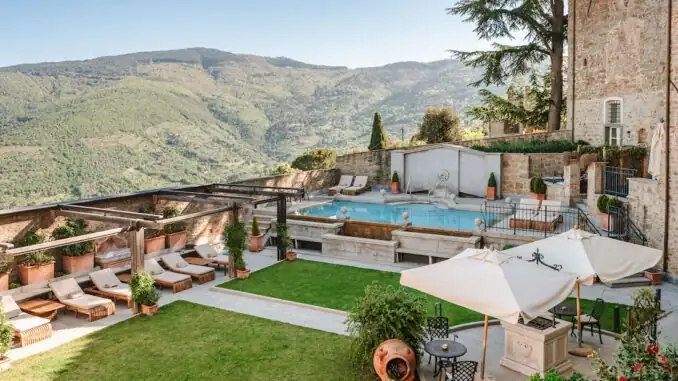
The Cortona Monastery: hotel, spa, two restaurants, and a terrace overlooking the Valdichiana.
The Monastery of Cortona thus becomes a hub of experiences rooted in the region: from haute cuisine to mixology, a wine list boasting over 300 labels, many of which are Tuscan, the Bagni di Bacco spa, housed in an ancient Roman cistern, and cultural activities dedicated to the history, art, and landscapes of the Valdichiana. The property boasts 36 rooms and suites, many of which are former monks' cells, blending historic charm with contemporary comfort. A panoramic terrace and gardens with a swimming pool complete the offerings.
Monastero di Cortona Hotel & SPA. Via del Salvatore snc, Cortona (Arezzo). Website.