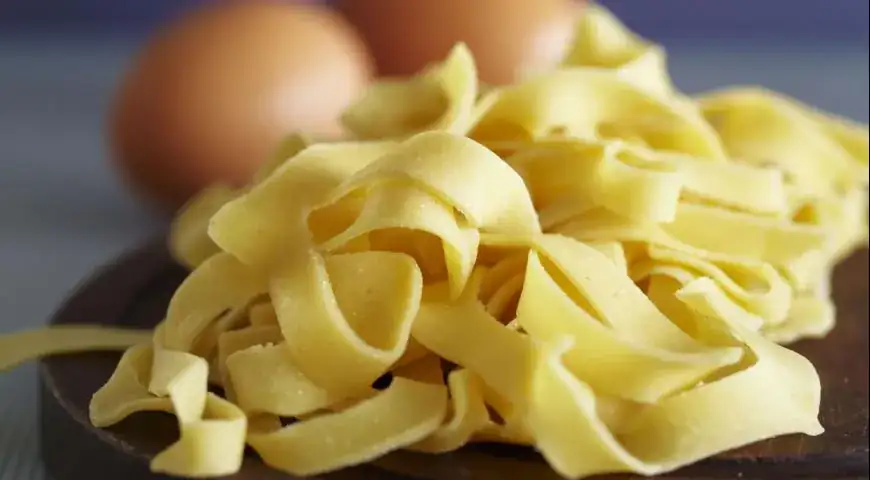
Basic Pasta Dough
This is a recipe used by many Italian cooks. Over time, as you gain experience in pasta-making, you can modify it—for example, make the pasta more eggy by substituting whole eggs with yolks at a ratio of 1 egg to 2 yolks. Just remember that rolling out this type of dough is significantly more difficult.
- Durum wheat flour
- Chicken egg
- Chicken egg (yolk)
- Salt
- Clean your work surface thoroughly; sift the flour and salt onto it to form a mound.
- Combine the eggs and yolks in a bowl. Make a well in the flour mixture—a fairly wide depression—and carefully pour the eggs into it.
- Lightly whisk the eggs to combine the whites and yolks (you can do this with your fingers or a fork), and begin to slowly knead the dough - add flour to the eggs, taking it from the "periphery" of your mound.
- Once the eggs and flour are combined, begin kneading the dough more vigorously, pressing it into the work surface and turning it over after each movement. This kneading process will take at least 8–10 minutes.
- Once the dough is smooth and homogeneous, lightly dust it with flour and cover with plastic wrap. Let the dough rest in a cool place for at least 30 minutes – attempting to roll it out right away will be much more difficult to achieve the desired result.
- If you're rolling out the dough with a rolling pin, dust your work surface with flour. Divide the dough into 4 pieces. Keep the pieces you're not working with covered with plastic wrap or a towel. Place a piece of dough in front of you, flatten it slightly with your hands, and begin rolling it away from you with the rolling pin, turning the resulting sheet constantly. Dust the rolling pin with flour as needed to prevent the dough from sticking. For a perfect result, after rolling out a thin sheet, shake off the flour from one side, fold the sheet in half, and roll it out again—you can repeat this process 5-7 times.
- You should end up with a sheet of dough about 1.5 mm thick. Cover it with plastic wrap or a towel and repeat with the remaining pieces of dough.
- Now start cutting. You can use a sharp, thin knife or a pasta wheel (plain or fancy). To make the strips even, dust the dough sheet with flour, roll it into a tube, and then cut. Unroll the resulting strips and leave them unrolled—your tagliatelle, farfalle, or pappardelle should dry slightly. If desired, you can dry the pasta, transfer it to a tightly sealed container, and use within 3-4 days.
Lasagna (Italian: lasagna) is a type of Italian pasta: wide, flat strips of dough up to 35 cm wide. The strips are layered with a variety of fillings and baked. Italians call the finished dish lasagne...
True pasta connoisseurs know: the most important thing about pasta is the sauce. And not store-bought pasta sauce, but one specially prepared. Italian cuisine boasts a wide variety of pasta sauces. Here's just...
Ravioli, tortellini, capellini, agnoletti, caramelli—the names of these Italian filled pastries ring like music, seeming to immediately suggest an exquisite, beautiful dish awaits. However, most lovers of stuffed pasta have never tried making it at home. And that's a shame: it's not particularly difficult, and the process is just as enjoyable as the result. We invite you to take our short course and treat your loved ones to fresh, homemade ravioli.
Homemade pasta pairs perfectly with thick sauces made with meat gravy, cream, butter, and cheese. Fresh dough instantly absorbs these ingredients, making it incredibly delicious.