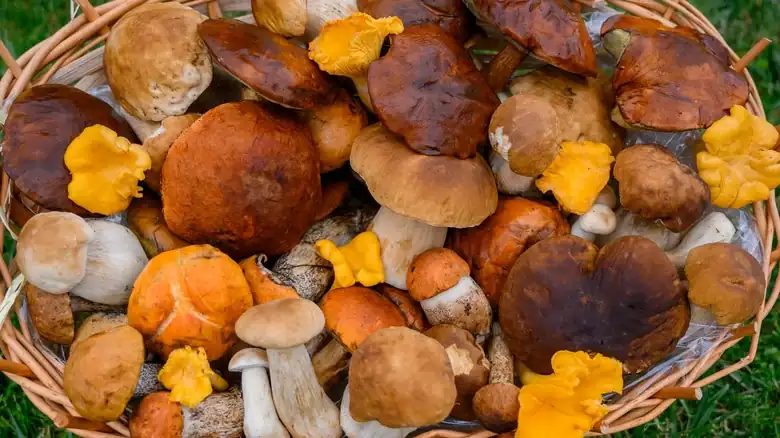
13 Different Types Of Mushrooms And How To Use Them
While supplements are available, incorporating maitake mushrooms into your culinary routine is a great way of getting a healthy dose of its possible medicinal qualities. It does have a very strong flavor so use it sparingly. And always make sure to cook it thoroughly so as to avoid any potential digestive discomfort.
“get their nickname thanks to their unique shape resembling the tail feathers of a hen. The word”
To utilize dehydrated mushrooms, they should be rehydrated in boiling water until plump, which will take approximately 30 minutes. Resuscitated dehydrated mushrooms are often more intense in flavor and work particularly well in applications requiring long cooking times, like soups and stews. And don't discard the liquid in which they have been rehydrated. Strain it through a fine mesh sieve and add it to a soup or a mushroom risotto for a deeply concentrated umami flavor.
Dried mushrooms can also be pulverized in a food processor or coffee grinder into a powder. This powder can be added directly to recipes for a rich punch of flavor or can be used as a dry rub for meat. It's also a great way to amp up the flavor of roasted vegetables. In fact, historically speaking, powdered mushrooms have been added to hot water to create a kind of tincture or tea when utilized for medicinal purposes for centuries.
Button mushrooms
The button mushroom is the most commonly available specimen of mushroom. A full 90% of mushrooms consumed in the U.S. are buttons, or champignon mushrooms, per Healthline. They are naturally low in calories, high in vitamin D2, high in protein, high in antioxidants, and may promote heart health. You can consume them raw or cooked, but ultimately the critical aspect of making these fungi delectable rests in how you approach them. First, you should never soak them in water to clean them, but rather brush them clean with a damp paper towel to remove any loose dirt. There's a lot of debate about this, suggesting that because mushrooms are already 80% water, they don't actually absorb much liquid in the washing process (via Cook's Illustrated ). However, they can develop a chewier, slimier texture after being washed, which is the chief complaint we hear from those who disli
Cremini mushrooms
Cremini mushrooms, or baby bellas, are actually the teenage version of a portobello mushroom, per WebMD. They tend to be bolder in flavor and slightly meatier in texture than the button, but not quite as replete with umami-forward flavors as the mature portobello. As with button mushrooms, creminis are nutrient-dense. It is also suggested that there is a link between the consumption of creminis and the proliferation of good bacteria in your gut, which can be instrumental in both immune support and better digestion. In terms of how to handle creminis, they should be cleaned and peeled in the same way that button mushrooms are for the best quality flavor and texture. From there, they are ideal in almost any application, although we are particularly fond of using them in a sausage-stuffed mushroom recipe. The richness of their flavor is somewhat more suit
Portobello mushrooms
The most mature version of the Agaricus bisporus species of mushroom — which includes the button and the cremini — portobellos are one of only 10 varieties of mushroom cultivated commercially (via WebMD ). Their distinct size and texture make them a popular mushroom to use in substituting meat for vegetarian and vegan recipes, although we maintain they are delicious in a variety of applications. While you should handle the cleaning and peeling of portobellos the same way you do button and cremini mushrooms, you should take one additional step prior to using them. Because they have dense gills, scoop those gills out using a teaspoon. The gills can contribute to a chewier texture when cooked and can retain a somewhat unpleasant gritty feel. As for the best ways to use portobellos, they can certainly be stuffed for a more hearty entree-sized portion, but we love t
Shiitake mushrooms
Often considered to be ubiquitous with Asian culinary tradition, the shiitake mushroom — or Lentinula edodes — is the third-most consumed fungus globally (via WebMD ). It is native to areas throughout East Asia, but was first cultivated in China about 1,200 years ago. Its name comes from its legacy as a part of Japanese samurai culture. "Shii" is the type of hardwood tree they most often grow on, and "take" is the Japanese term for mushroom. Shiitake mushrooms today are obtained both in the wild and commercially cultivated utilizing wood-like vessels. The majority of cultivated shiitake mushrooms come from China. Shiitake mushrooms are uniquely high in the mineral copper, which has been linked with good circulatory health, bone health, and increased immunity. It also has unusually high proportions of metabolism-boosting selenium. Rare cases of skin allergies have
Porcini mushrooms
According to Mushroom Appreciation, while the porcini mushroom is most commonly associated with Italy, it can be found throughout Europe, North America, New Zealand, and South Africa. These mushrooms are called mycorrhizal, meaning that they create a symbiotic relationship with the roots of plants generally found in hardwood forests composed of pine, chestnut, hemlock, and spruce trees. You can typically source them from late summer to fall, although they are often sold year-round in a dehydrated format. When purchasing fresh, you may find them labeled under one of their many monikers, including the king bolete, cèpe, or Steinpilz. Their name, "porcini," translates to "piglets" in Italian, presumably because of the appearance of their dense, sturdy stems. A peculiarity of their makeup is that they are highly susceptible to being infested with tiny worms. To ri
Enoki mushrooms
Also known as enokitake, winter mushrooms, velvet shank, or golden needle mushrooms, the enoki mushroom is another mushroom that is often associated with Asian cuisine (via WebMD ). Enokis can be found in the wild growing on the surface of dead elm trees or can be cultivated using a pseudo tree branch composed of sawdust, corn cob, rice bran, and other materials. The wild varietal is often golden in color thanks to the kiss of sunlight giving it a tan, while the commercially grown varietal is white thanks to it being grown indoors in an environment void of sunlight. This particular mushroom is uniquely susceptible to becoming contaminated with the bacteria Listeria monocytogenes, which can cause serious food-borne illness. It is therefore recommended that these mushrooms be meticulously washed, their stems removed, and then thoroughly cooked before consumi
Blue oyster mushrooms
The blue oyster mushroom is a subspecies of the pearl oyster mushroom and is one of the easiest mushrooms to cultivate at home (via Why Farm It ). While it originated in Western Europe, it is now found in virtually every corner of the globe. Its ideal growing conditions include temperatures ranging from 55-65 degrees, and humidity hovering between 50-70%. In the wild, oyster mushrooms are found on decomposing trees, but when cultivated, they generally come in pre-colonized straw or sawdust logs. You can get these mushrooms from your local farmers' market, and their distinctive bluish-gray caps have an almost glittery sheen to them. To use them, cut the caps off the dense, chewy stem and discard the stems. You can then remove any remaining dirt with a damp cloth or paper towel, although they tend to be extremely clean. They have a distinct flavor that has often been
Truffles
Considered one of the most valuable commodities in the world, the truffle can only grow as part of a symbiotic relationship with the roots of certain trees — a condition called mycorrhiza, per Britannica. While there are less than 10 types of truffle that are considered safe for human consumption, the most commonly utilized are the black Périgord truffle and the white truffle (via Gourmet Food Store ). The biggest difference between black and white truffles is that black truffles can be cultivated, making them less expensive and more widely available, according to Robb Report. White truffles, however, are incredibly difficult to cultivate, as they can only grow in very particular conditions. As such, these mushrooms are rare, and their prices are exorbitant. White truffles were selling for approximately $4,500 a pound in 2021 (via Robb Report ). If you do cough up t
Wood ear mushrooms
As their name implies, these ear-shaped mushrooms grow in the wild on a myriad of wood and plant species (via Livestrong ). They have a litany of different monikers, including black jelly, cloud ear, Judas's ear, jelly ear, and kikurage mushrooms. While they were first cultivated in China in A.D. 600, they are readily found throughout Asia and beyond. They are most often seen in their dehydrated form, particularly outside of Asia. Wood ear mushrooms are uniquely high in B vitamins and are often higher in minerals than other mushrooms, although their precise nutrient content is somewhat variable depending upon whether they are found in the wild or cultivated. The distinct gelatinous texture of the wood ear mushroom makes it less versatile than other varieties of mushrooms. While they still contain that same umami flavor profile, they aren't particularly appetizing
Chanterelle mushrooms
At the risk of sounding partial to the chanterelle mushroom, we find their spicy yet nutty flavor, velvety texture, amber color, fruity aroma, and trumpet-like shape to be especially appetizing. Perhaps part of their appeal is that they are extremely difficult to find fresh which makes chanterelles rather expensive. They are a wild mushroom that is typically found growing under shady patches below hardwood trees between late spring and early fall, per Wild Edible. They tend to favor moisture and often grow in colonies. Like other wild mushrooms, they may retain a bit of dirt and therefore need to be cleaned carefully. It is suggested that they be brushed gently with a toothbrush. Once harvested, they should be used immediately or dehydrated for storage. They aren't typically eaten raw, as they tend to benefit from a quick sauté before being added to any di
Morel mushrooms
Few mushrooms have quite the cult-like following that the morel mushroom does. Every spring, amateur mushroom hunters embark upon their mushroom harvesting trek. They are notorious for being misidentified, so if you are interested in doing a mushroom hunt, it's best to do so with someone who can verify that you've found the real deal. Morels have a unique honeycomb-like structure, and can range in size from under an inch to over three inches in length. Morels are also notoriously fickle in terms of storage. They won't last more than two to three days in the refrigerator after harvesting and should not be kept in an airtight container or they can get moldy. When you are ready to eat them, morels should be soaked in salty water to remove any residual dirt, silt, and pesticides. Dry them thoroughly prior to cooking them. Morels should never be consumed raw as the
Maitake mushrooms
According to the Mushroom Council, maitake mushrooms, or "Hen of the Woods," get their nickname thanks to their unique shape resembling the tail feathers of a hen. The word "maitake" itself translates to "dancing mushroom" in Japanese (via Healthline ). While these mushrooms can be cultivated, they seldom are. They are more likely to be found in the wild at the base of oak, elm, and maple trees during the fall. While they originated in Japan and China, they are now found all over the world. This mushroom is distinct in that while it is edible, it is also one of the mushrooms routinely harvested for its purported medicinal qualities. An extract from the maitake known as D-Fraction has been shown to effectively shrink tumors and treat cancer in several research studies. Other potential medicinal qualities include lowering cholesterol, increasing immune function, and re
Dehydrated mushrooms
For many of us, finding fresh mushrooms in the grocery store or at a local farmers' market is a challenge. Particularly in rural communities or areas that are considered to be food deserts, you are unlikely to come across anything beyond a button mushroom unless it is dehydrated. This isn't necessarily a bad thing. Mushrooms have a notoriously short shelf life, making drying them an ideal way to store them long-term. If kept in an airtight container, in a cool, dry place away from sunlight, dehydrated mushrooms can last almost indefinitely, per Cascadia Mushrooms. To utilize dehydrated mushrooms, they should be rehydrated in boiling water until plump, which will take approximately 30 minutes. Resuscitated dehydrated mushrooms are often more intense in flavor and work particularly well in applications requiring long cooking times, like soups and stews. And don'