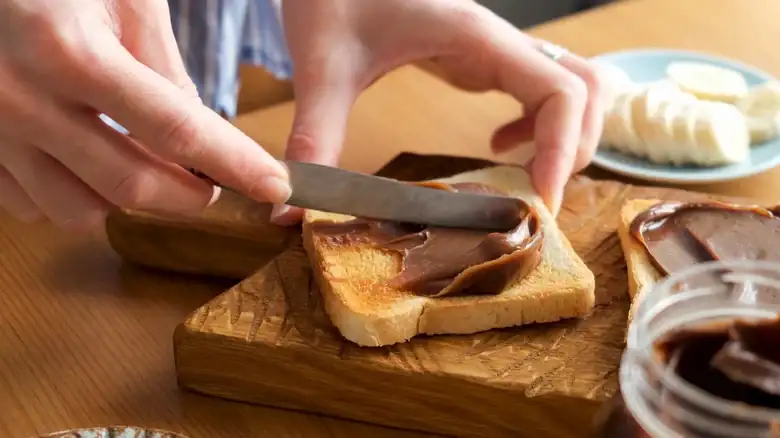
We Can Thank Napoleon For Chocolate Hazelnut Spread
Not a lot of people would consider Napoleon Bonaparte a good guy. He was a military leader who waged war across the European continent and caused the deaths of thousands of his own troops during his failed Russian invasion alone. With all that being said though, the culinary world may actually owe him a great debt.
Napoleon is often credited with the saying that "an army marches on its stomach" (per Oxford Reference). Knowing that it would be important to keep his men well-fed as they waged his wars, the legend goes that Napoleon asked for long loaves of bread to be baked that would be easier for his men to carry in their pockets. Allegedly, this was the creation of the first French baguettes.
Chicory coffee (a.k.a. the secret ingredient in New Orleans' Cafe Noir) was also created because of Napoleon's influence. When his blockades led to a coffee shortage in France, civilians chose to grind the roasted root of the chicory plant to supplement their morning joe.
Napoleon's role in creating chocolate hazelnut spread
Oddly enough, the history of chocolate hazelnut spread starts with Napoleon. The Italian name for the chocolate hazelnut spread most commonly identified by the brand name Nutella is gianduia. There are a few competing stories for how gianduia was first invented, but Napoleon did have an undeniable influence.
The first theory is that gianduia was invented in 1806 due to Napoleon's Continental System. This system called for all communications and trade with the United Kingdom to be cut off. At the time, it was the largest importer of the cacao beans needed to make chocolate. So, creative chocolatiers in Turin made the most of their environment by grinding some of the locally abundant hazelnuts in with the cacao to supplement their short supply.
The other theory is that around 1860 the Italian government was short on cash, and so started heavily taxing certain imports. This included the importation of cocoa beans, so confectioners turned to hazelnuts for help. Napoleon still plays a role in this story as well. The reason the Italian government needed those extra taxes was the financial toll brought on by the Napoleonic Wars.
From Napoleon to Nutella
Today, gianduia remains a point of pride for the Piedmont region of Italy where it was created. The chocolate spread itself was even named for a character in the Italian Commedia Dell'Arte who hails from the same region.
After the original gianduia was invented, chocolatiers in Piedmont continued to expand on the recipe. Isidore Caffarel is credited as the inventor of the gianduiotti candies that remain popular in Italy today. Gianduia itself has also remained a hit and is frequently used as a filling for chocolate truffles and other confections.
Of course, gianduia's most famous offspring is Nutella. One thing that you might not know about Nutella, is that it was also born from rationing. Pietro Ferrero was struggling to get by in post-World War II Italy due to chocolate rations. So, he again turned to local ingredients and made gianduia using almonds and hazelnuts as supplementary ingredients. It created a thick block of chocolate that could be cut into slices to enjoy with a slice of bread. Years later, Ferrero's son Michele would refine the recipe into a "Supercrema" that could be spread instead of cut, and the modern Nutella was born.