Should you really avoid butter? A nutritionist answers
For years, butter was considered a food to be avoided because it was associated with increased cholesterol and a high saturated fat content. But today, scientific evidence has led to a rethinking of these beliefs and a more balanced approach to its consumption.
Is butter bad for your health? True or false?
"Butter is a rather controversial food," explains nutritionist Simona Santini. "Always demonized, butter is actually a food that has some positive aspects, if consumed sparingly as part of a varied and balanced diet. For example, it provides vitamin A," she continues. "The guidelines issued by the Ministry of Health include butter in the chapter dedicated to fats. Therefore, the guidelines don't claim to abolish it, but rather place limits on its intake, reminding people to use it sparingly, in rotation with other sources of fat, primarily olive oil. The problem with butter is its saturated fat content, which should represent less than 10% of daily energy intake. Excess saturated fat is, in fact, associated with an increased risk of cardiovascular disease."
How much butter is safe to eat per week?
"As part of a varied and balanced diet, it's recommended not to exceed 5-10 grams of butter per day," advises the expert. "People who should avoid butter, however, include those with high cholesterol, as its consumption is associated with an increase in total cholesterol and LDL, unlike what happens with olive oil, for example, which would therefore be preferable."
Does butter make you fat? Calories, saturated fat, and facts you need to know.
Consumed in excess, butter is fattening, but no more so than olive oil. In fact, 100 grams provide about 750 kcal. But if we look only at calories, extra virgin olive oil provides more, about 900 per 100 grams. The difference between the two, therefore, isn't so much the calories, but rather the composition. Butter contains about 50% saturated fat, which is unhealthy, and 26% unsaturated fat, while olive oil contains only 16% saturated fat and a whopping 83% unsaturated fat.
Does butter raise cholesterol? True or false?
True, excessive and frequent consumption of butter increases cholesterol levels. First of all, because it is a source of cholesterol. One hundred grams of butter contains 250 mg of cholesterol, an intake very close to the maximum daily limit of 300 mg recommended by the guidelines. Secondly, butter contains high amounts of saturated fats, which reduce the liver's ability to eliminate bad cholesterol (LDL).
Is there a healthier butter?
Not all seasoning fats are created equal, and the choice also depends on how and to what extent they're used in cooking. But is there really a healthier butter than traditional butter? "An interesting alternative to traditional butter is clarified butter, also known as ghee," says nutritionist Simona Santini. "During the clarification process, water and milk proteins are removed, leaving a component composed almost exclusively of fat. This gives it a higher smoke point, around 250°C, making it more stable during high-temperature cooking than traditional butter. Ghee, however, is not a lower-calorie food. It contains a high amount of fat and should therefore be consumed in moderation, like regular butter. Its main advantage is its greater heat resistance and the possibility of using it in certain preparations that require higher temperatures."
«Margarine is often considered a healthier choice than butter, but it is not because it contains trans fats, which are also potentially harmful to health. In particular, they not only raise bad cholesterol, but also lower good cholesterol (HDL) and damage blood vessels».
How can you consume butter in a balanced diet without overdoing it?
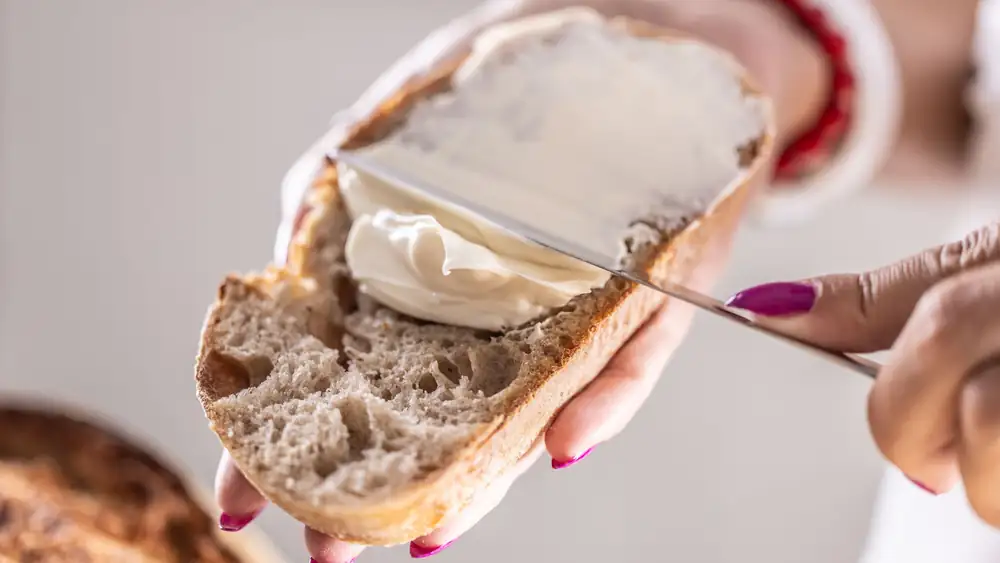
When it comes to butter consumption, moderation is key. As part of a varied and balanced diet, it's recommended not to exceed 5-10 g of butter per day. To avoid excess, butter can be used raw in small doses, such as spread on a slice of toast, or as an ingredient to flavor vegetables or desserts.