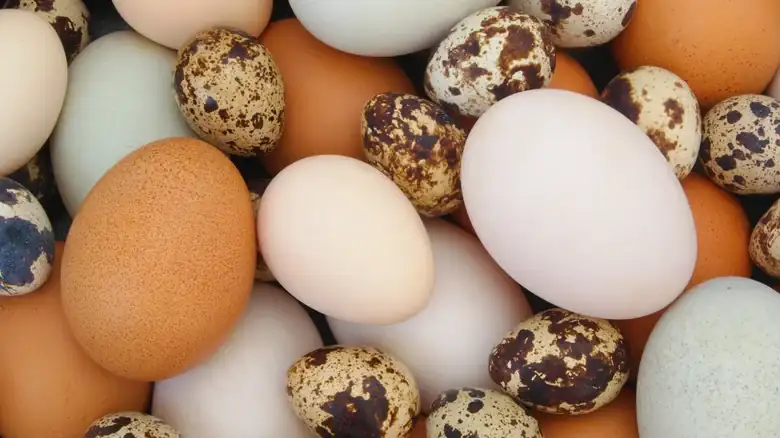
13 Eggs You Can Eat (That Don't Come From Chickens)
A common alternative to sturgeon caviar is the less expensive salmon roe. This bright orange roe is found on sushi. Like most roe, it is full of protein and vitamins A, B12, and D, (via Healthline ). Salmon roe has a rather salty and fishy taste as opposed to the buttery taste of some sturgeon caviar.
“Every now and then they do chase us out. Most of the time we can control the situation, but if they get feisty it's not worth our life, so we bail, regroup, and try again.”
Due to what they consume a wild pheasant egg might taste gamier. But a farm-fed pheasant would taste much like a chicken's egg — especially if they are being raised with the same diet. Pheasant eggs can easily be cooked up and substituted for other eggs. Still, it's good to know they are smaller than chicken eggs. Also, their contents are mostly yolk, so the quantity would need to be adjusted for some recipes — and not advisable for recipes requiring more egg whites.
A wild guinea fowl's diet of insects gives its eggs a rich yolk. Usually, they're tastier than a caged guinea fowl's eggs. These rare eggs can be cooked like most eggs: You can eat them poached or in an egg salad. Another way to enjoy guinea fowl eggs is by hard-boiling them and coating them in a batter of flour, sugar, and nutmeg for a little sweetness. To make a delicious twist on fried eggs , the guinea eggs are then deep-fried to a delectable golden brown.
Goose eggs
Quite a bit larger than chicken eggs, goose eggs are an eggcellent (sorry, couldn't resist) substitute for almost any egg recipe. Yes, they can be cooked the same way as chicken eggs. But it's worth noting that one medium goose egg is roughly the size of two larger chicken eggs. Due to their size, and because they contain more eggy goodness, they are richer in flavor and can upset the balance of a delicate baking recipe. Additionally, they are also more expensive due to the infrequency of egg production. Geese only lay about 40 eggs in the spring. Their larger size means they have a larger yolk, which adds more moisture to baked recipes than a chicken's average-sized yolk. Since they are double the size of chicken eggs, make sure to adjust the amounts in baking recipes. Adding too many eggs to a cake batter creates a custardy texture. However, their dense batter mak
Octopus eggs
Instagram No, they don't look appealing, but octopus eggs are a Japanese delicacy. They don't look like typical fish eggs. Rather, they resemble grains of rice in a gooey sac. The eggs cling together in long strands that are nearly translucent. Their otherworldly appearance earned them the nickname "alien eggs." While they have a nutty flavor when cooked, they're often eaten raw and on sushi. Raw octopus eggs are either strained and dipped in a sauce or made into nigiri. They can also be gently steamed or poached, seasoned with a little soy sauce and wasabi, and served in the flavorful broth in which they were cooked. Another way to cook them is to simply coat them in batter and deep-fry them. However, octopus eggs are not to be confused with the Japanese snack, tako tamago (translated literally as "octopus egg"), which is a candied octopus with a quail egg stuffed inside of it..
Turkey eggs
In most grocery stores, turkey meat is on multiple shelves in various forms — whole, deli-sliced, frozen, or ground. But turkey eggs are rarely found. While they are common poultry, their eggs are rare and expensive. This is because they require feeding turkeys more food and they lay eggs less frequently and later in the year than chickens. Due to these limitations, the eggs run higher in terms of cost and are rarer to find — as this production process doesn't make it too profitable for farmers. If chickens are meeting the consumer's demand for eggs, why struggle with getting a turkey to do the same for more work? You might find some in stores that sell more specialty goods. About twice as large as chicken eggs, turkey eggs can be cooked similarly. Despite their size difference, turkey eggs are similar to chicken eggs when it comes to taste. Since they are fa
Quail eggs
Tiny and packed with a unique flavor, quail eggs are more common in desserts. Their creaminess is perfect for pudding. But since its egg whites are often contaminated with yolk when separated, they're not a good choice for meringue, which relies on egg whites for its structure. Quail eggs can be eaten raw –- just crack it and swallow it like a shot of yolk — and are also ideal for making century eggs at home. Not only do they look like miniature chicken eggs, but they are also nutrient-rich and taste similar. Healthline states that one quail egg contains your daily dose of vitamin B12, selenium, riboflavin, choline, and iron. When substituting quail eggs for chicken eggs in recipes, use about three or four. While a simple brownie recipe would call for about three eggs, you would want to substitute about 10 quail eggs. Or try kwek-kwek, a popular Filipino str
Emu eggs
Massive and a beautifully speckled blue-green color, emu eggs can be cooked like any other egg. But one is equivalent to about eight to 10 chicken eggs. While it'll take longer, they can be scrambled, fried, or made into pancakes. One TikTok user says scrambled emu eggs are challenging to make, usually ending up mushier than chicken eggs with a gelatinous texture. If you can crack through that tough shell, their huge yolk makes them perfect for an omelet that the whole family can share. However, the cooking time is significantly greater because just one egg is so astonishingly large. It takes well over an hour to hard-boil an emu egg, so don't expect a five-minute omelet out of this big bird! These giant eggs are popular in Australia, and becoming more popular in America because of their rich taste, unique appearance, and nutritional benefits. When comparing an emu
Crocodile eggs
While they are edible, good luck harvesting a crocodile egg! Overall, it's a dangerous feat because mama crocodiles are very protective of them, staying close to their nest after laying them. As of 2018, Australia deemed it legal to harvest crocodile eggs. As one crocodile farmer stated to the Australian Broadcasting Company, "Every now and then they do chase us out. Most of the time we can control the situation, but if they get feisty it's not worth our life, so we bail, regroup, and try again." With such risk and high reward, it's not surprising that some Asian countries compete to collect these eggs. In Australia in 2023, crocodile eggs sold for around $55 to $65 per egg! Many say crocodile meat tastes just like chicken, and their eggs also aren't too far off from each other. Crocodile eggs are close to chicken eggs in size and appearance and can be cook
Ostrich eggs
Even bigger than emu eggs, ostrich eggs are equivalent to about two dozen chicken eggs. Plan to feed the family for a while after cracking one of these! The largest of any bird eggs, ostrich eggs are packed full of nutrients and a whopping 2,000 calories per egg (via Livestrong ). They are rich in protein and omega-3 fatty acids, which promote heart health and good eyesight. With their hard-to-crack shell, massive yolk, and abundant whites, ostrich eggs can be tricky to cook. One way to tackle this egg is by scrambling them Gordon Ramsay-style. In this video, he uses a saw to cut through the tough shell and scrambles one egg with a little scallion and chili peppers. But if you're wanting to devil these rich and tasty eggs, set aside more time because one egg can take up to two hours to hard-boil. Although, deviling just one emu egg sounds like an easy way to feed a f
Turtle eggs
Turtle soup isn't unheard of, but eating turtle eggs is a rarity many will never experience. Yet these eggs are edible and considered a delicacy, even an aphrodisiac, in countries like Costa Rica. However, sea turtles are illegal to harvest for food in many countries, including the United States as they're considered an endangered species. But if you're traveling where you can legally eat these eggs, know that the experience will be very different from eating other kinds of eggs. Turtle eggs are leathery in texture with soft shells, resembling ping-pong balls. Even after boiling them for 20 minutes, the egg whites can be "jiggly." A simple recipe that's popular in Costa Rican bars involves boiling them and enjoying them with some salt, hot sauce, and lime. The taste of turtle eggs is hit or miss. Some despise the wiggly texture, while others argue that hot sauce help
Duck eggs
Duck eggs are found in many recipes and are sometimes preferred in certain baked goods. You can also enjoy them scrambled, deviled, or poached. When comparing a duck egg to a chicken egg, they are near twice the size with a bright, deep orange yolk and a rich, creamy flavor. According to Healthline, a duck egg contains 168% of the daily value of vitamin B12. They're also full of healthy fats, protein, and folate. Due to their rich yolks, duck eggs are ideal for dishes like French toast. Additionally, the protein-rich egg whites create lighter, richer cakes. As a bonus, they create a natural yellow hue in cakes because of their vibrant yolks. Their creaminess produces delicious and moist deviled eggs. However, it's less common to find duck eggs in most American dishes. Rather, duck eggs are often found in Asian cuisines, like the Filipino specialty, balut
Gull eggs
Gull, or seagull, eggs are difficult to harvest and are considered luxurious, especially in England. Only a few select harvesters find them during a short window of time in the spring. Glaucous-winged gulls usually only lay a mere three eggs in each clutch. Since the eggs are such a rare find, harvesters get licenses and often pass them down through family members — all in an attempt to maintain secrecy about where to collect the eggs. Only about 25 people are licensed to procure these eggs! Although they are smaller than chicken eggs, gull eggs are rich and gamey in flavor and full of vitamin D. They have a more savory flavor than quail eggs and a bright, orange yolk much like a duck's egg. Perhaps because of a seagull's diet, some say their eggs have a fishy taste. While they may be tricky to find, you can cook them as you would any regular egg. We like them simp
Caviar
Caviar is synonymous with luxurious dining. What makes it different from other fish roe (or eggs) is that true caviar comes from sturgeon. Since some sturgeons are endangered, it can be difficult to obtain caviar, which, of course, raises its price. Among the many species of sturgeon, only a few produce the high-quality caviar sought after by foodies. Some caviar, such as beluga, is buttery with a flavor that resembles hazelnut, while osetra caviar tastes more like the sea. When it is of high quality, it has a perfect pop that bursts in your mouth. Full of iron, protein, and vitamin B12, caviar is highly nutritious (via Cleveland Clinic ). Due to its buttery taste, it can be enjoyably spread on toast, but often it is served simply by itself on a spoon. Its decadence and distinct flavor make caviar a great ingredient to heighten any dish, but several well-like
Pheasant eggs
Similar to hen eggs, but with a more distinct flavor, pheasant eggs are a great source of protein and daily vitamins. Pheasants lay a small number of eggs during the springtime, with about eight to a dozen for a common pheasant and sometimes only a single egg for a smaller bird. Since pheasants take much longer to raise than chickens and lay eggs much less frequently, they aren't always profitable poultry for farmers. Additionally, the eggs of pheasants are rather low in demand — making it a riskier endeavor to invest in as a farmer. Due to what they consume a wild pheasant egg might taste gamier. But a farm-fed pheasant would taste much like a chicken's egg — especially if they are being raised with the same diet. Pheasant eggs can easily be cooked up and substituted for other eggs. Still, it's good to know they are smaller than chicken eggs. Also, their contents ar
Guinea fowl eggs
Despite their size difference, guinea fowl eggs are more nutritious than chicken eggs. While they are typically smaller than chicken eggs, they are full of protein, potassium, and iron. Overall, they contain less fat than chicken eggs. They also contain vitamins E, D, and B. Additionally, some studies have shown they are a good alternative for those with an egg allergy. Like others on this list, these game birds lay eggs less frequently, so they are pricier to obtain. A wild guinea fowl's diet of insects gives its eggs a rich yolk. Usually, they're tastier than a caged guinea fowl's eggs. These rare eggs can be cooked like most eggs: You can eat them poached or in an egg salad. Another way to enjoy guinea fowl eggs is by hard-boiling them and coating them in a batter of flour, sugar, and nutmeg for a little sweetness. To make a delicious twist on fried egg