Digestible and delicious even in summer: all the curiosities about TALEGGIO DOP
Its sweet, aromatic flavor, its inviting softness, its distinctive aroma that beckons you to try it, its shape that stands out from all the others: TALEGGIO DOP is one of those cheeses that has been part of our gastronomic culture for centuries, and has been used throughout Italian cuisine for centuries, simply paired with walnuts, honey, and grapes, or as an ingredient in fortifying, comforting,
Everyone knows TALEGGIO DOP for its sweetness, its smooth, dense texture, its tender texture beneath a thin rind that becomes more crumbly toward the center, its white color verging on straw yellow, its unique aroma, and its distinctive square shape. However, not everyone knows that it's also easily digestible and high in energy, that it's a "living" cheese, or that it's made only with milk from specific areas and is a great ally for teeth and bones.
Here are all the curiosities about TALEGGIO DOP
Who would have imagined, back then, that even today we would be talking about that "Lombard cheese" that appears in documents dating back to 1200? A cheese originally made by the inhabitants of the Taleggio and Valsassina valleys to use up the milk left over from direct consumption. It was then aged in caves where, thanks to the cool temperature and just the right humidity, it developed such a delicious flavor that it was used as a trade good (and even contraband!).
Passing through Renaissance recipe books, its fame and its production increased more and more, so much so that even Giacomo Casanova, an 18th-century writer and adventurer-seducer, gourmet and lover of cheeses that “make themselves felt”, included it in his never-finished work, the “Encyclopedia of Cheeses”.
Over the centuries, the production area expanded towards the Po Valley: today TALEGGIO DOP is produced all year round and its area of origin includes the provinces of Bergamo, Brescia, Como, Cremona, Lecco, Lodi, Milan, Monza and Brianza, Pavia, Novara, Verbano-Cusio-Ossola and Treviso.
Although TALEGGIO DOP was born as a mountain cheese, its success was so widespread that production had to be extended to some artisanal structures and dairies in the plains, where the traditional method was improved by the technological innovations of the time: making TALEGGIO DOP became a skilled and careful art.
To this day, the process is carried out entirely naturally according to precise regulations and without the use of any additives: the milk collected in the area of origin is heated, the resulting curd is distributed into 18-20 cm square molds and left in temperature-controlled rooms to complete the whey expulsion process.
During the aging process, which must last at least 35 days, the cheeses are constantly turned and sponged with water and salt. This encourages the development of microflora, which, in addition to making the crust soft and naturally pink, also allows for proper centripetal ripening, that is, from the outside in. This characteristic is reflected in the texture of the cheese, which, despite being firm and uniform, is softer and creamier under the crust, where it ages first, and slightly more crumbly toward the center.
It's the quintessential square cheese, easily recognizable thanks to the brand imprinted on the rind: three circles with a T and a circle with a number, which traces the production chain back to the producer. The distinctive symbol, a four-leaf clover formed by three letters side by side (CTT), is also always present on the packaging.
Whole, quartered, sliced, or diced: when you buy it from the "furmagiatt," he knows how to cut it best, but for a perfect service, even at home, it's good to know a few tricks. Being a soft cheese, it should be cut with a long, thin, smooth-bladed knife, preferably perforated, so that the cheese doesn't stick too much to the blade and can be removed more easily. The whole cheese should first be cut into quarters with two perpendicular cuts, then into slices about a centimeter thick and, if necessary, into even cubes. For eating it plain, it's not necessary to remove the rind!
TALEGGIO DOP is at its best during the first week, but it can, of course, be stored for longer. Being a living, natural cheese, it continues to mature until it's ready to be consumed, gradually becoming more flavorful and fragrant! To extend its shelf life, store it in the lowest part of the refrigerator, wrapped in its original packaging or, alternatively, in a damp cloth, which will keep it soft and allow it to breathe. Avoid plastic wrap. It releases its best aromas at room temperature: remove it from the refrigerator about half an hour before serving, or store it a little longer if it's not particularly hot outside.
We've already talked about how TALEGGIO DOP blends beautifully with risotto—with mushrooms, pumpkin, radicchio, or strawberries—and how it pairs beautifully with fillings for timbales, meatballs, ravioli, and lasagna. Not to mention its pairing with fruit, like grapes and pears, and how delicious it is in frittatas or savory pies. TALEGGIO DOP can also be used to prepare fresh, summery recipes, such as cold pasta, diced with cherry tomatoes, olives, capers, and oregano, or melted and poured over a chilled tomato gazpacho, or even diced over focaccia with ripe apricot segments, or even diced into large cubes tossed in chopped almonds or pistachios for an unusual aperitif!
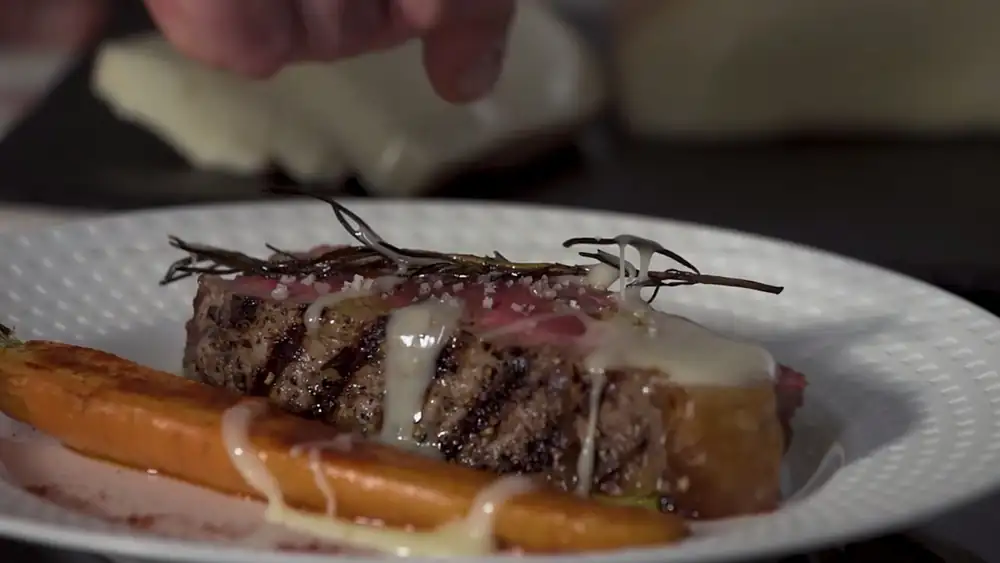
Its sweet and slightly aromatic flavor, sometimes with a truffle aftertaste, also lends itself to new and unconventional food pairings, which is why chefs are playing with it a bit: we find it elegantly served with seafood, creamed over mini canapés as a finger food, melted over scallops, in a salad with marinated anchovies and avocado, with entrecôte and carrots (find the recipe at the bottom), and even as ice cream, as an accompaniment to a dark chocolate cake.
It can be enjoyed as a main course, accompanied by a generous portion of salad, as an appetizer, cut into cubes and served with fresh fruit, as a main course, in a sandwich, together with grilled vegetables and a drizzle of extra virgin olive oil, or as a hunger breaker, for an energy-packed snack.
Here are the reasons why TALEGGIO DOP is good at any time of day.
It's a particularly digestible cheese, thanks to its aging process, which promotes the breakdown of fats and proteins by the microflora. Eating it provides a high level of protein, minerals, and vitamins A and B2: vitamin A is beneficial for bone development, while B2 provides the body with energy throughout the day.
It has a balanced fat composition.
Its calcium-to-phosphorus ratio allows for excellent calcium absorption in the intestine and the binding of salts in the bones. 100g of product contains 311 kcal.
Did you know that in 2020, nearly 8,400 tons of TALEGGIO PDO were produced, for a total of 4,200,000 wheels? Nearly half of the entire production comes from the province of Bergamo. For every kilogram of this cheese, 8 liters of fresh milk from the area of origin are used. The wheels are square with sides measuring 18-20 cm, a height ranging from 4 to 7 cm, and an average weight of 2 kg. Taleggio was awarded the Protected Designation of Origin (PDO) 25 years ago: all production phases take place within a limited geographical area, following the production process defined by the relevant regulations.
Creamy, succulent, and spicy: this recipe combines the deliciousness of grilled meat with the aroma of peppercorns and the richness of TALEGGIO DOP sauce. For the entrecôte to be perfectly cooked, ask your butcher to slice it very thickly, at least 3 fingers thick, so it stays pink and juicy inside. To balance the creaminess of the TALEGGIO DOP sauce, pair it with a light, young, fragrant, slightly acidic, and slightly sparkling red wine, such as Lambrusco or Bonarda.
- 500 g beef entrecôte (about 3 cm thick) 160 g TALEGGIO DOP 4 carrots black, white, green, pink peppercorns paprika powder extra virgin olive oil – salt
Wash the carrots, cut them in half lengthwise, and place them on a baking sheet. Season with a pinch of salt, a pinch of paprika, and a drizzle of extra virgin olive oil. Bake at 180°C (350°F) for 12-15 minutes. Dice the Taleggio cheese and melt it in a bain-marie, avoiding stirring until it's completely melted. Crush a handful of mixed peppercorns with a mortar or pestle, then sprinkle them over the entrecôte and roast it on a hot cast iron griddle, without adding any seasoning, for 4-5 minutes per side. Finally, bake at 220°C (425°F) for about 5 minutes. Remove the meat from the oven and let it rest for a few minutes, then slice it thickly and serve with the carrots, Taleggio sauce, and a pinch of paprika.