TALEGGIO DOP: tips for recognizing it, preserving it, and using it in a variety of ways
Walking past the cheese counter at the supermarket or in local shops, you can recognize TALEGGIO DOP by its characteristic square shape, the natural pink color of the rind, the compact and uniform texture, and also by its unmistakable aroma.
Its origins are ancient, dating back to the 13th century, when the inhabitants of the Taleggio and Valsassina valleys began producing cheese to use up their unused milk. They then aged it in caves and then traded it for other goods. Little did they know that this cheese would become so unique and special, the star of both classic and more contemporary recipes. Even today, this DOP-certified excellence is still produced naturally with milk collected in the area of origin and through a meticulous production and aging process that does not allow the use of any additives.
The original comes in 18-20 cm square wheels. Its rind is naturally pink, and it bears its distinguishing mark: three circles with a T imprint and a circle with a code, which can be used to trace the production chain back to the producer. With a little attention, this mark can be recognized even if the cheese is quartered or sliced thickly. Once cut, you can see that its white, straw-yellow paste is firm and uniform, slightly softer under the rind and more crumbly toward the center. This different consistency is due to its typical maturation process, which lasts a minimum of 35 days, starting from the outside and working its way to the center: centripetal maturation.
TALEGGIO DOP has a unique flavor, one that tastes like... Taleggio! Sweet, slightly aromatic, sometimes with a truffle aftertaste, and a distinctive aroma unlike that of other cheeses.
It's been a staple in the kitchen for centuries, served as an aperitif, starter, main course, or after a meal, sliced on a cutting board, melted in fondue, polenta, stuffing, or risotto. But what's most surprising is how its aroma is also perfect in fresher, summer-appropriate recipes: here are 10 ideas for enjoying it in spring and summer.
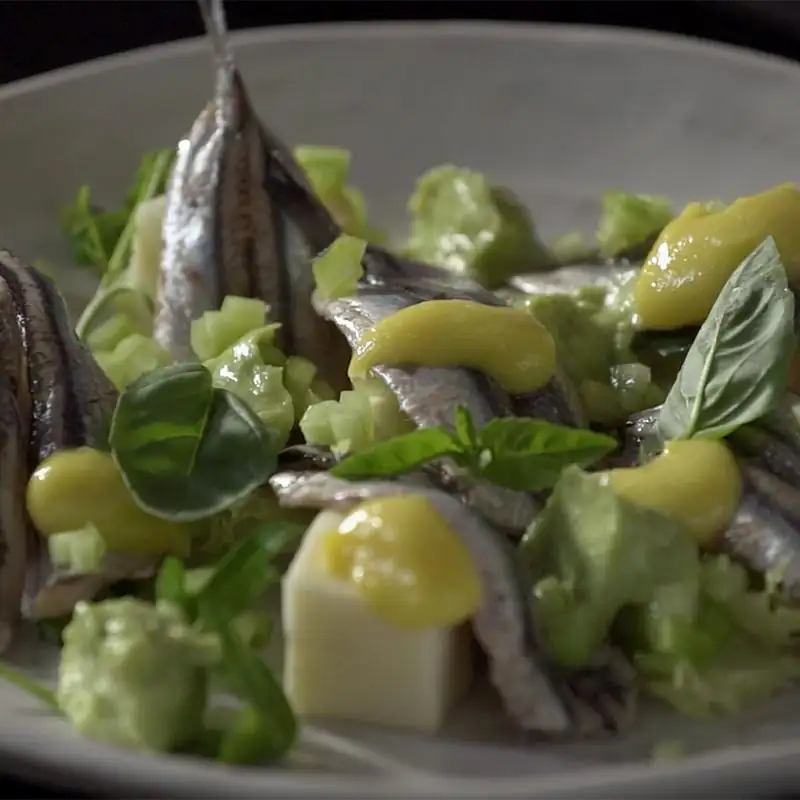
1. Cold, in a salad with celery, cherry tomatoes, and basil 2. Melted over mini focaccias and flavored with fresh marjoram 3. Creamed into strawberry risotto, to give it more character 4. Melted into stuffed vegetables mixed with stale bread (or meat) and thyme 5. In an omelette, with courgettes 6. In thin strips in pasta with vegetables 7. In aubergine parmigiana 8. In the filling of spinach erbazzone and in piadina 9. In puff pastry baskets with arugula and prawns 10. Diced with marinated anchovies, guacamole, and lemon (find the recipe at the bottom)
TALEGGIO DOP is a natural, living cheese that continues to mature until it's consumed, and therefore needs to "breathe." To preserve its flavor, aroma, and texture, it's best to store it in the refrigerator at a temperature between 4°C and 6°C, in its original packaging or wrapped in a damp cloth that allows air to circulate, avoiding plastic wrap.
If you enjoy it plain, it's important to bring it to the table at room temperature and, in any case, remove it from the refrigerator at least half an hour beforehand to fully enjoy its aroma.
When you eat TALEGGIO DOP, you get a load of protein, minerals, and vitamins A and B2: vitamin A is essential for bone development, while B2 provides energy throughout the day. It's also highly digestible, thanks to its maturation, which promotes the breakdown of fats and proteins by the microflora. It has a balanced fat composition, and its calcium-to-phosphorus ratio is ideal for optimal calcium absorption in the intestine and the binding of salts in the bones.
The Protected Designation of Origin (PDO) is awarded to products whose entire production process must take place within a defined geographical area, following the production process defined by the relevant regulations. TALEGGIO PDO obtained this recognition about 25 years ago and its area of origin includes the following provinces: Bergamo, Brescia, Como, Cremona, Lecco, Lodi, Milan, Monza and Brianza, Pavia, Novara, Verbano-Cusio-Ossola, and Treviso.
A special blend of very different ingredients, expertly combined in a fresh, light, innovative, and easy-to-replicate recipe. Because in the kitchen, it's good to be daring, changing the way you interpret ingredients and exploring new flavor combinations. This dish, which requires only four main ingredients, has it all: the comforting softness of Taleggio cheese, the freshness of marinated anchovies, the sweetness of lemon syrup, and the enveloping creaminess of ripe avocado.
Ingredients for 4 people 250 g apple cider vinegar 230 g granulated sugar 160 g TALEGGIO DOP 24 whole anchovies (or fillets already cleaned and frozen) 3 untreated lemons 1 cucumber 1 ripe avocado ½ lime aromatic herbs: mint – thyme – marjoram – basil pink peppercorns salad extra virgin olive oil – salt.
Method: Clean the anchovies by removing the heads and innards, then rinse them under cold water. Open them like a book and carefully remove the central bone. Place the anchovy fillets in the freezer for at least 96 hours (4 days): this step will neutralize any dangerous parasites.
After 96 hours, thaw the anchovy fillets in the refrigerator. Arrange them flat, skin-side down, on a tall serving dish. Bring the apple cider vinegar, 30g sugar, 10g salt, a few mint leaves, and 4-5 pink peppercorns to a boil in a saucepan, then combine to form a marinade. Let it cool, then pour it over the anchovies and let them marinate for 2-3 hours.
Meanwhile, cut the lemons into segments, removing the seeds, and boil them for about 40 minutes with 200g of sugar and enough water to cover everything (check frequently to make sure the water hasn't evaporated completely). Blend the lemons with a little of their syrup until you obtain a sauce.
Peel the avocado, mash it with a fork, and season with a pinch of salt, a drizzle of extra virgin olive oil, and a few drops of lime juice to make a guacamole-like paste. Slice the cucumber lengthwise, then dice it into small cubes.
Cut the Taleggio into cubes (it is not necessary to remove the rind) and divide them among the plates together with the salad, the diced cucumber, the marinated anchovies (6 per portion) and aromatic herbs to taste. Finally, season everything with drops of lemon sauce and guacamole and serve.