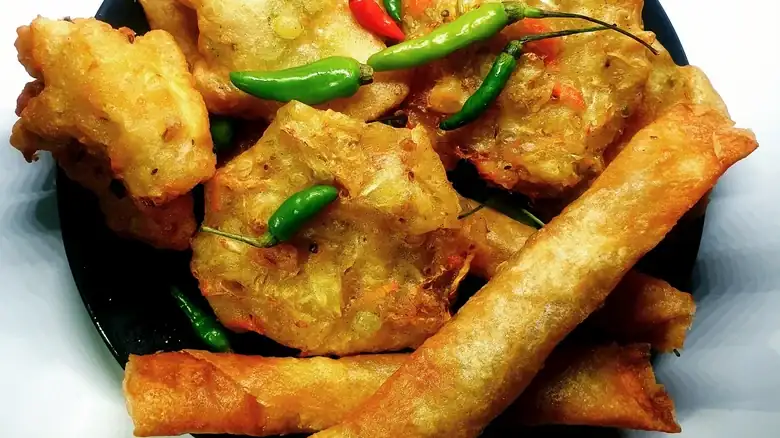
14 Fritters From Around The World That You Need To Order
Depending on where they're made, buñuelos can be made with pretty variable ingredients, with the Cuban version including yucca in its recipe, thanks to its local availability. Buñuelos are usually flavored with spices that, for many, taste like Christmas, like anise, cinnamon, and cloves.
Many cuisines worldwide have their own form of fishcake, so when picking one, the only limit you have is the flavors you want that evening. For a Western take, fishcakes with capers and horseradish-parsley sauce use traditionally British and French flavors and help to bulk out the cakes with mashed potato. If you want something with a bit more heat, Thai fishcakes can be rustled up with leftover salmon , flavored with red curry paste to give them some spice. Really, though, you can put whatever you like in your fishcakes.
The dough, as with Western-style doughnuts, is a fairly simple concoction of flour, water, and eggs, but their spice makes them shine. Using these flavors means that they can act either as a dessert or as an accompaniment to savory dishes, and they can serve as a replacement for bread when eating soups, stews, or curries. The flavors of mandazi mirror the ingredients available locally and bear strong influences of spice trading across the region. Their versatility means that they can be eaten at virtually any time of the day, and for some, they can act as a simple yet satisfying breakfast.
Tempura
If you like your fritters with maximum crunch, this one's for you. Tempura is a highly popular fritter from Japan, and if you've ever eaten at a Japanese restaurant, you've likely tried it in some form. Characterized by being pieces of vegetables or seafood that are battered and deep-fried, tempura was first developed in Japan in the 1600s, when Portuguese missionaries brought a fried dish designed to be eaten during Lent to the country. The food quickly took off, thanks in part to its unique cooking style, a new innovation in Japan, and became a bite-sized treat to be served between larger portions of food. Tempura can be made from pretty much anything, and tempura shrimp, fish, onions, and potatoes are frequently found on menus, often served alongside rice or noodles. The batter is usually made with sparkling water, which makes it super-crispy and light. But if you'
Pakora
There's a good chance that you've had pakora before and not even realized it. This term encompasses a huge range of Indian fritters, including the ever-popular onion bhaji, and has been a staple food across the Indian subcontinent for generations. Mentions of pakora, then called parika, have been found in ancient Indian literature and evolved notably during the Mughal period when chefs took to deep-frying battered foods to make crispy, delicious snacks. Nowadays, pakora is a common street food and is served as an appetizer in eateries. Pakora is typically made with gram flour, with spices and seasonings added to the mix, giving the fritters a uniquely complex flavor. And one of the best things about pakora is that you can make it with virtually anything. Virtually any vegetable can be battered and fried into pakora, with corn, chili, eggplant, yam, and chana dal all de
Pisang goreng
While some of the most famous fritters — pakora, croquetas, and fishcakes, to name but a few — are savory, that doesn't mean you should forget that there are loads of sweet fritters out there to sink your teeth into. And one of our favorites is pisang goreng. This Indonesian fritter, which literally translates into fried bananas, is exactly what it says on the tin: Bananas that are coated and deep-fried until golden brown and oozing in the middle. Rather than dipping slices in a liquid batter, pisang goreng chefs will instead wrap whole small bananas in a light dough, usually laid out in a long strip on the table so the fruit can be rolled into it. The finished product is then submerged in hot oil before being fished out and drained of excess fat. These snacks are delicious enough on their own, but some chefs put a twist on them by adding cheese, a variation known as
Arancini
While famous worldwide, arancini is a distinctly Sicilian invention and appear to have been first made as far back as a thousand years ago, although recipes for them didn't start to appear in cookbooks until the 19th century. The word for the snack is derived from the Italian word for orange, arancia, perhaps speaking to the traditional use of saffron in arancini recipes, which gives the rice an orange hue. Arancini are a masterclass in how to reuse food: These small balls are often made from leftover risotto wrapped around whatever filling you desire and then coated with breadcrumbs. They're then placed into a deep-fat fryer, where they turn golden and hot before being piled onto a plate. If cheese is stuffed into the arancini, every bite is full of creamy, gooey goodness. Be warned, though: If you order arancini at a restaurant, be sure to order extra, you'r
Latkes
Latkes are, for many, the quintessential potato fritter. These potato pancakes are traditionally associated with Hanukkah when they're eaten not only to satisfy appetites but also due to their symbolic importance. Latkes, and the oil they're cooked in, represent the miracle of the menorah of the Second Temple of Jerusalem burning for eight days on one day's oil supply. Their significance means they're commonly eaten at this time of the year, although they can be consumed at any other time. To make latkes, white potatoes are grated using a box grater or food processor and are combined with white onion that's grated to the same size. These vegetables are drained of excess juice and mixed with beaten eggs, salt, flour, or matzo meal. The latkes are then formed into individual patties and placed into hot oil, where they become crispy on the outside while remainin
Coxinha
When we think we've tried every fritter out there, a new, delicious variety comes our way and becomes our go-to food obsession. And that's exactly what happened with coxinha, the drumstick-shaped, deep-fried delicacy from Brazil that's charmed countless diners. Coxinha is shaped like a drumstick to mirror the interior of the fritter, which is made from shredded, lightly-seasoned chicken. The chicken mixture is stuffed into a dough, made from chicken stock, flour, and occasionally a tuber like a potato or sweet potato, and is sometimes topped with requeijão cheese. Once shaped into a drumstick, the word coxinha translates to little thigh, then the finished fritter is deep-fried until cooked. Coxinha has several origin stories and is purported to have been invented as a way to replace more expensive chicken drumsticks as a roadside snack. This theory is supported by
Akara
Fritters may be simple food items, but they often carry with them a long and fascinating history through which it's possible to track their development. A prime example of this is akara. A fritter made from black-eyed peas, akara is particularly popular in countries in West Africa, including Nigeria and Cameroon. However, while they were originally developed in this region by the Yoruba community, they then traveled to other parts of the world through the movement of enslaved people, particularly to parts of Europe, the Americas, and most notably Brazil, where the fritter is known as acarajé. As a result, recipes for akara and acarajé can vary depending on the location where it's being made. But in its most elemental form, it combines black-eyed peas, flour, water, fat, and additional vegetables or seasonings like onion, parsley, and scotch bonnet. The black-eyed peas
Mücver
Take a trip back into the food history of many countries, and you'll likely find a fritter recipe at some point, usually influenced by the local ingredients available. Mücver is a great example of this. A fritter made with zucchini commonly found in Turkey, mücver is influenced by the styles of cooks in the Ottoman period. While mücver can be made with many different types of vegetables, it's the style made with zucchini that's one of the most popular, and it's a great way to use the leftover parts of the plant that might normally be discarded when making other zucchini-based dishes. To make mücver, shredded or grated zucchini is mixed with herbs like parsley and dill, chopped scallions or white onions, and a batter made from flour and eggs. Once the whole mixture is seasoned, the mücver is pressed into fritter or pancake shapes. The finished fritters are deep-fri
Croquettes
Few fritters are as iconic or as loved across different cultures as croquettes. These bite-sized golden nuggets are found in multiple countries, and each of them has its own way of making them. Generally, the word describes a small, cylindrical fritter, which often has a savory filling and is bound together by mashed potato or béchamel sauce. The fritters are then breaded and deep-fried, heating up the filling and making the small morsels of food deeply moreish. Béchamel as a binding is usually more popular in Spain, where they're also known as croquetas and are frequently found on tapas menus. As its name suggests, croquettes originated in France, and from there, they spread to different parts of the globe. Croquettes are especially popular in the Netherlands, with the country's McDonald's menu reflecting this, offering a burger called the McKroket, consisting of a
Spam fritters
Instagram It sometimes feels like there are endless ways to enjoy Spam. And just when you thought you'd seen it all, someone comes along and puts a Spam fritter in front of you. Spam fritters are somewhat self-explanatory, but to avoid doubt, the term refers to a piece of Spam coated in batter and deep-fried, sometimes with extra fillings like cheese added. While this might sound like the invention of a bored schoolkid, this food has a specific history. Spam fritters gained popularity during World War 2 in the United Kingdom, thanks to the lack of fish that would usually be available in fish and chip shops. Spam, as a canned food with a long shelf life, was able to provide a worthy substitute. Over the years, Spam fritters have been a homemade favorite, as well as being available at the local shop, and are for many a comfort food. In recent times, however, the Spam fritter has seen a res
Buñuelos
The sheer versatility of fritters makes them so beloved across the globe, with different countries favoring either savory or sweet versions as their deep-fried bite of choice. And in countries across Latin America, a sweet variety is an ever-popular choice, especially around the holidays. Buñuelos originated in Spain and can now be found in countries like Cuba, Mexico, Columbia, and Uruguay. Depending on where they're made, buñuelos can be made with pretty variable ingredients, with the Cuban version including yucca in its recipe, thanks to its local availability. Buñuelos are usually flavored with spices that, for many, taste like Christmas, like anise, cinnamon, and cloves. They can vary considerably in shape, too, with some buñuelos woven into knotted shapes and others molded into disks. The finished product is usually served with a flavorful piloncillo syru
Fishcakes
Fritters may be simple to make, but they certainly aren't basic-tasting. And while certain fritters excel with making just a few ingredients taste dynamite, others serve as a vehicle for various flavors. This is the case with fishcakes, arguably the most versatile of all the fritters out there. Fishcakes come in all shapes and sizes, but they're generally defined as a combination of flaked or chopped fish formed into patties with a binding agent like eggs or flour. The fishcakes may then be coated in breadcrumbs or left as is. This fish mixture can also have a seemingly endless variety of flavorings and seasonings, and the whole thing is deep-fried. Many cuisines worldwide have their own form of fishcake, so when picking one, the only limit you have is the flavors you want that evening. For a Western take, fishcakes with capers and horseradish-parsley sauce use t
Beignets
In the wild world of fritters, which can come in endless combinations of flavors and textures, sometimes you want something basic but delicious. That's where beignets come in. These small square doughnuts are made by taking choux pastry, a light form of dough made from flour, eggs, water, and butter, and deep-frying them. The pastry squares then puff up and become golden brown before being dredged in powdered sugar. Beignets are found in several different countries, but they're mainly known as a Cajun dish and are common across Louisiana, especially in New Orleans. The dish was brought to the region by French communities in the 1700s, and nowadays, they're usually enjoyed as a sweet treat, either after a main meal or in the morning. As with other fritters, they're best enjoyed hot and can also be great with a sweet dipping sauce like a tart jam or a warm coffe
Mandazi
Many cultures worldwide have their own type of doughnut, which is a style of fritter. But doughnuts commonly have a key problem: They're just a little bit bland or else become completely overpowered by sugar or glazes. But mandazi doesn't have that problem. These doughnuts, found across East Africa in countries like Tanzania, Uganda, Kenya, and Burundi, are pieces of dough that are elegantly flavored with cardamom and coconut before being deep-fried so they puff up. The dough, as with Western-style doughnuts, is a fairly simple concoction of flour, water, and eggs, but their spice makes them shine. Using these flavors means that they can act either as a dessert or as an accompaniment to savory dishes, and they can serve as a replacement for bread when eating soups, stews, or curries. The flavors of mandazi mirror the ingredients available locally and bear stron