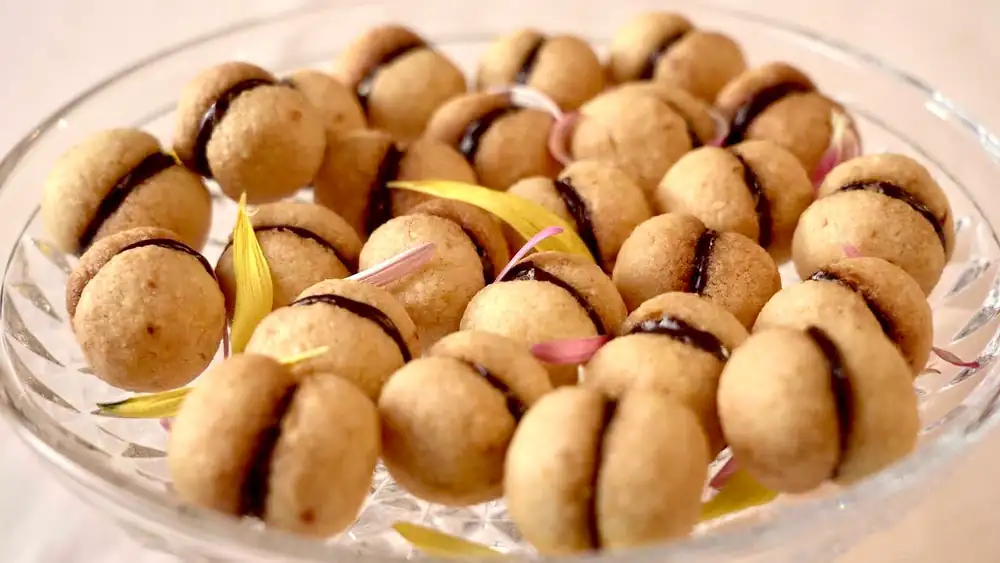
Los irresistibles besos de una dama
Al igual que las magdalenas de Proust, el aroma y el sabor de ciertos postres tienen el poder de evocar nuestros recuerdos de la infancia.
Like Proust's madeleines, the scent and flavor of certain desserts have the power to evoke our childhood memories. Grandma and mom in the kitchen rolling out the dough for Sunday cake, that plum cake puffing up in the oven, spreading its delicious aroma throughout the house, the simple yet unique flavor of biscuits dipped in milk in the morning. There are countless recipes stored in family notebooks, and sooner or later they call to us, inviting us to share them with our children and grandchildren.
Rediscovering family traditions is a growing trend these days, when we're craving certainties and comforting dishes that offer a sense of comfort, replete with the affection we felt as children. And there's no greater indulgence than preparing a dessert to share with loved ones, starting with trusted family recipes, with time-tested ingredients, yet enriched with contemporary touches, drawing on the flavors we discovered and grew to love as adults. Like our baci di dama, to which we've added a fresh, exotic touch.
Piedmontese specialty
Perhaps they were invented by a chef from the House of Savoy to satisfy the request of King Vittorio Emanuele II, or perhaps they originated in Tortona from the intuition of a pastry chef from Novi Ligure. What is certain is their Piedmontese origins, and today these irresistible "one leads to another" sweets are included in the list of traditional Italian agricultural and food products. They owe their name to their unusual shape, which resembles the lips of a woman intent on giving a kiss.
As with all successful creations, countless variations have emerged over time, such as the famous Baci di Alassio, which contain cocoa and honey in the dough. We've added coconut and orange zest to the original ingredients, small, contemporary touches that give them a fresher flavor and a delicious citrus aroma. The secret ingredient to making them irresistibly crumbly? A truly special butter.
Not all butter is the same
Not everyone knows that butter can be produced in two ways, with very different quality results. The first method, by skimming, produces butter made from the cream left over from dairy production and therefore a byproduct of cheesemaking. The second method, by centrifugation, produces butter made directly from fresh milk. This process preserves the cream's organoleptic characteristics, resulting in a high-quality butter that retains the aroma and pure, sweet flavor of fresh cream.
To be sure you're buying good butter, look for the words "centrifugal butter" or "centrifugal cream butter" on the label. Campina recently launched a new product, a butter made from centrifuged cream that simplifies dough kneading thanks to its extreme softness, even straight from the refrigerator. It blends perfectly with other ingredients, ensuring better aeration of the dough: the result is crumbly pastries that retain their fragrance longer. Wondering what the secret to its softness is? The cows' diet, which is free to graze and feeds on fresh grass, rich in omega-3 fatty acids.
Our recipe: almond, coconut, and orange ladyfingers' kisses
150 g Campina butter 150 g granulated sugar 150 g 00 flour 100 g dark chocolate 75 g almond flour 75 g grated coconut 20 g egg white 1 untreated orange salt
Cream the butter and sugar, then fold in the grated orange zest, coconut, and almond flour. Stir in the egg white and a pinch of salt, then the 00 flour, continuing to work the dough. Once it's smooth, cover with plastic wrap and refrigerate for about 2 hours.
Roll out the dough to a thickness of 1 cm, then divide it into cubes of about 8 g each. Shape the dough into balls, place them on a baking sheet lined with parchment paper, and bake in a preheated oven at 165°C (325°F) for about 13 minutes, until lightly golden. Remove from the oven and let cool.
Melt the chocolate in a bain-marie until it reaches a temperature of 55-58°C, taking care not to soak the mixture with water. Then, immerse the bottom of the bowl in ice water and stir the chocolate until it reaches a temperature of 28-29°C. Then immerse the bowl again in hot water and bring the chocolate to a temperature of 31-32°C: the chocolate is tempered and ready to use. Transfer it to a piping bag. Distribute it over half of the balls, then layer the remaining balls on top, creating the characteristic lady's kisses shape.