Emmental DOP: ¿sabes por qué es tan bueno? Te lo contamos (y te damos dos recetas)
De niños, llamábamos al Emmental DOP "el queso suizo con agujeros", y cuando nuestra madre lo traía a la mesa, siempre nos peleábamos por un trozo más. Ya entonces nos encantaba, con su delicado sabor que se deshacía en la boca.
As children, we called Emmentaler PDO "the Swiss cheese with holes," and when our mother brought it to the table, we always competed for an extra piece. We loved it even then, with its delicate, melt-in-the-mouth flavor. Mothers, too, actually, because it has always made life easier in the kitchen, as it lends itself to so many excellent recipes.
All of this has remained the same: those of us who have become parents do the same with our children, while those who haven't continue to serve Emmentaler PDO to our guests and ourselves. What has changed is that today, more than ever, we eat Emmentaler PDO with the knowledge that we've chosen a genuine, artisanal product that respects the environment and animals. Ultimately, it's our future.
How Emmentaler PDO is produced
Emmentaler PDO is not an industrial product. It is a quality product that has been produced the same way and in the same places for 700 years, following strict sustainability and other standards. This is why it was the first Swiss geographical trademark to be registered, the AOP (Protected Designation of Origin) certification, the equivalent of our PDO, a designation reserved for typical products rooted in a specific region.
Where Emmentaler PDO is born
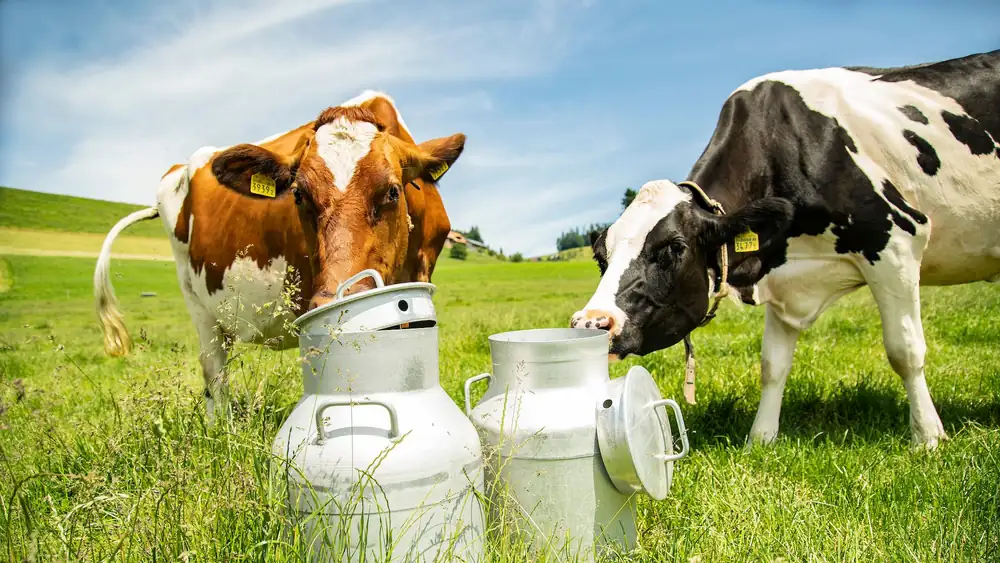
Emmentaler PDO has been produced for seven centuries on 2,000 farms spread across 100 Swiss villages in the cantons of Bern (excluding the administrative district of Moutier), Aargau, Glarus, Lucerne, Schwyz, Solothurn, St. Gallen, Thurgau, Zug, Zurich, and parts of the canton of Fribourg. It has always been produced with raw—that is, unpasteurized—milk from cows raised happily in the meadows of this Alpine paradise. For this reason, Emmentaler PDO is considered a model of animal welfare: the cows from which its milk is derived graze outdoors, can move freely even in barns because they have plenty of space, and eat only fresh grass in the summer and hay in the winter, ensuring local biodiversity and a milk that is particularly rich in nutrients. To preserve its quality, it is handled with great care: dairies only use milk produced within a 20-kilometer radius, avoiding long transport routes (and therefore unnecessary emissions) and ensuring freshness. And all this without wasting anything: it takes a lot of milk to produce the "king of cheeses." A wheel of about 95 kilos requires 1,200 liters of raw milk, processed only with water, rennet, and bacterial cultures (as with any cheese), and strictly free of additives and genetically modified organisms (GMOs).
The nutritional properties of Emmentaler PDO
The result is a cheese that's unique in terms of its nutritional value: rich in vitamins A, D, B2, and B12, low in salt, and packed with calcium, which is beneficial for the bones of children and the elderly, and lactose-free. Last but not least, it's an excellent source of protein, making it a perfect main course, even for those watching their weight and playing sports. In short, an ideal food for any age.
How to recognize real Emmentaler PDO
What makes it special is also its recognizability: during the production process, each wheel is marked with the "Emmentaler DOP" logo, along with the number of the producing dairy, allowing us to distinguish the original and know exactly where our food comes from. It's important to know this, as it's a guarantee of quality, but it's also nice to show it off when friends come over, offering Emmentaler DOP during an aperitif, perhaps choosing a different one each time. Emmentaler DOP is produced at eight different stages of maturation, and depending on the maturation, it offers different aromas. From the nutty, sweet flavor of the "Classico" to the aromatic, intense flavor of the "Riserva": what if we tried them all?
Meanwhile, two ideas to start: for a nice, healthy and balanced lunch, another aperitif with company and Emmentaler PDO.
The recipe for Lollypops with Emmental
- 200 g of Emmentaler DOP
- 1 tablespoon flour
- 1 egg
- 50 g of breadcrumbs
- 20 bretzel sticks
- 1 teaspoon paprika
- 1 teaspoon dried parsley
- 1 teaspoon poppy seeds
- peanut oil for frying
- Using a melon baller, cut out balls of Emmental cheese, flour them, dip them in the egg and then in the breadcrumbs.
- Fry in plenty of peanut oil.
- Serve skewered on pretzel sticks and decorate with herbs, spices and imagination!
The recipe for the power salad with Emmentaler PDO
- 200 g of Emmentaler DOP
- 100 g of cashews
- 100 g of yogurt
- 1 bunch of chives
- 4 carrots
- 1 green apple
- 400 g of lamb's lettuce
- extra virgin olive oil
- Cut the Emmental cheese into cubes and toast the cashews in a pan.
- Prepare the vinaigrette by mixing yogurt, oil, salt, pepper and chopped chives.
- Cut the carrots into ribbons and the apples into thin strips.
- Add all the ingredients to the lamb's lettuce and season with the vinaigrette!