A delicious journey through the cantons
Sweet or creamy, spicy or rich, artisanally crafted with locally produced milk and respecting ancient traditions, Swiss cheeses satisfy every taste and have a rich history to tell.
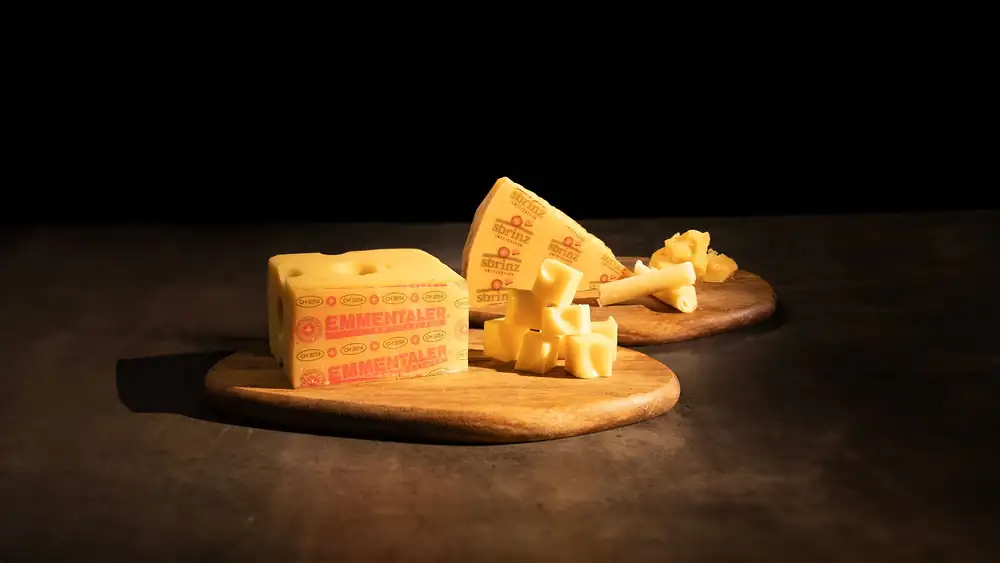
We're taking you on a three-part journey through Switzerland's various regions to learn about the history, characteristics, and curiosities of the main Swiss cheeses. Today, we're moving to Central Switzerland, home to Emmentaler PDO, the iconic cheese with holes, and Sbrinz PDO, the tasty and versatile extra-hard cheese.
Emmenataler DOP, an icon with holes
Emmentaler PDO owes its name to its place of origin, the Emme River Valley in the canton of Bern, where it originated almost 700 years ago. Today, it is produced in the regions of Northern and Central Switzerland, in the German-speaking cantons of Aargau, Bern, Glarus, Lucerne, Schwyz, Solothurn, St. Gallen, Thurgau, Zug, Zurich, and part of the canton of Fribourg. Completely free of additives and genetically modified organisms (GMOs), each wheel is a piece of refined craftsmanship, perfected over centuries in village dairies. Its traditional character, appearance, and exceptional quality have earned Emmentaler PDO the reputation of being the "king of cheeses." Each wheel of approximately 95 kg requires 1,200 liters of raw milk, water, rennet, and bacterial cultures, as well as the experience and loving, patient care of the cheesemaker. After soaking in brine, the cheeses rest in special warm fermentation cellars—where the characteristic holes form—before being transferred to cooler cellars for the actual maturation. With its even rind, ivory-colored interior, characteristic holes, and unparalleled, sweet nutty flavor, Emmentaler PDO is an excellent snack for breakfast or afternoon tea, a must-have on a classic cheeseboard, and also a valuable ingredient in many recipes: try it in savory vegetable pies, meat roulades, or, soft and stringy, in soups and baked gratin pasta dishes.
Sbrinz DOP, the hard cheese with a crumbly heart
Originating five centuries ago, Sbrinz PDO is the oldest extra-hard Swiss cheese and is produced in 26 dairies in the lowlands and alpine pastures of central Switzerland. As early as 1530, traders were transporting Sbrinz cheeses to Italy on the backs of mules, which they then traded for salt and wine. Made exclusively from regional cow's milk and aged in its area of origin, it is a 100% natural cheese, free from additives. The approximately 35-kilogram wheels conceal a crumbly, easily digestible texture, characteristics due to the slow aging process. Indeed, it must wait at least 18 months before it can be consumed: after this time, Sbrinz PDO is ideal enjoyed sliced very thinly as an aperitif, with dipped vegetables and fragrant bread, or as a light lunch, when it is used as an ingredient in a salad. If the maturation is extended to 22-22 months it becomes ideal to serve in morsels on a cheese platter at the end of a meal, together with a glass of meditation wine, while between 24 and 30 months, it develops a very intense flavour and is ideal for grating, to flavour first courses and meat recipes.
Addresses to visit
To discover all the secrets of Emmentaler PDO and Sbrinz PDO and taste them in the places where they originate, you can visit the dairies that produce them. Here are the addresses:
Emmentaler Schaukäsereistrasse 6 3416 Affoltern im Emmental.