An irresistible focaccia
Born in Rome in 1990, she was studying law in the capital before love changed her life. Her first love at first sight was cooking, a passion that made her abandon her law studies to dedicate herself to cooking.
Love and precision
It was at Duo that we first tasted Lucia's amazing focaccia, a fusion of Roman and Ligurian techniques, which is even better when topped with herbs or onions or served with slices of porchetta. "To make good focaccia, kneading the dough is essential," Lucia told us. "You have to be precise in measuring and mixing the ingredients, and you have to respect the rising times perfectly." Lucia usually makes focaccia at her restaurant, but we asked her to put the new Bosch Series 6 stand mixer to the test to show us how you can achieve the same soft, crispy results at home. "What struck me most about the new Bosch Series 6 stand mixer is the 3D planetary motion, which allows you to knead the dough as if by hand, without leaving residue on the bottom or sides of the bowl," Lucia told us. "This way, you get truly homogeneous dough."
The focaccia recipe
- 750 g 00 flour
- 490 g water (1)
- 60 g water (2)
- 50 g water (3)
- 6 g brewer's yeast
- 15 g fine salt
- 15 g extra virgin olive oil
- 100 g water
- extra virgin olive oil
- sale
- 200 g porchetta
- 10 sprigs of rosemary
- 10 sprigs of thyme
- 10 large sage leaves
- 3 yellow onions
- extra virgin olive oil
- Knead the flour with the first part of the water in a mixer, setting the speed to level 3, for 5 minutes.
- Let the dough rest for 20 minutes.
- Add the brewer's yeast and continue kneading at the same speed for another 5 minutes, gradually adding the second part of the water.
- Let the dough rest for another 20 minutes.
- Add the salt and knead at maximum speed for 10 minutes, first adding a third of the water and then the oil, pouring in a drizzle.
- Once the dough is finished, transfer it to a large enough bowl and fold it: there should be six folds in total, one every 10 minutes.
- Grease a baking pan with extra virgin olive oil and roll out the focaccia dough.
- Let the focaccia rise for a couple of hours, finishing rolling it out.
- Prepare a brine by mixing 100 g of water with 2 tablespoons of oil and 2 pinches of salt.
- Dust the focaccia with a little flour, then pour the brine over it and use your fingers to make the classic Ligurian focaccia holes.
- Finely chop the rosemary, thyme, and sage and drizzle with plenty of oil.
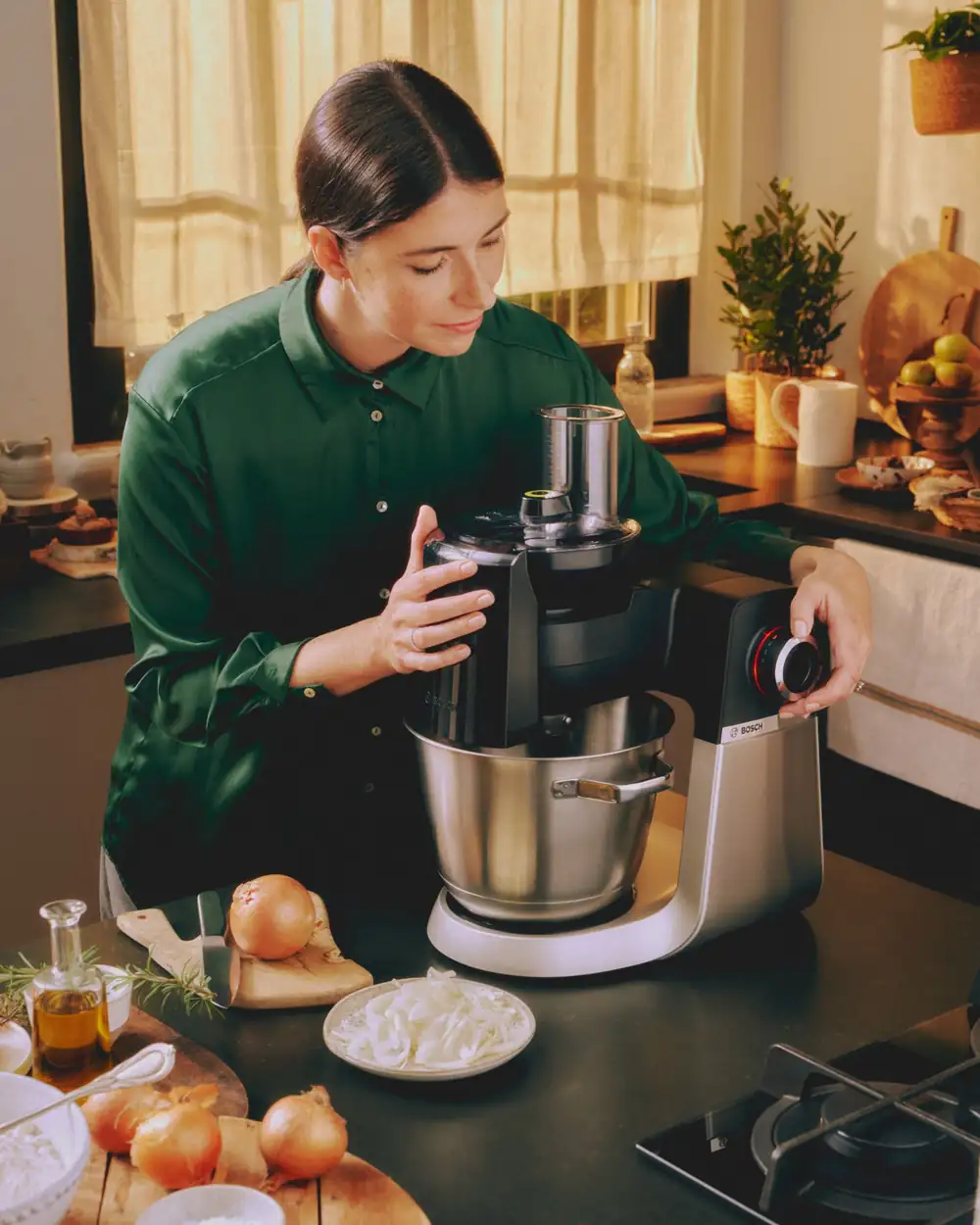
- Peel and thinly slice the onions using the slicing disc on the Bosch Series 6 stand mixer.
- Spread the chopped herbs over a third of the focaccia surface and the sliced onions over another third.
- Preheat the oven to maximum power and cook the focaccia until golden brown: we cooked it at 250°C for about 12 minutes.
- Remove the focaccia from the oven, spread the sliced porchetta over the other third and serve.
A friend in the kitchen
The new Bosch Series 6 stand mixer is equipped with the best technology to simplify life in the kitchen and encourage experimentation and creation, even when the preparation is particularly challenging, like Lucia's focaccia. What made the difference in this recipe was the 3D planetary motion, which kneads the dough as if it were hand-kneaded, but with greater power, until it reaches the perfect consistency. The ingredients are gently mixed, leaving no residue on the bottom or sides of the bowl. The new Bosch Series 6 stand mixer comes with a comprehensive set of accessories, including, for example, a disc for slicing onions thinly and evenly. Furthermore, the Bosch Series 6 stand mixer's built-in timer lets you know when it's time to start kneading the dough again. The new design features have also made the new Bosch Series 6 stand mixer extremely convenient to use: all contact points are accessible from the front, and once finished, all accessories are conveniently dishwasher-safe.