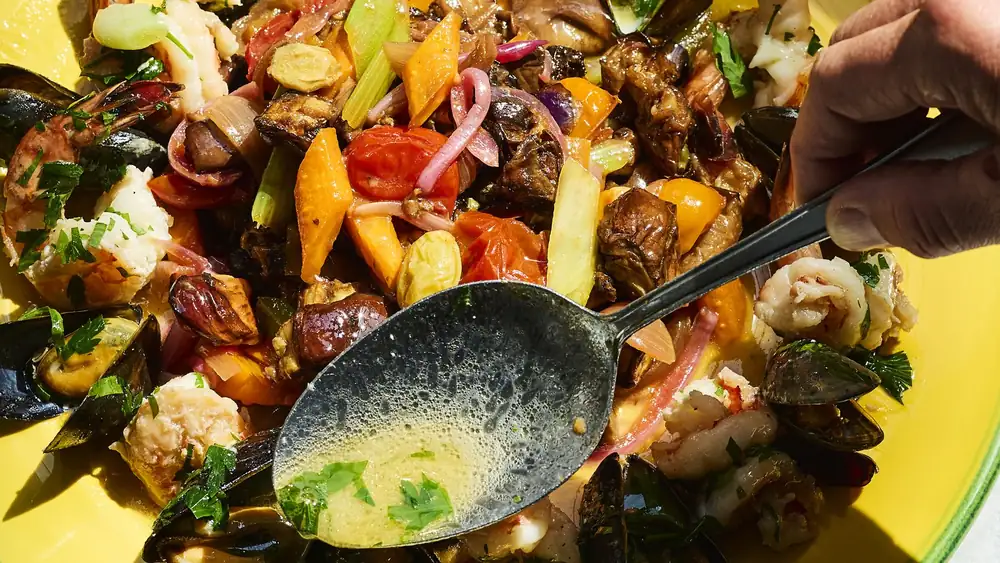
Sicilian caponata (sweet and sour aubergine stew) from Toscanini Amsterdam
Even before the pasta and secondo (the main course) arrive at the table, the team at Toscanini Amsterdam places a plate of antipasti on their white linen-covered tables.
Kick things off with a spritz or martini in your hand and plates on the table with this Sicilian caponata, charcuterie, cheeses, pickled fish, crostini, and bread with olive oil, and you’ll remember how sweet life can be.
After their cookbook on pasta, the Toscanini team decided to dedicate a second volume to antipasti. From aperitifs like a Negroni alla Toscanini to Sicilian street food such as arancini, panelle, and mozzarella in carrozza, and from bruschetta and crostini to vegetables, salads, and seafood: the book is packed with all the Italian delights that sweeten life. And so, it also includes one of the most colorful vegetable dishes we know: caponata, or Sicilian eggplant stew.
Toscanini's caponata recipe contains all the colors of the rainbow, including eggplant, celery, carrots, red onion, tomatoes, capers, olives, and raisins. And if you're in the mood for a little 'extra', you can add prawns and mussels.
About this Sicilian eggplant stew
Team Toscanini: “Caponata is a Sicilian dish dating back to the Middle Ages. Sicily was dominated by the Arabs between the 9th and 11th centuries, who introduced all kinds of ingredients and preparation methods. Citrus fruits, sugarcane, spinach, chickpeas, artichokes, pistachios, pine nuts, almonds, and saffron, to name just a few. And the main ingredient of caponata: eggplant. Later, Spanish rulers brought new products from the New World, including tomatoes and peppers, which found their way into local dishes, including caponata. The name likely refers to capone, a fish served in sweet and sour sauce at the tables of wealthy citizens and nobility. For those who could not afford that luxury, eggplant offered a good alternative. Caponata was also practical. In a warm climate without refrigeration, vinegar, sugar, and olive oil ensured that vegetables lasted longer. But it is precisely because of this that it becomes such a delicious dish; all the flavors are intertwined. From city to city – Palermo, Catania, Trapani – subtly changes the composition. Raisins and pine nuts here, almonds or cocoa there, sometimes more tomato, sometimes more acidity. This is our version.”
Toscanini's caponata recipe
- Place the diced aubergine on a plate lined with paper towels, sprinkle with salt, and place another layer of paper towels on top. Let stand for 30 minutes to lose some moisture.
- Preheat the oven to 200 °C.
- Pat the aubergine dry. Spread over one or two roasting pans or baking sheets and mix 2/3 of the oil thoroughly through them, ensuring each piece of aubergine is coated. Bake for 25 minutes, or until nicely golden brown. Turn them over once halfway through. It is better for the aubergine to be slightly too dark than too light; they need to be thoroughly cooked, which also enhances their flavor. Remove from the oven and set aside.
- Bring a pan of water to a boil and add salt once it is boiling. Taste; it should taste lightly salty. Blanch the celery and carrots for about 3 minutes until al dente. Remove from the water and let drain well.
- Place a large, wide pan on the stove and heat a generous splash of olive oil in it. Sauté the red onions over medium heat for about 15 minutes until just sweet and soft. Add the peeled tomatoes and let simmer gently for another 20 minutes.
- Add the olives, capers, anchovies, red wine vinegar, pine nuts, and raisins, and simmer for a few minutes.
- Remove the pan from the heat. Mix in the aubergine, celery, and carrot. Drizzle generously with some good olive oil. Taste; it should taste sweet and sour at the same time. Otherwise, season to taste with some salt, pepper, or red wine vinegar.
- Serve the caponata lukewarm. Or let it cool and serve at room temperature, as a standalone dish or as part of an antipasto misto.