The Fish You Might Want To Avoid Ordering In Restaurants
If you're a seafood aficionado, here's a useful piece of advice for you: Don't order the red snapper when you're dining out (or buying groceries, for that matter). This is because there's a very high chance you're actually getting some other type of fish.
Researchers in this field have sometimes labeled red snapper as the number one fish species that gets mislabeled. It's hard to say exactly how often red snapper is mislabeled, as different studies have given different answers depending on the place and time they were conducted. But it's safe to say that it's very common. One study from 2019 suggests it happened 77% of the time and that 100% of red snapper in sushi restaurants they studied was fake.
It's an ongoing problem as well. A 2004 study suggested 60% of red snapper was fake, and more recent studies have put the rate anywhere from 45% to 90% — one of those studies suggested that restaurants were worse when it came to mislabeling, but red snapper from supermarkets was only a little more likely to be legit. It's not just red snapper, either. Some 20% of all fish are thought to be mislabeled — grouper is another common one — but again, the numbers vary depending on the source. In any case, it's seen as a serious problem in the seafood industry.
What fish am I getting instead? And why?
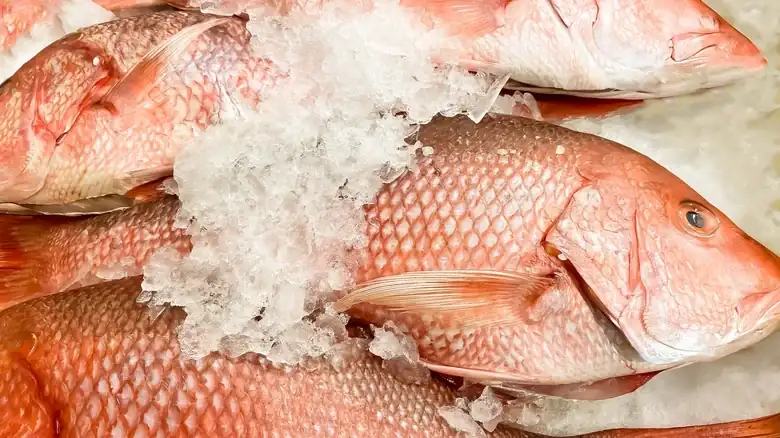
There doesn't seem to be one particular fish that takes the place of red snapper. Various other types of snapper like silk or blackfin snapper look quite similar and could be mistaken for red snapper. You'd have to look closely to pick the difference, and it'll be easier if you're planning to cook a whole fish since you can look at their fins, where the differences are noticeable.
One study has suggested that vermillion snapper and low-calorie tilapia were the most common substitutes, but there's more than a couple of dozen fish that are known to be subbed in for red snapper, including pollock and seabream. You should generally look out for bright reddish-pink skin if you want real red snapper, although there are still lookalikes. Picking the differences out may require you to seriously brush up on your fish visuals. Knowing the standard prices is also a good idea too. This way, if you see red snapper available for a too-good-to-be-true price, it could be a red flag.
Generally, you'll get fish that's much easier to find or cheaper than red snapper, since red snapper has been overfished in recent decades and thus is more rare. The main reason for mislabeling is obvious: Unscrupulous sellers are looking to make some extra money by selling something cheaper in place of red snapper. Still, accidental mislabeling is also possible.