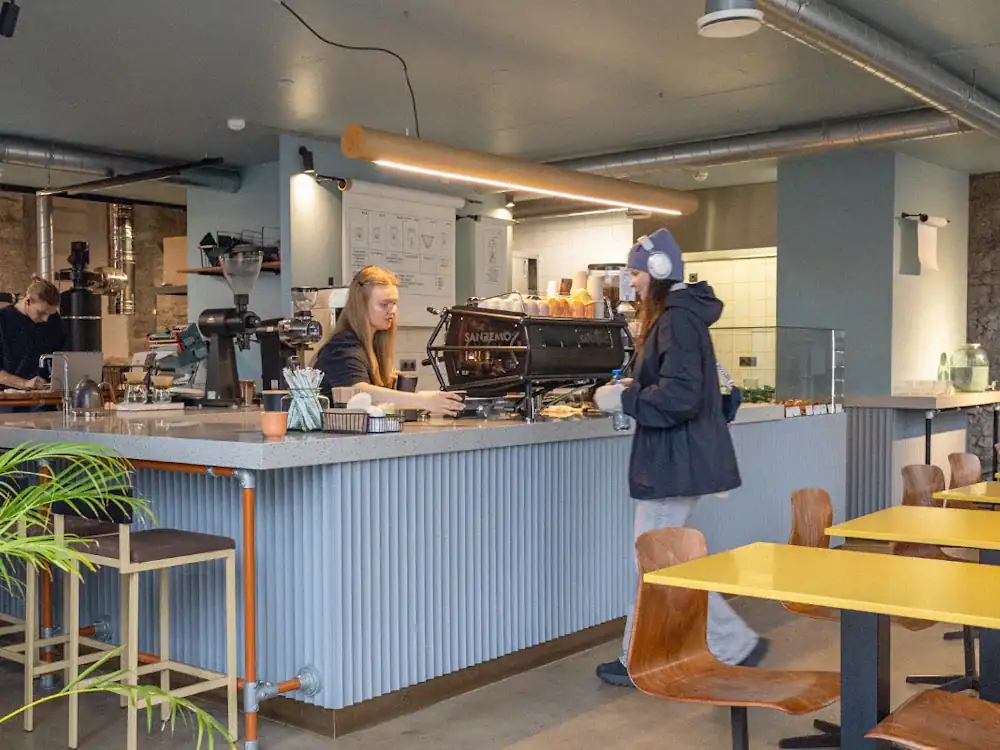
Specialty coffee is maturing in the Baltics
Key takeaways
“As with most countries worldwide, drinks like lattes, cappuccinos, and flat whites are the most popular,”
- Baltic specialty coffee culture has developed rapidly over just the last decade.
- Soviet occupation shaped coffee habits that still influence the region today.
- Scandinavian and Nordic roasting styles now drive Baltic coffee trends.
- Lithuania leads in roasteries, but Latvia and Estonia are catching up.
The Baltic states of Estonia, Latvia, and Lithuania lie on the eastern shore of the Baltic Sea. The three small nations that regained independence from the Soviet Union in 1991 have since built some of Europe’s most vibrant coffee scenes. All three are now EU and NATO members, and their shared history runs deep, as does their coffee culture.
“The Baltics feel more like one connected coffee ecosystem rather than three completely separate markets,” says Ancis Romanovskis, the CEO of Rocket Bean in Riga, Latvia. The roaster was the Flat White Alternative Gold Winner and the Latvia National Winner at the Global Coffee Awards Europe. “The culture and consumer expectations across the region are very similar.”
Despite their relatively small populations, all three countries rank among Europe’s highest for per capita coffee consumption, and specialty roasters have spread across the region at a considerable pace.
You may also like our article on how Indonesia’s coffee market is thriving.
A history of coffee in the Baltics
Coffee arrived in the Baltic region during the 17th and 18th centuries, initially a luxury reserved for the nobility before gradually reaching wider society. Even so, tea remained the dominant drink for much of the region’s history.
“Tea was deeply embedded in household habits,” says Ancis. “In Latvia, herbal teas also had a long tradition, which in many households still continues today. Coffee existed more in the shadows, and access to good-quality coffee was very limited. If tea was a daily ritual, coffee was more occasional and less sophisticated.”
Lithuania followed a different path. Geographical influences drew it closer to Western European tastes, and brewed coffee, typically prepared in ibrik or moka-style pots, took hold there more quickly than in its neighbours. By the 19th century, cafés had become established social spaces across all three countries, and coffee culture was broadly settled.
Then, in 1940, Soviet occupation brought that momentum to an abrupt stop. Under Soviet rule, roasted coffee became scarce. People turned to substitutes made from chicory root, barley, and occasionally acorns. The most widely available options were instant coffee or green beans.
Some enthusiasts roasted their own at home, since private businesses, including roasteries, were banned across the Soviet republics. The Soviet Union sourced coffee exclusively from allied nations such as Cuba and India, centralised all roasting in Moscow, and distributed the finished product to republics in fixed quotas.
For Lithuania, where demand was already high, those quotas were never sufficient. “Because Lithuania really liked coffee, it was never enough. There was a constant deficit,” says Vytautus Kratulis, CEO and founder of Huracán Coffee in Vilnius, Lithuania, which was recently crowned the winner of the 2025 Global Coffee Awards World Championship.
Coffee culture grows
During the 1980s, the Soviet Union signed trade agreements for coffee equipment from the US and Italy, and began importing coffee from Colombia. Colombian beans became a staple in Lithuanian households, and espresso became the dominant brewing method. Exposure to dark-roasted, Italian-style coffee shaped consumer preferences that persist today.
“As with most countries worldwide, drinks like lattes, cappuccinos, and flat whites are the most popular,” says Darius Vėželis, CEO of Vero Coffee House in Kaunas, Lithuania. The roaster won the Lithuania National Winner at the Global Coffee Awards Europe.
When independence came in 1991, state-controlled industries, including coffee, returned to the free market. Consumption grew across all three countries, though at different rates.
“Gradually, Latvia gained access to different coffee products, and international café concepts started to emerge,” says Ancis. “In the 1990s and early 2000s, the market was still dominated by instant coffee and large international brands, but slowly, espresso culture began to develop.”
With free market access restored, coffee equipment and culture from Germany, the Nordic countries, and Scandinavia began flowing into the region. Today, all three Baltic countries draw heavily from Scandinavian and Nordic approaches to roasting, sourcing, and café design, though each has developed its own character.
Latvian coffee culture sits at the intersection of Nordic specialty thinking and Southern and Central European espresso traditions, Ancis explains. Estonian café culture, meanwhile, reflects the strongest influence of France, Austria, Denmark, and Italy.
A thriving region for coffee
Huracán helped establish Lithuania’s roasting sector in the mid-1990s. By the early 2000s, it was one of just four roasteries in the country, but the latter part of that decade brought rapid growth. Lithuania set up an SCA chapter and began organising coffee competitions in 2005. Vytautus tells me he sponsored the Lithuanian Barista Champion to attend the world finals in Seattle, Washington, US.
That same year, two chains launched that would go on to define the market: Vero, based in Kaunas, and Caffeine, which has since grown into the largest coffee chain across all three Baltic countries.
Rocket Bean played a significant role in shaping Latvia’s specialty coffee sector. “When we started our coffee business in 2007, the term ‘specialty coffee’ was still practically unknown in Latvia,” says Ancis. “When we opened the first Rocket Bean coffee shop in 2015, specialty coffee was still a relatively niche concept, and we were among the early players in this space.”
Estonia’s scene developed along a similar timeline. Gourmet Coffee Kadriorg began roasting in 2008, becoming the first to bring drip and pour over methods to Estonian consumers. Today, Estonia’s specialty coffee market is concentrated in Tallinn and Tartu, while Latvia’s is centred almost entirely on Riga.
Lithuania’s scene is more widely distributed. Around 30 roasteries operate across the country, with Huracán and Vero, which now has more than 37 locations, among the most prominent.
“All three countries share a similar trajectory: instant coffee, then espresso, then specialty. The timelines differ slightly, but the direction is the same,” say Kristel Parts and Margus Varvas, co-founders of Paper Mill Coffee in Tallinn, Estonia. “The community is small enough that there’s a natural awareness of what’s happening across the region and the scenes feel connected without them being identical.”
Baltic coffee trends
Baltic consumers today are better informed about coffee than at any previous point, and the quality of cafés and roasters reflects this shift. “The markets are relatively small but very dynamic, and consumers are curious and open to new ideas,” says Ancis.
Estonia and Latvia have nearly closed the gap with Lithuania on per capita consumption, and the specialty segment, though still a fraction of the overall market, continues to grow.
Coffee trends in the region broadly reflect international ones. Alternative milks and matcha have both gained ground, but Baltic consumers differ from their Western counterparts in one notable respect: traditional hot espresso drinks remain more popular than the highly customised cold beverages now common elsewhere. Filter coffee and alternative brewing methods are also attracting a growing audience.
“Lighter roast has been gaining ground, and there’s substantial curiosity around origin and processing,” say Kristel and Margus. “Complex filter flavour profiles and light roast have moved from solely enthusiast territory into something more people are genuinely seeking out.
“More modern processing methods used to be incredibly niche, whereas now there’s a dedicated audience for it,” they add. “People also want to know where their coffee comes from and who they’re supporting.”
At home, Baltic coffee drinkers have traditionally relied on simple brewing methods and bean-to-cup machines, but espresso machines are becoming increasingly common. “More people are investing in equipment and trying to replicate café-quality coffee at home. This has increased demand for freshly roasted coffee and higher-quality beans,” says Ancis.
Specialty coffee spreads beyond major cities
E-commerce and social media have also carried specialty coffee beyond the major cities. In Latvia, roasters have been opening in smaller towns over the past five years, reaching consumers who would previously have had little access to the sector.
Estonia is seeing something similar, with people moving to smaller and more remote areas and bringing an appetite for specialty coffee with them. “They’re opening restaurants, seasonal cafés, pop-ups, and they want specialty coffee as part of what they’re building,” say Kristel and Margus. “There’s also a growing understanding among restaurants that great coffee belongs alongside great food.”
What’s ahead for specialty coffee in the Baltics?
The growing appetite for specialty coffee has begun attracting international brands to the region, while Baltic chains are expanding into new markets, and domestic opportunities for new roasters and cafés continue to open up.
Supermarkets, long dominated by large international brands, are also shifting. “Consumers are beginning to recognise local roasters and appreciate freshness and transparency,” says Ancis. “We see this as a natural evolution of the market, making better coffee accessible not only in our cafés but also for everyday consumption at home.”
Events such as the Tallinn Coffee Festival and Vilnius Coffee Festival have, over the past decade, helped build appreciation for specialty coffee and encouraged local innovation.
Latvia only began hosting coffee championships in the 2010s, which suggests its specialty scene may still be in its earlier stages. “Coffee culture in Latvia is still relatively young, but that is exactly what makes it exciting. There is still a lot of opportunity for innovation and growth,” says Ancis. “For roasters, the challenge will be scaling production while maintaining quality and authenticity.”
Price is a consideration
The growth, however, is not without its pressures. In Lithuania, coffee shops have had little choice but to raise prices as the minimum wage, business taxes, rent, and the cost of goods have all climbed sharply in recent years, according to Vytautas. Purchasing power remains a genuine constraint across the region.
“Estonia is a small market, and what people are willing and able to spend shapes which trends land here and what’s actually sustainable as a business,” say Kristel and Margus. “For us, it comes down to doing fewer things better: sustainable sourcing, clean roasting, and honest relationships with the people drinking our coffee. The community here is serious and dedicated, and at a size where you can really make a difference and connect.”
The Baltic coffee story is, in some ways, still being written. Three small countries that were cut off from global coffee markets for decades have, in little more than thirty years, built scenes that rival those of far larger nations.
Each country has arrived at specialty coffee by its own route. There are challenges ahead, but specialty coffee has moved well beyond the cafés of Tallinn, Riga, and Vilnius. For a region that once relied on chicory and barley to stand in for coffee, the distance travelled is considerable.
Enjoyed this? Then read our article on how specialty coffee is taking over in Turkey.