Discover the most authentic Mediterranean in a farmhouse with pizzica, gin, and sea
There's a word that's been so overused in the food and wine narrative of the last twenty years that it's become transparent: Mediterranean.
Villa Mare, or making a philosophy habitable
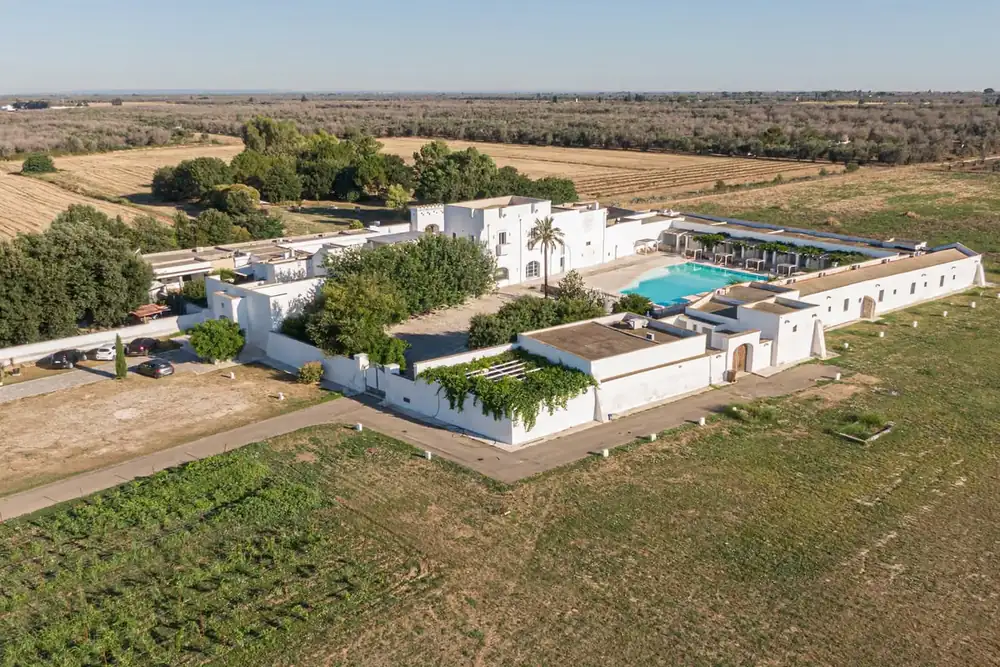
Villa Mare is the name Gin Mare gave to the project that, for seventy-two hours, transformed Masseria Malvindi, in the Mesagne countryside, into something that's neither an event nor a stay. The idea is as simple as it is risky: to make what the brand calls Med Attitude habitable, the belief that the Mediterranean is not a geographical location but a way of being in the world. Risky, because a declared philosophy is easy to write in a press release and extremely difficult to make people feel it: if you fail, you get a showcase; if it works, you get something that continues to work even after you return.
The location is already half the battle. Malvindi is no ordinary farmhouse renovated for contemporary luxury: it's an 18th-century building, a former post station, located in the countryside of the ancient Messapian city of Mesagne, on the edge of the Appian Way, which connected Rome to the port of Brindisi. A few steps away, the remains of a Roman bath complex emerge. Rooms cluster around a courtyard, olive groves stretching to the horizon, a rustic simplicity that the restoration has chosen not to betray. The style is set by the dress code communicated to guests: casual, elegant, or sporty, the only rule is to feel at home.
Gin as a map
Gin Mare was created in 2007 in Vilanova i la Geltrú, an ancient fishing village between the Costa Brava and the Costa Dorada (Spain), in a 250-liter Florentine still installed inside a former monastery chapel. But the composition conveys the idea better than any claim, because the botanicals are geographical rather than aromatic: Italian basil, Turkish thyme, Greek rosemary, Spanish citrus fruits, and Arbequina olives, a Catalan cultivar that lends the product's signature salty, slightly bitter note. Each is macerated separately and distilled separately before blending; the citrus fruits macerate for over three hundred days. It's a slow and costly process, and it's also a statement: no ingredient dissolves into the whole, each remains recognizable. The Mediterranean is a sum of identities that coexist without canceling each other out. If there's a metaphor that holds up in this operation, it's this one, and it has the advantage of being already written into the production process rather than pasted on by an agency.
The early afternoon continues with a cooking class dedicated to traditional Apulian dishes, and here the first interesting thing happens: no one tries to blend gin with local cuisine; the two coexist and recognize each other as cousins. Then comes aperitivo with signature cocktails, dinner with a selection of local products, and, late in the evening, pizzica by the pool. Anyone familiar with Salento knows that pizzica isn't postcard-perfect folklore, but music born as a ritual, obsessive and liberating at the same time: listening to it under a September sky, a glass in hand and skin still warm, explains the Mediterranean essence better than any presentation.
Grottaglie, where craftsmanship is not a souvenir
The second day shifts focus from pleasure to material culture: a forty-minute drive brings us to Grottaglie, the Taranto town that has been the capital of Apulian ceramics for centuries, with its Ceramics District carved into the ravine. Visiting the workshop and creating a piece could have been just another brochure experience. They aren't, for one reason: putting your hands in clay forces you to reckon with time.
The wheel doesn't accelerate, the clay doesn't cooperate if you force it, the piece comes out or it doesn't. In an age where every tourist experience is designed to be instantly shareable, an hour spent getting the shape of a bowl wrong is almost a subversive act. And it's the part of the program that most coherently ties the brand to the region, because ceramics embodies the same principle as gin: a deep-rooted tradition that has been passed down while maintaining its identity while everything around it has changed.
Pietro Penna's dinner
The moment when the operation stops being a nice plan and becomes serious comes in the evening, when the dinner is overseen by Pietro Penna, chef of the Casamatta restaurant at the Vinilia Wine Resort in Manduria, a Michelin star since 2019 and the first Green Star in Puglia since 2021. His biography explains much of his cuisine: born in Specchia, near Lecce, in 1984, over fifteen years away from home, between the kitchens of Sergio Mei at the Four Seasons in Milan and a Parisian experience alongside Éric Briffard at the George V, then a return to Puglia with a technique and rigor that were not a given in the South, in that form. Penna himself described the change with a formula that almost seems like a poetic declaration: "Before, I did nothing but add to the dishes; I learned to take away."
The menu confirms this line by line. It opens with chia, lettuce, and radishes, puffed bread and giardiniera, and apple and pistachio: three entrees that focus on vegetal and crunchy flavors, almost as if to reset the palate before taking it to the sea. Next comes the scampi on brioche bread with raspberry and bell pepper, where the acidity of the red fruit counterpoints the sweetness of the crustacean. Then comes the dish that best expresses the evening: pacchero cacio e pepe with amberjack, lime, and Gin Mare. On paper, it might have been a forced product placement, but instead it works because the gin isn't a guest of honor but an ingredient: the herbaceous, saline note interacts with the savory cheese and the fattiness of the amberjack, while the lime cuts through. No one announces the gin on the plate; it's instantly recognizable, and it's different. Next up is a beef chop with garlic, lime, and tomato, a direct homage to Puglian tradition in a more pared-back guise, and a dessert that picks up where the story began: chocolate, Gin Mare, and rosemary, with Greek rosemary used not as a garnish but as a structural aromatic note. The light-hearted finales conclude with a truffle and calvados dessert and a raspberry, apricot, and mint macaron.
Throughout the dinner, the selection of breads deserves a paragraph of its own, from whole-grain bread to durum wheat semolina to tomato focaccia: in Puglia, bread isn't a side dish but a declaration of belonging, and serving it with this care at a haute cuisine dinner means knowing exactly where you are. A philosophy Penna summarizes with an almost programmatic phrase: "There's no such thing as haute or low cuisine, but rather taste and daily research." Behind that apparent simplicity lies a precise idea of haute cuisine. Penna explained how difficult it was in Puglia to overcome the prejudice that gourmet cuisine is synonymous with beautiful dishes that fail to satisfy: "Here, gourmet cuisine isn't perceived as a cuisine that can satisfy the stomach and, at the same time, be elegant." His response was to create a cuisine capable of combining both, placing technique and pleasure on the same level.
My Sea, the part you can't see
If Villa Mare is the story, Mare Mio is proof that behind the story there's a structure. It's the environmental project Gin Mare has been carrying out since 2021, when it began in Capri with an idea so simple it seems naive: a gozzo, the traditional boat of the island's fishermen, which sets out at dawn to clean the sea and caves of floating waste. From there, it expanded to Camogli and Portofino, Porto Ercole, and Pantelleria, in collaboration with Marevivo, which analyzes and catalogs the collected waste: in the summer of 2022 alone, over six hundred kilos of plastic microwaste were collected in Capri, and since the project's inception, the threshold of three tons has been exceeded. In 2026, in its sixth edition, it moved from the surface to the seabed, with a project to protect the coral in the Tavolara Punta Coda Cavallo Marine Protected Area, in Gallura.
This is the step that makes the operation credible. A brand that builds its identity on the Mediterranean and then simply photographs it is extracting value; one that invests in restoring the habitats it claims to draw inspiration from is, at the very least, making a coherent argument. Villa Mare didn't try to convince anyone that a gin is Mediterranean: it placed people in a place where the Mediterranean already exists—an eighteenth-century farmhouse on a Roman road, a neighborhood of ceramicists, healing music, a cuisine that knows its territory well enough to afford simplicity—and let the context speak for itself, simply pouring the drinks. It's a lesson that applies far beyond the world of spirits and one that anyone working in hospitality would be wise to espouse: authenticity isn't communicated, it's experienced. The rest—the cocktail at sunset, the Michelin star, the ceramics brought home in your carry-on—comes naturally.