English Pubs: What Are Snugs and Other Fun Facts?
English pubs aren't just places to order a pint.
English pubs aren't just places to order a pint. Names, signs, separate rooms, and tap systems tell centuries of British social history. Behind a hand pump or a door marked "snug" lie habits, hierarchies, and rituals that have transformed public houses into true landmarks for local communities.
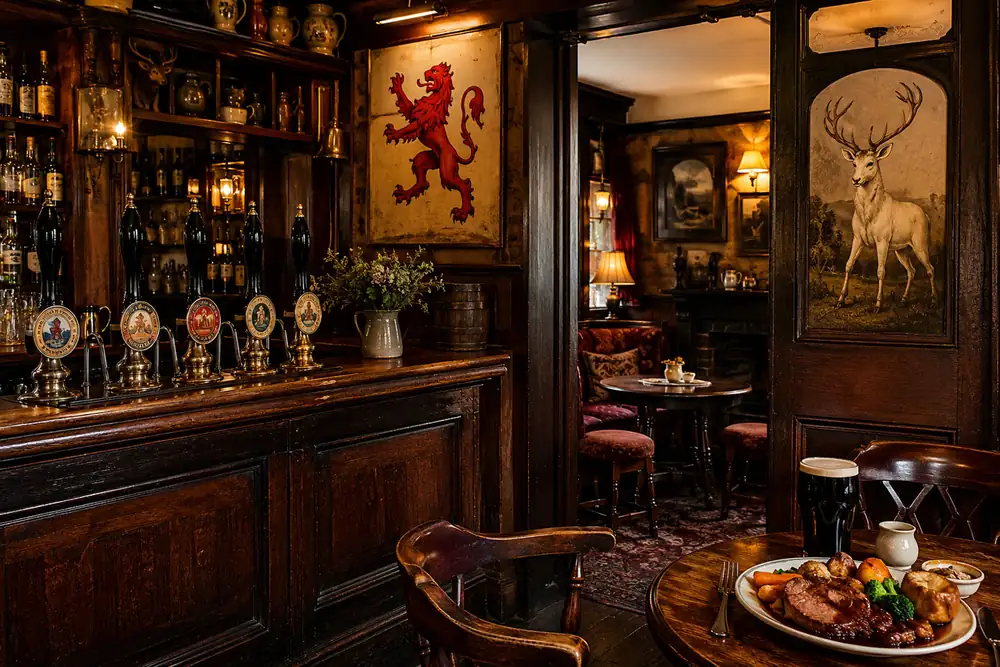
For those arriving in the UK, a pub might seem like a bar with a strong traditional identity: a wooden bar, warm lighting, draft beers, and cozy tables. The very term "public house," however, refers to a place open to the community, where people can drink, eat, and meet.
For centuries, pubs have been a constant feature of daily life in neighborhoods and small towns. Their charm stems from the overlapping of different eras: a medieval sign, a Victorian bar, a still-functioning handpump, and a contemporary menu can all coexist in the same space.
Why are so many pubs called “Arms”?
Among the most common names are The King's Arms, The Queen's Arms, The Coachmakers Arms, The Mason's Arms, and many other variations. The word "Arms" does not refer to arms, but to heraldic arms, that is, the coat of arms associated with a family, a sovereign, a corporation, or a trade.
Many inns adopted the coat of arms of the landowner, the local patron, or the ruling house of the area. In other cases, the name recalled a guild or professional category: hence insignia like Carpenters Arms, Bricklayers Arms, or Blacksmiths Arms. The connection did not always imply direct ownership of the establishment, but conveyed belonging, protection, loyalty, or a relationship with the local community.
Even when the original reference was lost, the formula remained deeply tied to the British imagination.
Figurative signs were a practical tool
Crowns, lions, swans, deer, horses, ships, and mythological creatures weren't just decorations. In an era when a significant portion of the population couldn't read, a picture allowed them to instantly recognize an inn.
The sign had to be visible and easily memorable. Saying "See you at the Red Lion" was easier than relying on an address, especially before modern building numbering. Symbols could evoke monarchy, nobility, professions, or local legends.
The White Hart, for example, takes its name from the white stag used as King Richard II's personal emblem. The Red Lion, however, can have different origins depending on the region, as the red lion appears in numerous noble and royal coats of arms. It is precisely this layering that makes pub signs a sort of visual archive of British history.
Among the most recognizable elements of a traditional pub are the long levers mounted on the bar. These are handpumps, manual pumps used primarily to serve cask ales, often also referred to as real ales.
Unlike many keg beers that are pushed to the tap via external gas, cask ale continues to mature in the vessel from which it will be served. It contains live yeast and develops its own natural carbonation in the cask. The handpump allows the publican to mechanically draw the beer from the cellar to the bar.
In the glass, a well-preserved real ale has delicate carbonation, a smooth texture, and a cool, not icy, temperature. It shouldn't be flat or lukewarm: the balance depends on proper cask and system management.
A seemingly simple system
Serving a good cask ale requires experience. After arriving at the pub, the keg must be allowed to settle, prepared, aerated, and checked before serving. The publican must evaluate the clarity, flavor profile, temperature, and condition of the beer.
Once service begins, the consumption window is shorter than that of many keg beers. Rotation must therefore be consistent with the venue's actual demand. Keeping too many cask ales at once may seem like a sign of a rich offering, but it becomes counterproductive when volumes don't allow them to be served in optimal conditions.
For a manager, cask ale requires at least four attentions:
- keep the cellar at the correct temperature;
- respect the settling and conditioning times;
- clean the tap lines regularly;
- choose a number of references adequate for the rotation.
This is also why the quality of the pint is often considered a measure of the pub's reliability. A flashy handpump isn't enough: what counts is the work done behind the bar and in the cellar.
British Sundays have their own ritual dish: the Sunday roast. Its composition varies according to region, season, and family habits, but the classic structure includes roast meat, potatoes, vegetables, gravy, and, very often, Yorkshire pudding.
Its origins can be traced back to the tradition of a hearty meal eaten after Sunday church services. For a long time, roast dinners were primarily associated with home and family. Pubs later transformed it into one of the most important weekly services, so much so that in the most popular establishments, booking for Sunday lunch is almost essential.
The Sunday roast perfectly fulfills the social function of the public house: bringing together families, friends, and different generations at the same table. It retains a domestic character even when served away from home.
There's no single, definitive version. The most common meats are beef, chicken, pork, and lamb; the vegetables, sauces, and accompaniments also vary. Yorkshire pudding, despite its name being misleading to Italian readers, isn't a dessert: it's a savory, baked, batter-based dish traditionally paired with roast beef and gravy.
In recent years, many pubs have expanded their offerings to include vegetarian roasts, vegan options, and influences from other cuisines. The ritual remains recognizable, but continues to evolve along with British society.
A snug is a small room or compartment separated from the main bar, enclosed by walls, doors, ornate glass or wood paneling. The term evokes a cozy, sheltered, and comfortable environment. In historic pubs, it may be a tiny space, with just a few seats and direct or side access to the bar.
To understand its function, it's important to remember that pubs of the past were often divided into multiple spaces. Public bars, saloons, smoke rooms, tap rooms, and private bars could accommodate different patrons, with varying levels of comfort, prices, and social norms. Today's open-plan space was anything but predictable.
The snug offered privacy to those who didn't want to expose themselves to the eyes of the main bar. In some pubs, it became a "ladies' snug," intended for women at a time when the public bar was perceived as a predominantly male space. Elsewhere, it was used by professionals, small groups, or customers who preferred to drink and converse in peace.
These spaces also reveal the social divisions of the past. Privacy could be a privilege, but it sometimes stemmed from customs that kept some people marginalized from the public life of the place. Today, a snug bears witness to how relationships between classes, genders, and social spaces have changed.
Why many snugs have disappeared
Throughout the twentieth century, many pubs eliminated walls and partitions to create larger rooms, increase seating capacity, and streamline service. Transformations in consumption patterns, new regulations, and a more open concept of conviviality made rigid separation of spaces less necessary.
The surviving snugs are therefore particularly valuable. In some establishments, they are still used as small lounges; in others, they are booked by groups or preserved as part of the historic furnishings. Panels, bells for table service, frosted glass, and fixed seating allow us to read the pub's original layout almost as if it were a social plan of the building.
Entering a snug means understanding that a public house's identity isn't built solely on beer. The layout of the rooms, the distance from the bar, and the visibility of patrons also reveal who might frequent the place and how.
Handpump, cask ale, heraldic emblems, Sunday roasts, and small, secluded rooms demonstrate how closely tied the British pub is to its history. None of these elements has remained completely unchanged: service techniques have been updated, menus have become more inclusive, and spaces have lost many of their old distinctions.
Continuity lies in the ability to remain recognizable while the people who frequent it change. A pub can be an everyday place, a destination for beer, and a testament to an architectural and social heritage.
For this reason, when traveling in the UK, it's worth looking beyond the contents of the glass. The name above the door, the design on the sign, the lever on the bar, or a small hidden room can tell more than meets the eye. The pint remains important, of course, but the true character of the pub comes from the stories that continue to live on around it.