When cocoa understood ham
Some experiences begin in the mouth and end in a place much harder to explain.
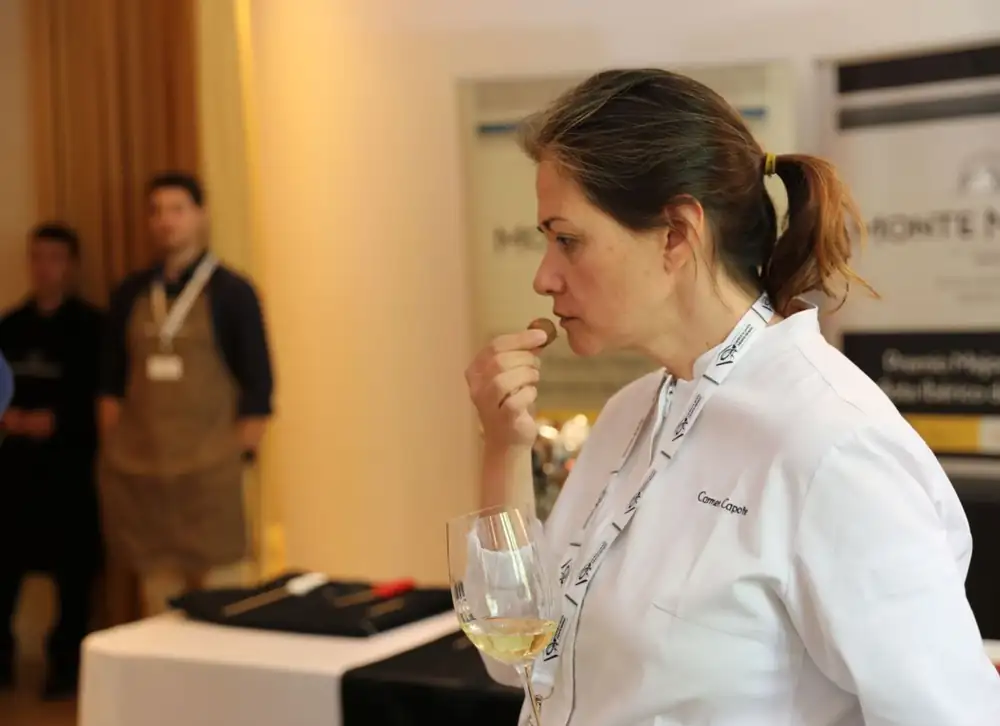
That's exactly what happened at the latest edition of 'Unexpected Pairing,' the sensory laboratory with which Monte Nevado has been questioning the limits of cured ham for years. This time, the historic Segovian company decided to look towards a seemingly unrelated territory: cocoa. And they did so in collaboration with Carmen Capote, founder of 24 Onzas, and recently awarded Best Pastry Chef by ACYRE Madrid.
The scene had something of an initiation rite about it: long-cured hams, delicate-looking chocolates, precisely poured glasses, and a shared feeling that this could turn out very well, or become a hopeless experiment. The first bite was enough to understand that Capote hadn't come to provoke for the sake of provocation. He had come to demonstrate that ham can inhabit entirely new territories.
The star of the day was her. Not only because of her impressive resume—the French Presidential Pastry Brigade, L'Atelier de Joël Robuchon in Paris, and Le Cordon Bleu—but above all because of her talent for interpreting a product and translating it into another language. “Chocolate isn't here to sweeten the ham, but to reveal nuances that normally go unnoticed,” Capote explained. “The interesting thing was understanding what type of fat each ham had and which cocoa could amplify it without masking it,” she added. Capote understands chocolate as a fatty, aromatic, and structural material, capable of interacting with the ham through texture, persistence, bitterness, or even mouthfeel. While others might seek the easy impact of an unlikely combination, she discovers hidden affinities.
Original bites that open up a new territory
The first pairing, featuring Jamón Serrano 24, was the most accessible and revealing. The Serrano ham, with its notes of cereal, cellar, and nuts, peeked out crisply within an almond praline, accompanying a whisky and fig truffle. The ham's fat melted with the cocoa butter, amplifying the nutty notes; the whisky warmed the whole, and the fig brought the salinity back to the forefront. The entire experience was finished off with the acidity of a Monopole Clásico 2021.
If Serrano ham spoke of balance, Mangalica ham spoke of voluptuousness. Monte Nevado has been working for years with this revived Hungarian breed, renowned for its fat with an extremely low melting point and a buttery texture. Capote presented it in a macadamia praline alongside a sake and peach truffle. The nut prolonged the meat's unctuousness, the sake acted as a catalyst for the umami, and the peach added an unexpected freshness. The Chocolate Block 2023 provided structure to the whole.
The third course raised the intensity. The 100% Ibérico Bellota ham, recognized as the best by the prestigious Spanish Food Awards, appeared in all its complexity, with its herbal notes and ferruginous nuances. Alongside it, Capote constructed a precise architecture within a pistachio praline, next to a chamomile toffee truffle. Here, cocoa played a decisive role, as its bitterness triggered the latent sweetness of the Ibérico, the chamomile prolonged the umami, and the pistachio provided a perfect bridge to its nutty notes. The Marguet Shaman Rosé Grand Cru Champagne enhanced the whole.
The most fascinating moment came at the end, when the intermediaries disappeared and the ham was directly integrated into the cocoa coatings. Hand-sliced Serrano 24 melted into a 75% Piura white; Mangalica found depth in an 85% African Grand Cru; and Ibérico measured itself against the almost savage power of a 95% Chuncho from Cusco. It was an exercise in extreme precision. The percentages, origins, and textures of the cocoa changed, but so did the way the ham expressed itself. The chocolate ceased to be an accompaniment and became an aromatic amplifier.
Snowy Mountain and the obsession with investigating
What's admirable about Monte Nevado is that, with over 125 years of history, it remains committed to research. To that end, it created the Jamón Campus, a unique training and research center in Spain, complete with a sensory laboratory, natural cellar, cutting room, and spaces dedicated to studying ham as a living gastronomic object. The brand, founded in 1898 in Carbonero el Mayor, has built a reputation thanks to the quality of its Serrano, Iberian, and Mangalica hams, but it doesn't seem content to rest on its laurels. It wants to break new ground.
And on this occasion, she did so alongside an exceptional creator. Because if anything was clear during the tasting, it's that Carmen Capote doesn't just master chocolate; she knows how to listen to what a ham needs, what its fat conceals, or what happens when a bitterness comes into contact with a specific salinity. Hers wasn't simply an exercise in pastry applied to ham. It was a demonstration that there are still uncharted territories in Spanish gastronomy.