
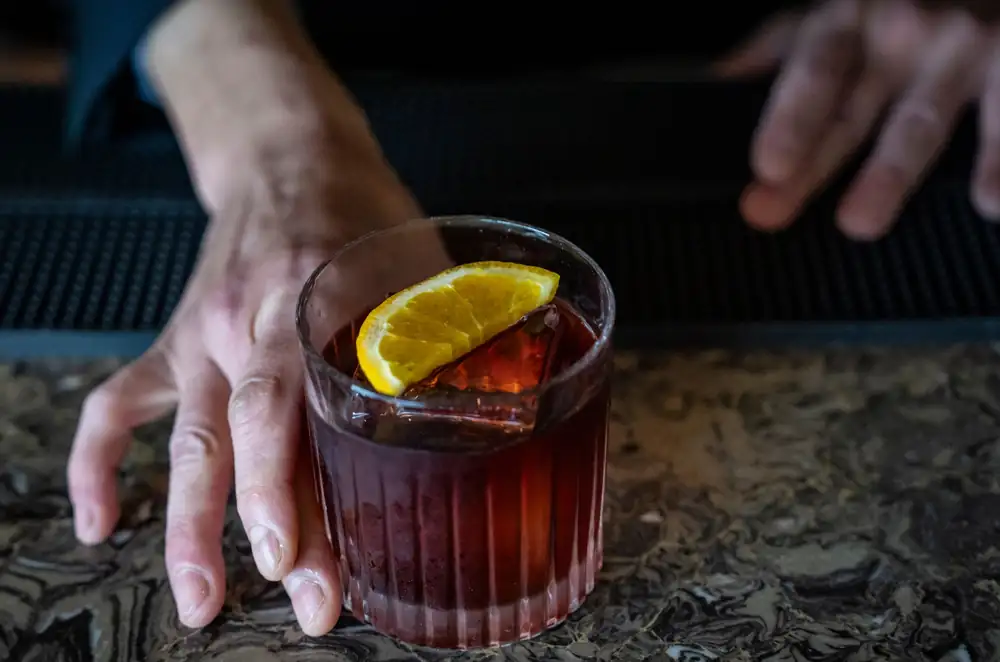
Why equal parts cocktails are so hard to achieve
Equal parts cocktails, like the Negroni, are rare, but when they work, their balance is remarkable.
Anyone who's made a cocktail knows the basic proportions. The golden ratio for a Margarita is two parts liquor, one part sweet, and one part sour. Classic long drinks, like the Moscow Mule, use about two parts liquor to five parts mixer. Others, like the Corpse Reviver No. 2 or the Blood & Sand, are made with exactly equal parts.
A cocktail with equal parts ingredients has something special about it. Bartender Erik Lorincz, co-owner of Kwãnt Mayfair in London, says: “It’s about discovering how complementary ingredients harmonize perfectly.” Lorincz recalls his first experience with the Negroni: “When I first read about the Negroni, I didn’t want to try it; it just seemed like it contained a lot of alcohol. But when I tasted it, I discovered something more: the balance between the sweet vermouth, the bittersweet Campari, and the gin.”
Carina Soto, director of the Equal Parts bar in Hackney, London, argues that the appeal of these cocktails lies not only in the harmony of the ingredients, but also in the fact that no single ingredient dominates. This is unusual, because we tend to talk about cocktails "based on" a particular type of alcohol. "It's about the different layers of flavor. It's not about a specific ingredient or profile, but about the result of all those layers."
Marc Sarton du Jonchay, co-founder of Circle13, another Hackney bar, has a more practical view of their popularity: “People remember cocktails they can’t mess up. Equal parts cocktails are the perfect basis for that, as you only have to remember the ingredients. You don’t even need a jigger, just a utensil to measure the equal parts.”
The base of each cocktail is the same in equal parts, but the variations are endless. The Paper Plane contains bourbon, Aperol, Amaro Nonino Quintessentia, and lemon; the Last Word, gin, green Chartreuse, maraschino liqueur, and lime. Soto points out that, in addition to the balance between sweet, bitter, and dry elements, the total alcohol content is crucial: "The Negroni usually has between 21% and 25% alcohol, depending on the ingredients chosen to prepare it," he explains.
Lorincz agrees that the total alcohol content should be considered, but emphasizes the importance of specific flavors, which can lead to unexpectedly delicious combinations. He recalls a test at the Savoy: “When I was at the Savoy, I made a cocktail with equal parts mezcal and cognac. Both had a high alcohol content, but very different flavor profiles, and the truth is that the smokiness and the peaty notes complemented each other,” he says. Lorincz also believes that equal-part cocktails tend to be the most successful among dark spirits, while Sarton du Jonchay thinks that acidic cocktails work best because their acidic component counteracts the high alcohol content.
Creating a new masterpiece with equal parts is no easy feat, and even bartenders with years of experience never stop striving for that perfection. Soto advises starting with existing recipes and identifying what you like about them: "Experiment little by little, replacing one or two ingredients." He recommends using no more than four individual elements and taking into account the effect of ice dilution. Sarton du Jonchay suggests thinking in terms of blocks: "It's about finding the balance between the blocks: acidity, sweetener, and alcohol."
Cocktail definitions vary. Sarton du Jonchay points out that, technically, the Negroni belongs to the Martini family, a cocktail that balances aromatized wine and liqueur, and that within that family, there are no strict rules about proportions. Many bars modify their house Negroni, reducing the Campari or increasing the vermouth, in a heated debate about whether the original is balanced. Classic cocktails with equal parts may be iconic, but that doesn't make them immutable.