Pulejo in Rome: Three Must-Try Dishes from Davide Puleio's Evocative Cuisine
Pulejo in Rome. In the heart of Prati, a Roman neighborhood experiencing a veritable gastronomic boom in recent years, Pulejo, a gourmet restaurant run by owner and chef Davide Puleio, opened a few months ago.
Pulejo in Rome. In the heart of Prati, a Roman neighborhood experiencing a veritable gastronomic boom in recent years, Pulejo, a gourmet restaurant run by owner and chef Davide Puleio, opened a few months ago. This young establishment, where the dining room and kitchen work in synergy, makes guests feel at home and pampers them without mannerisms, but with authenticity and quality.
Chef Puleio (who was also sous chef to Luciano Monosilio at Pipero) is young but has a wealth of high-profile experience under his belt. He began his career in Rome at Convivio Troiani, then honed his skills behind the stove at some of the most renowned restaurants in Italy and Europe: Noma in Copenhagen, Agnar Sverrisson in London, Trussardi and L'Alchimia in Milan. But as they say, some loves never end; they travel endlessly and then return. So Davide Puleio returned to the capital and, "with healthy recklessness," launched his personal project: Pulejo.
The intimate restaurant, seating about 25, fully reflects the chef's vision of hospitality, which aims to rejuvenate the concept of fine dining with a friendly atmosphere and intelligible cuisine. "Great cuisine doesn't need to be forced; it can be elegant with simple, intuitive dishes that hark back to tradition." This leitmotif applies not only to the kitchen but also to the dining room, where Simone Cavaterra and Mattia Zazzaro "have an empathetic and present approach that should never be lost, even in Michelin-starred restaurants." For Puleio, the human side of dining is an "added value to the restaurant; the customer notices it." Simone and Mattia are skilled not only with their customers but also with their cellar, for which "they have created an intelligent, growing menu, with many local, niche labels, and several natural and biodynamic wines."
Chef Puleio works with top-quality ingredients in a simple and understandable way. "My cuisine is one of memories, as in the case of the bonito (only on the menu for a few more days, ed.), where kefir is made with fig leaves. I grew up in the countryside, and the scent of fig leaves takes me back to my childhood, to those flavors." The inspiration for his approach to cooking and catering came from his grandfather, "who owned several restaurants in Rome," and who passed on his love not only for cooking but also for flavors that always evoke something in the mind: "the future is an evocative cuisine."
Here are three dishes to try from Pulejo.
Risotto Mi-Ro (25 euros)
Mi-Ro is like the train that goes from Rome to Milan, because "speaking of evocative cuisine, this is a dish that speaks of my culinary journey between Rome and Milan." A traditional Milanese saffron risotto, which combines ingredients that speak of Rome and Roman tradition, such as cocoa and oxtail stew. To Milan, "I brought my exuberance, typical of the Romans," and to Rome, "I pay homage to Milan and the work done there with its classic risotto," which, however, is combined with a touch of Roman flavor.
Pepper like beef (18 euros)
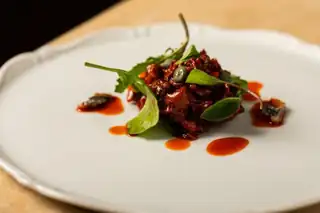
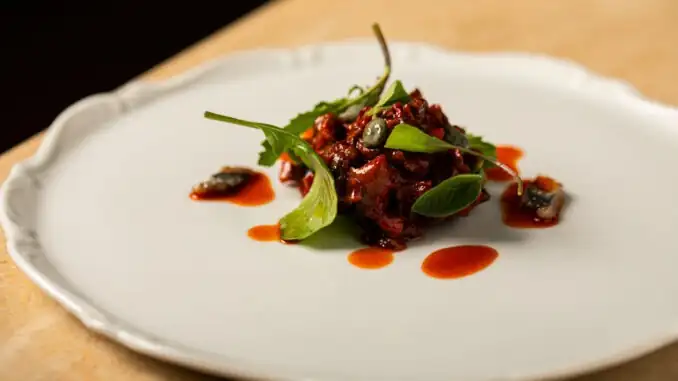
A vegetable dish that's a statement of intent, recreating the flavor of meat using an unexpected ingredient. "For me, it's a dish that defines my identity; I play on the fact that it's truly similar to a tartare." A dish that was born by chance, like all great recipes. "It dates back to the time of Pipero. I noticed that when the pepper was left there, oxidizing, it took on the appearance of meat, and I wanted to study it further, to get as close to that consistency as possible." The pepper is then treated like an animal product, adding Parmesan, capers, anchovies, and oregano. It evokes the feeling of savoring a real tartare; "if I don't tell you it's a pepper, you'd almost forget it."
Guinea fowl according to Marcus Gavius Apicius (27 euros)
This is a dish that pays homage to Rome and its history. "I've adapted the original recipe from ancient Rome by Marcus Gavius Apicius, who was one of the first to codify some recipes of the era." A sumptuous dish with ancient roots that Puleius hasn't completely altered, "especially in the sauce, which I've given a contemporary structure using some more modern techniques, but without changing it, keeping the flavors intact with apple cider vinegar and cardamom." A recipe that speaks to the ancient glories of the Roman Empire "and truly takes you by the hand to the markets of antiquity, among the flavors and aromas of forgotten and pervasive spices." It is served with fresh grapes and a small vine leaf roll containing "guinea fowl legs seasoned with lard, rosemary, garlic, and pepper, and then grilled."
Pulejo. Via dei Gracchi 31-33, Rome. Tel. 06 85956532. Website. Facebook. Instagram.