Alvia: un vino en el Camino
Al salir de Ventosa y continuar por el Camino de Santiago, el peregrino se topa a su izquierda con un edificio flanqueado por dos robustos y antiguos olivos. Se trata de la bodega Alvia.
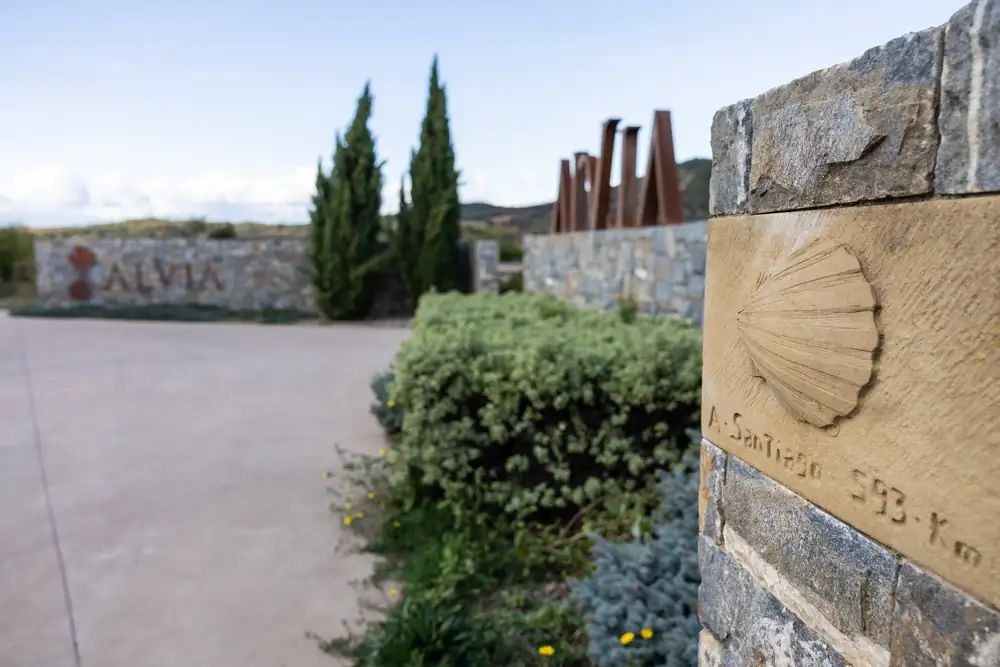
As the pilgrim leaves Ventosa and continues along the Camino de Santiago, they come across a building on their left flanked by two robust, ancient olive trees. This is the Alvia winery. At the entrance, a small scallop shell carved into the wall reminds them that only 593 kilometers remain to the tomb of the Holy Apostle.
To the right, in a well-tended garden, the pilgrim can observe a plot of each of the varieties commonly grown in Rioja. Each one displays the unique characteristics of its leaves and the distinctiveness of its grape clusters.
Upon entering, one discovers a charming, small, but well-maintained winery, where Alfredo Bernáldez, in 2003, realized his dream of crafting his own single-varietal wines from the different grapes of Rioja. "At the time, I was one of the first to produce a 100% Garnacha wine… now there are many wineries that do it," acknowledges this winemaker, passionate about his work.
In 2014, he restructured the winery to integrate it into the Camino de Santiago and capitalize on the flow of pilgrims; the vine and scallop shell logo that identifies the winery is a clear statement of intent. One of his most successful initiatives is aimed at these pilgrims. He sells them a wineskin, which he fills with his aged wine. It's a unique souvenir that accompanies the pilgrims to Compostela and then travels back home like a treasure.
Bodegas Alvia is a small winery that produces great wines, most of which are exported to the United States, Central America, and some European countries. Ninety percent of their wines are destined for export.
Mileto (white and young red, crianza, reserva, and gran reserva) is the winery's mid-range line, while Livius is its premium line, highly valued in fine dining. Many Michelin-starred restaurants feature these wines on their wine lists.
One of the distinguishing features of Bodegas Alvia's premium wines is their extended bottle aging. The Garnacha wines are aged for up to 11 years, and thanks to this approach, Alvia also produces white and rosé reserve wines.
Alvia's production is small, around 150,000 bottles a year. It comes from old vines located in the Huércanos and Cárdenas area. "They are old vines, with a very low yield. They are harvested by hand, and the grapes are collected in 18-kilo boxes. We don't have a hopper; they go directly to the sorting table," Bernáldez explains.
Often, those old vines (almost always centuries old) that produce the highest quality wines in the winery barely yield enough to fill more than 4,000 or 5,000 bottles.
Among this high-end range, the winery's 'jewel' stands out. Anthos (meaning 'flower' in Greek), made with Tempranillo and Graciano grapes, spends 26 months in oak barrels, but then rests in the bottle for 12 to 13 years. The 2006 Gran Reserva is now available.
Visitors have the opportunity to discover all the wines offered by the winery in a shop that opens onto the Camino de Santiago through a huge glass window. If they wish, they can follow the grape's journey step by step during their visits. The stainless steel tanks, the welcoming barrel room, and the cellar where the bottles rest are all part of a process that, in Alvia's case, often culminates on the tables of top restaurants around the world. "We can't compete with the big brands, and it's hard to get there, but when people try our wines, they appreciate them and they end up on the wine lists," says Alfredo Bernáldez proudly.
Experiences
The winery offers several experiences to visitors, from the most basic which includes a guided tour and a tasting of three wines (must for the children) with an appetizer of local sausages to the possibility of participating in an Escape Room game in which the team (between 8 and 25 members) will have to open four barrels of wine that hide the information necessary to stop the countdown before it ends.