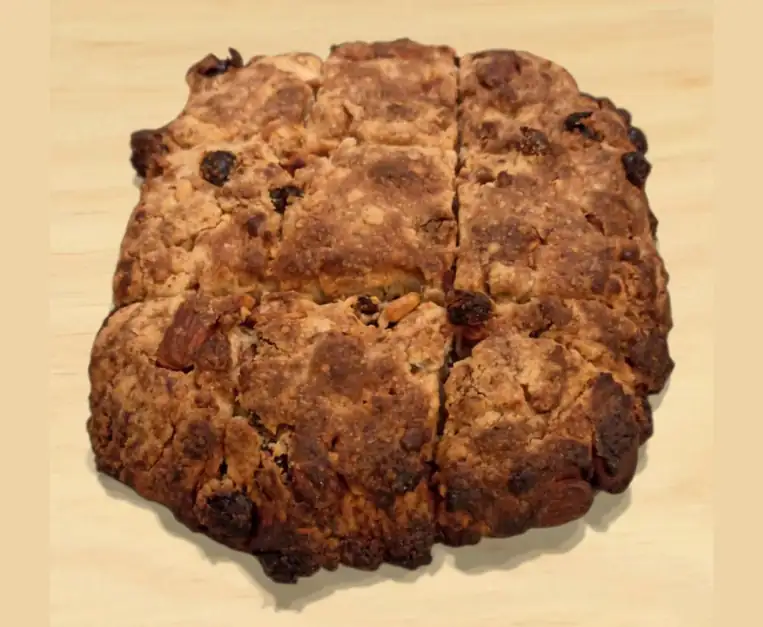
Beridde's sweet pizza, the Roman dessert that tells a five-hundred-year-old story
Beridde's sweet pizza, also known as Jewish pizza, is a traditional Roman-Jewish dessert, typical of the Jewish community in Rome and specifically linked to the celebration of the ritual circumcision of newborn boys, the Brit Milah.
It belongs to the category of dry baked sweets with a soft interior, characterized by a compact structure and a dual consistency: a crunchy surface and a moist interior. It is not a breakfast or dessert in the modern sense, but a ceremonial product, designed to be distributed and consumed in a ritual context.
The meaning of the name
The term "pizza" should be understood in its medieval sense, as a flatbread or oven-baked dough, and not in its contemporary sense. In medieval Latin, the term piza generically referred to flattened dishes, both sweet and savory, and is attested as early as the 10th century in documents from southern Italy.
The word "Beridde" derives from the Judeo-Roman form of Brit Milah, which in Hebrew literally means "covenant of cutting" and refers to the ritual of circumcision. The name of the dessert is therefore directly linked to the social and religious function of its preparation: it is not a symbolic name, but a descriptive one. It is traditionally prepared for this holiday and distributed to guests in a bag called a kavodde, a Hebrew term meaning "honor." The act of distribution represents the family's thanksgiving and sharing the joy of the child's entry into the community.
This ritual element also explains why Beridde pizza has remained highly localized. Unlike other Jewish pastries like challah, babka, or sufganiot, it has never truly spread internationally and is almost exclusive to the Roman Jewish community.
The history of Beridde's sweet pizza
The precise origins of Beridde pizza are not documented, but most scholars place its birth between the late 15th and early 16th centuries, following the arrival in Rome of Jewish communities expelled from Spain in 1492 and Sicily in 1493. Both territories were strongly influenced by Arab gastronomic culture, characterized by the systematic use of dried fruit, raisins, honey, sugar, and candied fruit.
The composition of Beridde's pizza clearly reflects this Mediterranean and Middle Eastern origin. Almonds, pine nuts, raisins, and candied citrus fruits are typical ingredients of Sephardic pastry and Islamic confectionery traditions. In Rome, these elements were integrated with local products like olive oil and white wine, giving rise to a distinct and timeless recipe.
What does Jewish pizza taste like?
Technically speaking, Beridde pizza is a low-hydration dessert, free of leavening agents. The absence of eggs and butter makes it more similar to a sweet bread dough than a cake. Olive oil plays the main role in providing lipids, while wine contributes to both the aroma and structure of the dough.
Baking is the key to this recipe. The oven must be very hot, generally over 200 degrees Celsius, and the baking time relatively short. The goal is not to completely dry the product, but to create a crispy surface while keeping the inside soft. Overbaking produces a dry and tough cake; underbaking compromises the structural integrity.
The flavor of Beridde's pizza is sweet but not cloying. The presence of dried fruit, oil, and a light saltiness creates a complex aromatic profile, with a slightly savory finish that balances the sweetness of the candied fruit and raisins.