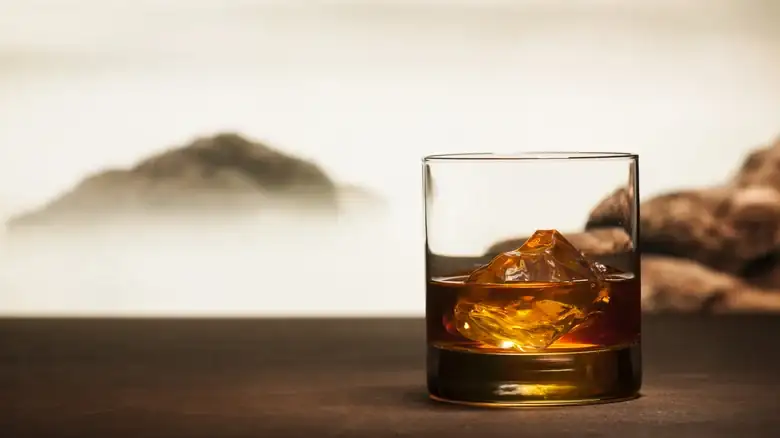
Japan's Umami-Packed Spirit Is No Longer A 'Forgotten' Whiskey
Japan offers an incredible array of unique alcohol styles. There's rice- and barley-distilled shochu, plum-based umeshu, and rice-brewed sake — the production of which received recognition by UNESCO. Yet especially abroad, one of the most rapidly emerging styles is Japanese whisky.
Called koji whisky, this enthralling spirit intersects several of the nation's distinct alcohols. The booze starts in the same production manner as shochu: Polished rice or barley is fermented with koji — a type of mold also used to make sake, soy sauce, and miso — and then distilled. The liquor then goes through a cask-aging step, rounding out its flavor and lending the caramel color distinct to whisky.
However, under the new regulation, the spirit faces an uncertain stance in Japan. Shochu must be sold in a colorless, more purified form while koji-based whisky is explicitly banned from being called "Japanese whisky." On the other hand, American regulation upholds this richly flavored spirit as whisky. As a result, distributors are increasingly pouring this unique style into the glasses of American drinkers, showcasing a delicious spirit.
What does koji whisky taste like?
Koji whisky's distinct production translates to a delicious palate. The mold kickstarts rice fermentation in a manner akin to what malting does for other grains. However, koji functions faster and with its own characteristic undertones. Most notably, it produces umami; after all, koji also creates savory flavors when soy beans ferment into soy sauce. Although in the case of whisky, this complex taste is usually matched with a delicate and pleasant mouthfeel. Furthermore, such umami flavor is often accompanied by a balanced sweetness, and likely a funk akin to naturally-fermented spirits such as rhum agricole and mezcal. All the while, the spirit still manages to showcase a delicious barrel character, even letting creative wood-aging shine. It all adds up to a distinct — and captivating — flavor that appeals to spirit fans.
While the style is emerging in the United States, it's been crafted for decades in Japan. Its niche nature is typically confined to small-scale distillers, often in the countryside. So, while such a liquor style isn't as easily found as Costco's fan-favorite Japanese whisky, it's nevertheless worth the effort to sample.