
History and ritual of vermouth hour in Spain and Argentina
Vermouth time is much more than a drink: it is a time of day and a social ritual deeply rooted in Spain and Argentina.
Vermouth originated in 18th-century Turin, Italy. Its name comes from the German word Wermut, meaning wormwood, the herb that gives it its characteristic flavor and which was used for centuries as a digestive remedy. Early vermouths were concoctions that herbalists macerated in white wine; over time, sugar and spices transformed it into a pleasurable drink.
By the end of the 19th century, it was already common in the cafes of Turin, Marseille, and Barcelona. In Argentina, it arrived with Italian immigrants and quickly became part of Buenos Aires' aperitivo culture.
Today, two styles are most commonly consumed. Red vermouth is more aromatic, with notes of caramel, vanilla, clove, and cinnamon, and is the classic choice for serving with ice and soda water. White vermouth is light, citrusy, and floral, and has gained popularity among bartenders, who use it in cocktails. Rosé and dry vermouths also exist, the latter being almost exclusively used in cocktails.
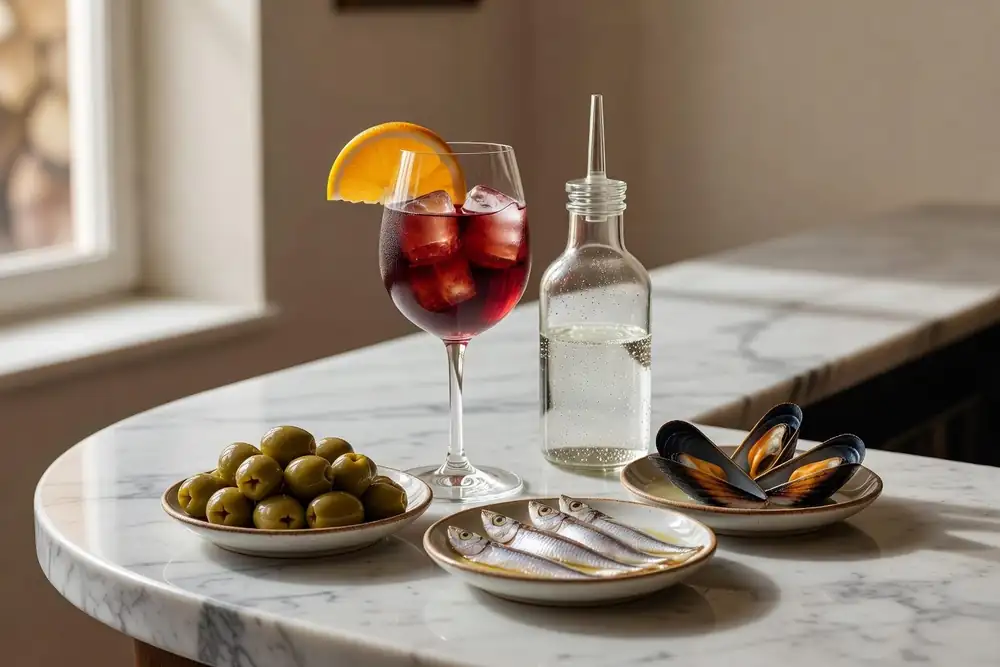
In Barcelona, ordering "un vermut" usually means a balloon glass or a lowball glass with three large ice cubes, an orange slice, and an olive. It's often accompanied by olives, marinated anchovies, pickled mussels, and sometimes potato chips or fuet sausage, with Sunday midday being the most sacred time to enjoy it. In Madrid, red vermouth is the predominant choice, served in a tall glass with plenty of ice, and canned seafood like cockles, razor clams, and sardines are staples on the tables of neighborhoods like La Latina, Malasaña, and Chamberí. In Buenos Aires, the red variety, sweeter than the Spanish vermouth, is served in a wine glass with ice and an orange slice, and the ritual includes olives, cheese, and salami.
The complete ritual calls for a chilled glass, plenty of ice, vermouth filled to within a finger's width of the rim, and a strong splash of soda water to create a frothy head. To prepare it at home, choose a red vermouth with an alcohol content between 14% and 18%, pour it into a wide glass, and sip it slowly, at a temperature of between 4 and 6°C before adding the ice.
Artisanal vermouth has gained popularity in recent years, with small brands in Catalonia, Madrid, Galicia, and Mendoza using local wines, native botanicals, and less sugar. A typical serving in bars is around 70 to 90 ml, and with ice and sparkling water, the final drink reaches 180 to 200 ml. In Spain and Argentina, "martini" usually refers to the Martini & Rossi brand, distinct from the Martini cocktail, which mixes gin and dry vermouth.